Leasing vs. Buying Solar Panels in Bee Cave, TX: Which Is Right for You?
If you own a home in Bee Cave and you are ready to go solar, you have two paths: lease the system from a company that owns it, or buy it outright with cash or a solar loan. What is the difference between leasing and buying solar panels in Bee Cave TX? The short answer is ownership and who keeps the value. Buying wins if you plan to stay in the house and want the lowest lifetime cost. Leasing wins if you have no upfront cash, cannot use tax credits, and want someone else to own the maintenance risk. Bee Cave sits in Pedernales Electric Co-op territory for most addresses, and PEC's export credit terms shape the math either way.
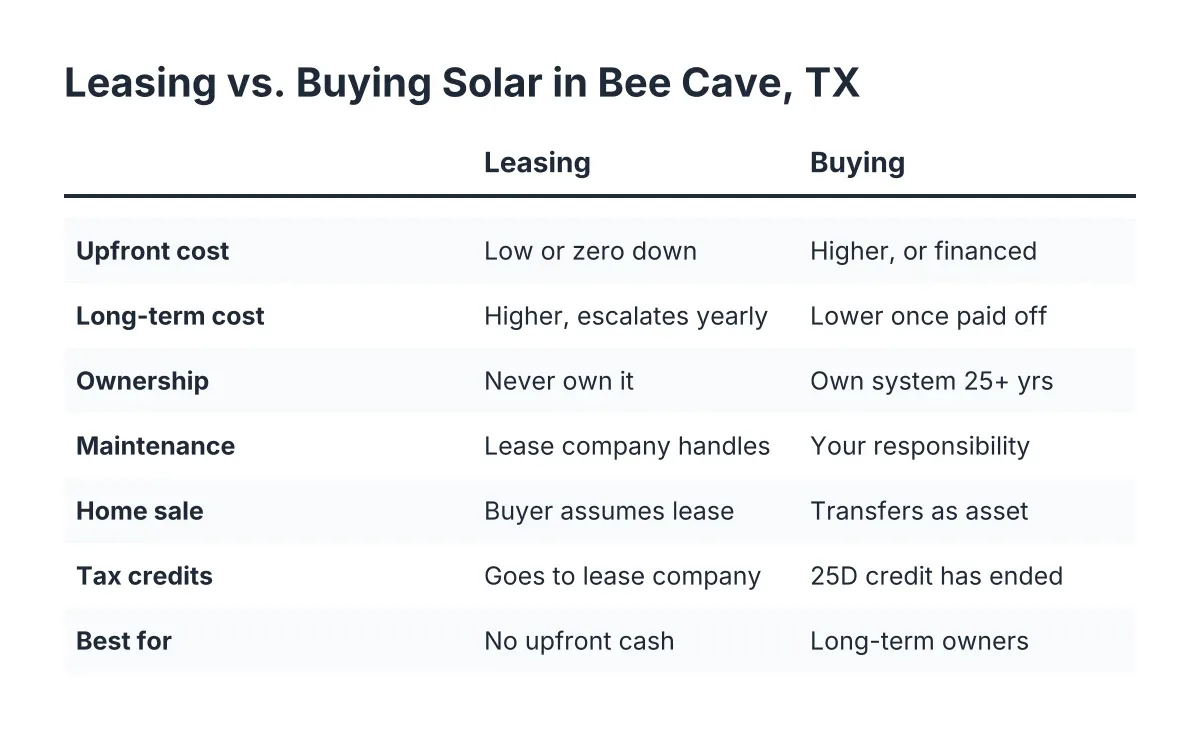
| Criterion | Leasing | Buying Solar Panels in Bee Cave, TX |
|---|---|---|
| Upfront cost | Low or zero down | Higher upfront, or financed with a solar loan |
| Long-term cost | Higher over the contract term; payments often escalate yearly | Lower lifetime cost once the system is paid off |
| Lifespan and ownership | You never own it; the lease company does | You own a system that typically produces for 25 years or more |
| Maintenance | Lease company handles repairs and monitoring | Your responsibility, usually covered by manufacturer warranties |
| Home sale | Buyer must assume the lease or you buy it out | System transfers with the house as an asset |
| Tax credits | Lease credit (48E) goes to the lease company, not you | Purchase credit (25D) has ended; check current incentives before you sign |
| Best for | No upfront cash, low tax liability, short planning horizon | Long-term owners who want maximum savings and control |
Leasing: Strengths and Trade-offs
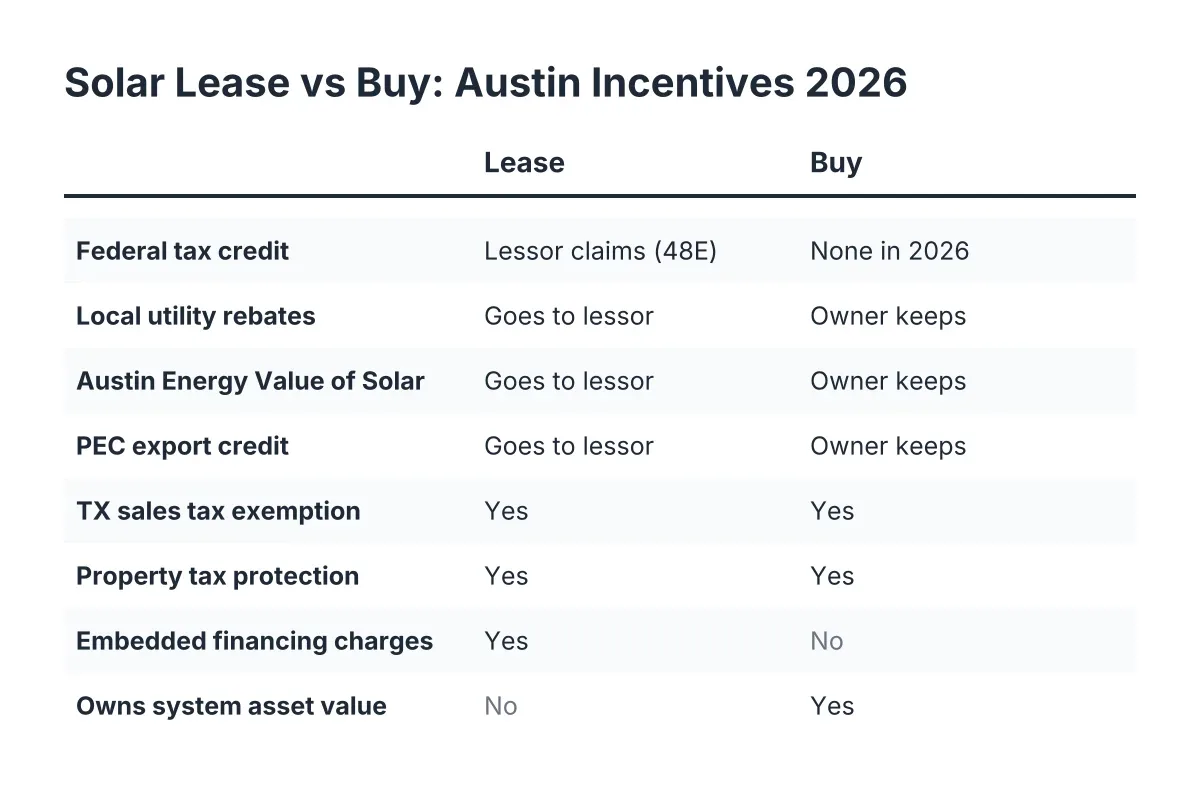
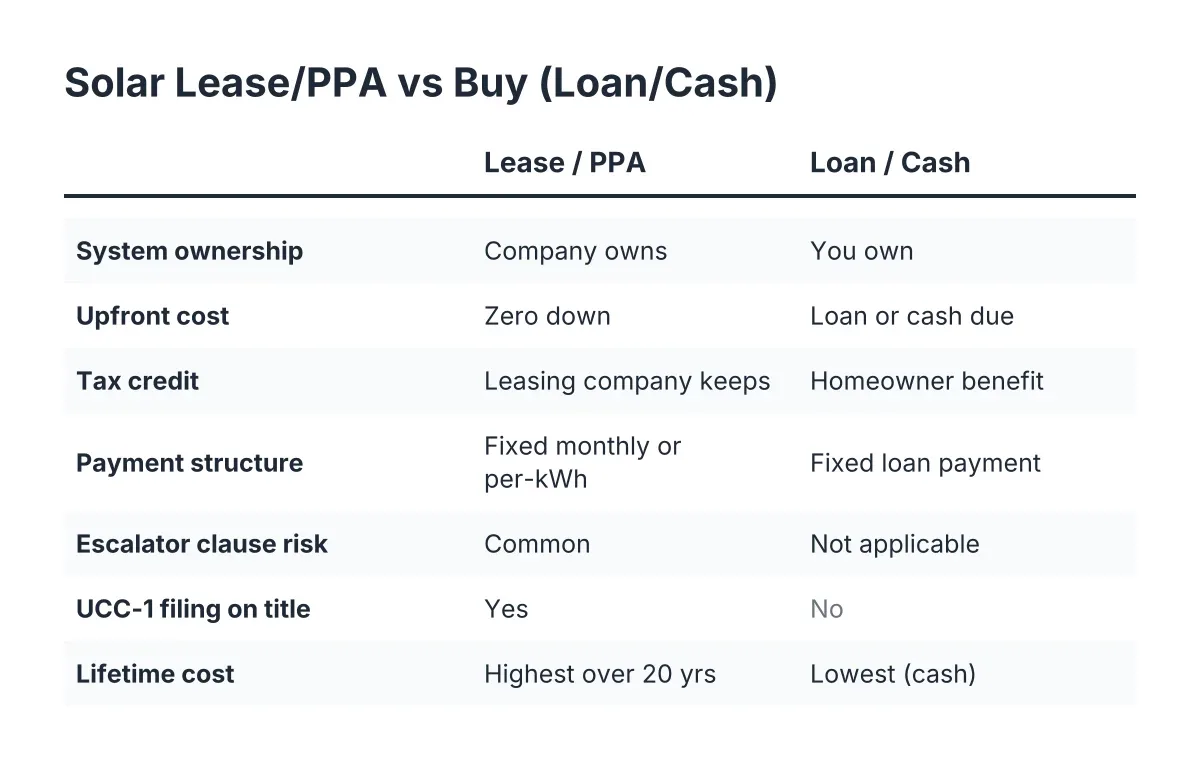
A solar lease means a company installs panels on your roof, keeps ownership, and charges you a fixed monthly payment for 20 to 25 years. You use the power the panels make. The lease company keeps the tax benefits, including the lease credit under the surviving 48E path, which is now the main way federal money flows into residential solar after the purchase credit ended.
Where leasing shines: you pay nothing or close to nothing upfront, and the lease company handles monitoring, repairs, and inverter replacements for the life of the contract. If your federal tax bill is small, say you are retired on fixed income, a lease lets someone who can use the lease credit pass part of that value to you through a lower payment. Whether they actually pass enough of it along is the question. I have read a lot of these contracts, and the answer varies by company and by salesperson.
Where leasing disappoints: most leases include an annual payment escalator, and even a small one compounds for two decades. In PEC territory, where the export credit for power you send back is not one-for-one with the retail rate, an escalating lease payment can outrun your bill savings in the later years. And when you sell the house, the buyer must qualify for and assume the lease, or you pay a buyout. That slows some sales. The contract terms that matter most are often the ones buried deepest; I walk through the common ones in the hidden fees in Austin-area solar leases.
Buying Solar Panels in Bee Cave, TX: Strengths and Trade-offs
Buying means you pay for the system with cash or a solar loan and you own it from day one. Every kilowatt-hour it makes is yours, every bill reduction is yours, and when the loan is paid off the power is effectively free for the remaining life of the panels, which in most homes is 25 years or more.
Where buying shines: lifetime cost. Over the life of the system, ownership almost always beats a lease on total dollars, because you are not paying a company's financing margin and profit on top of the hardware. You also control the system. You can add a home battery later, size the system for an electric vehicle, or pair it with a standby generator without asking a lease company's permission. When you sell, the system is an asset that transfers with the house, not a contract the buyer has to assume.
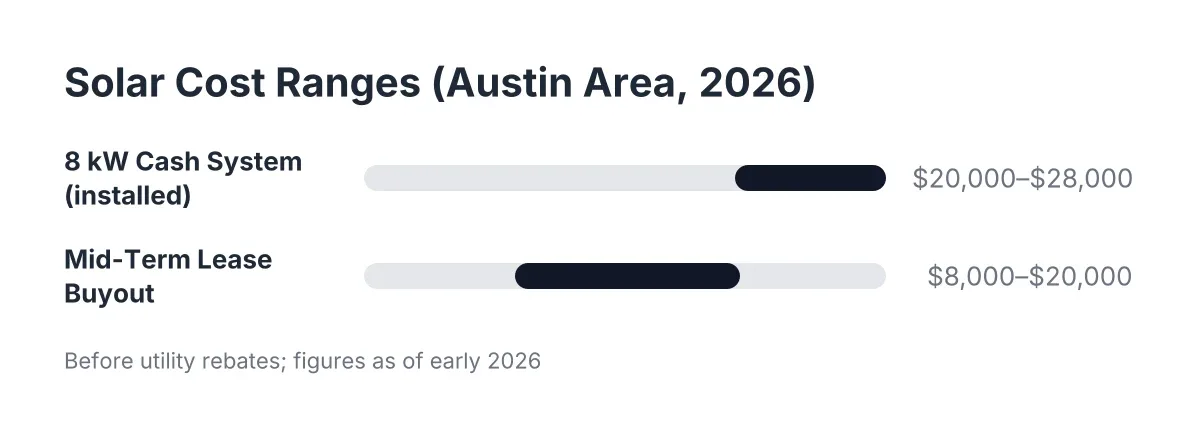
Where buying disappoints: the upfront number is real, and the federal purchase credit (the 25D credit) has ended, which changed the ownership math for cash and loan buyers. Repairs after the installer's workmanship warranty expires are your problem, though panel and inverter manufacturer warranties cover the expensive components for a term that varies by product, so read those terms before you pick the hardware. And if you move within a few years of installing, you may not stay long enough for the savings to overtake the cost. I put the monthly numbers side by side in the lease versus buying cost comparison for the Austin area.
Leasing vs. Buying Solar Panels in Bee Cave, TX: The Deciding Factors
Cost drivers
Buying costs more now and less over time; leasing reverses that. A lease trades your long-term savings for a low entry price. The lease company prices in its financing cost, its profit, and the risk it carries, and the escalator clause means your payment grows whether or not PEC's rates do. An owned system has one big cost and then small ones. In every Solar lease vs buy comparison I have run for homes in this area, ownership comes out ahead on lifetime dollars when the owner stays past the loan payoff. Your numbers will differ, so run them against your actual PEC bill before you sign anything.
Lifespan and ownership
An owned system keeps paying you after year 20; a leased system never belongs to you. Panels typically produce for 25 years or more, often at reduced but useful output beyond that. When a lease ends, you face a choice: renew, buy the aging system at a price the contract sets, or have it removed. The years after a loan is paid off are the best years of ownership. A lease does not have those years.
Installation
The installation itself looks the same either way; the paperwork does not. Both paths put the same class of equipment on your roof, and both require PEC interconnection approval before the system can export power. The difference is who signs the interconnection agreement and who owns the equipment on your roof, which matters for insurance, refinancing, and selling the house.
Maintenance
Leasing wins on maintenance, cleanly. The lease company owns the system, so repairs, monitoring, and inverter swaps are its cost for the contract term. Owners rely on manufacturer warranties and the installer's workmanship warranty, which cover most failures but require you to notice the problem and file the claim. If you want a bill you never think about, that is a genuine point for the lease.
Situational fit
Your utility and your timeline decide this more than the sales pitch does. Bee Cave is PEC territory for most homes, and PEC's buyback terms mean oversizing a system or signing a long escalating lease carries more risk than it would under a one-for-one credit. If you expect to move within five to seven years, a lease complicates the sale and a purchase may not break even. If you are settled, ownership compounds in your favor every year. The right structure also shifts with which utility bills you; I cover that in solar loans, leases, and ownership by Austin-area utility.
Which Should You Choose?
Choose Leasing if:
- You have little or no upfront cash and do not want a loan on your credit
- Your federal tax liability is too small to benefit from ownership-side incentives
- You want zero maintenance responsibility for 20 or more years
- You have read the full contract, including the escalator and the end-of-term terms, and the numbers still work against your PEC bill
Choose Buying Solar Panels in Bee Cave, TX if:
- You plan to stay in the house past the loan payoff
- You want the lowest total cost over the life of the system
- You may add a home battery, a standby generator, or an electric vehicle later
- You want the system to transfer with the house as an asset, not a contract
So what is the difference between leasing and buying solar panels in Bee Cave, TX, once the sales pitch is stripped away? Who keeps the value. If you are on the fence and you plan to stay put, buy. The lifetime math favors ownership in most PEC-territory homes, and the lease's main advantages, low entry cost and no maintenance, fade over a 20-year horizon. Lease only when the tax or cash situation genuinely blocks ownership.
Common Questions
What is the difference between leasing and buying solar panels in Bee Cave, TX?
Ownership. When you buy, you own the panels, the power, and the long-term savings, and the system transfers with your house. When you lease, a company owns the system on your roof, keeps the lease credit, and charges you a monthly payment that usually escalates each year. The question of leasing versus buying solar panels in Bee Cave comes down to who keeps the value the system creates over 25 years.
Is it cheaper to lease or buy solar?
Leasing is cheaper this month; buying is cheaper over the life of the system. A lease has little or no upfront cost but you pay every month for 20 to 25 years with nothing owned at the end. A bought system costs more now, then produces power at no ongoing cost once it is paid off. Your numbers will differ based on your PEC rate, your roof, and your contract terms.
What is the difference between leasing and buying solar panels in Round Rock, TX?
The lease-versus-buy logic is the same, but the utility changes the payoff. Many Round Rock homes are in retail-choice territory, where your buyback rate depends on the electricity plan you pick, while Bee Cave homes mostly sit with PEC and its export credit terms. The utility, not the town, decides how much your exported solar is worth, so run the numbers against the utility that sends your bill.
What is the difference between leasing and buying solar panels in San Marcos, TX?
Same structural choice, different utility. San Marcos homes are served by a different utility than Bee Cave depending on the address, each with its own export credit treatment, while Bee Cave is mostly PEC. A lease escalator that works under one utility's buyback terms can fail under another's, so check your utility's current export credit before signing either contract.
For help with solar with austin energy in austin, TX, Austin Solar FAQ is the place to start.
Prefer to talk it through? Call +15125571906 — a quick call is usually the fastest way to get a straight answer for your situation.