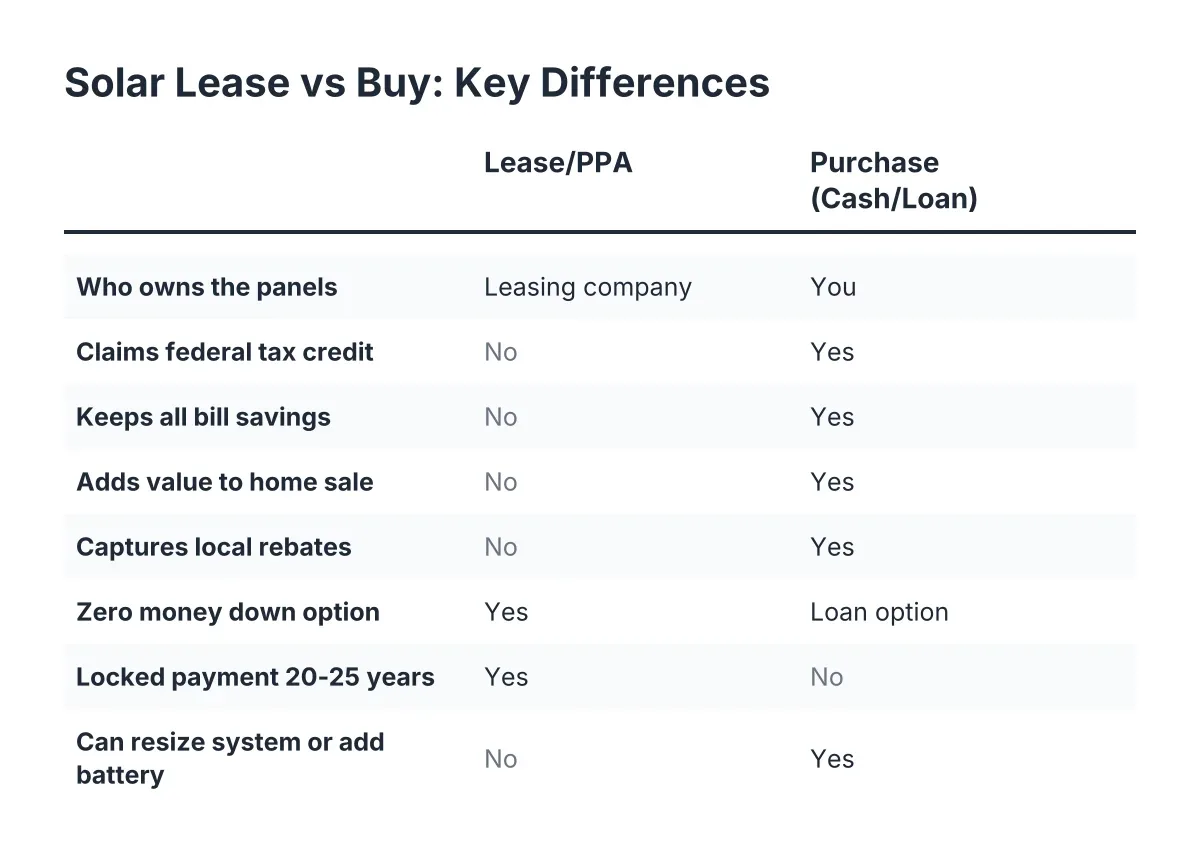
Solar Lease Vs Buy — Complete Guide
Choosing between a solar lease vs buy decision in the Austin area is really a question about who owns the savings on your roof. This guide covers cash purchases, solar loans, leases, and power purchase agreements, and explains how each one plays out under the utility that actually sends your bill. That last part matters, because Austin Energy, Pedernales Electric, Oncor retail plans, and the smaller area utilities all credit your exported solar differently. By the end, you will know which financing path fits your utility territory, your tax situation, and your plans for the house. You will also know which questions to ask before you sign anything.
What You'll Find in This Guide
Prefer to have a pro handle it? Solar lease vs buy is one call away.
Solar Lease vs Buy: Why Your Utility Decides the Answer
Most national guides treat this as a simple finance question. In the Austin area, it is not. The utility that bills you sets the value of every kilowatt-hour your panels export, and that value changes the math for every financing option on the table.
Consider the two biggest players locally. Austin Energy pays residential solar customers 9.91 cents per kWh for exported electricity under its Value of Solar tariff, according to NuWatt Energy. That is a fixed credit rate, separate from what you pay for the power you buy. Meanwhile, Pedernales Electric Cooperative offers full retail-rate net metering to its roughly 375,000 customers, crediting exports at $0.06/kWh, according to SolarSavingsAI. Two homes ten miles apart can see meaningfully different returns from the same system.
This matters for the lease vs buy choice because ownership and leasing respond differently to export rates. When you own the system, every exported kilowatt-hour flows straight to your bill savings. As a result, a strong buyback rate shortens your payback period and improves your return. When you lease, however, your monthly payment stays fixed regardless of what the utility credits you. If the export rate is weak, or if the utility changes it later, an owner absorbs that change directly while a lessee may find the lease payment no longer beats the savings.
The Territories That Shape Your Outcome
The Austin metro splits across at least six utility situations: Austin Energy, Pedernales Electric Co-op, Oncor territory with retail electricity choice, Georgetown Utility Systems, Bluebonnet, and San Marcos. Each handles solar exports on its own terms. For example, homes in Oncor territory shop for a retail plan with a solar buyback component, which means your export value depends on which plan you pick and renew. That is a very different risk profile from a municipal utility with a published tariff.
To put it simply, do not start with "should I lease or buy." Start with "who sends my bill," then work the numbers from there. The full solar lease vs buy breakdown walks through each territory in detail, so you can see the math for your specific situation rather than a national average.
How to Compare Buying vs. Leasing Solar After the 2025 Federal Credit Shift
The federal residential solar tax credit was the single biggest lever in the buy-versus-lease calculation for years. Homeowners who purchased a system, with cash or a loan, could claim a credit against their federal taxes. Lease and PPA customers could not, because the leasing company owned the equipment and kept the credit for itself. The 2025 change to the federal credit reshuffled that logic, and it is the main reason older articles and stale suburb guides now point you in the wrong direction.
Here is the practical effect. Previously, the tax credit gave ownership a large head start, and leases competed by offering zero money down. Now, with the residential credit landscape changed, the gap between owning and leasing looks different depending on how the deal is structured. Some third-party ownership arrangements can still capture commercial-side incentives that individual homeowners cannot. Consequently, a lease or PPA is no longer automatically the worse financial choice in every scenario, even though ownership still wins for most Austin-area homeowners who plan to stay put.
That said, ownership carries advantages no lease can match. You keep every dollar of bill savings for the life of the system, typically 25 years or more. Additionally, you avoid escalator clauses, transfer complications when selling the house, and end-of-term buyout negotiations. Texas homeowners are buying in at scale: the state installed 2.7 GWdc of solar in the first quarter of 2025 alone, 92% more than second-ranked Florida, according to the Solar Energy Industries Association. Strong install volume also means a competitive local market, which helps purchase pricing.
Loans: Ownership Without the Upfront Cash
A solar loan sits between the two extremes. You own the system from day one, so you keep the bill savings and any incentives available to owners. However, you also take on a monthly payment, and dealer fees baked into some loan products can inflate the system price. In practice, comparing a loan against a lease means comparing total cost over the full term, not just the monthly payment. The Austin lease vs buy guide shows how to run that comparison line by line.
What a Lease or PPA Actually Commits You To
A solar lease and a power purchase agreement look similar on the surface. Both put panels on your roof with little or no money down, and both leave ownership with a third party. The difference sits in what you pay for. Under a lease, you pay a fixed monthly amount for the equipment. Under a PPA, you pay per kilowatt-hour for the electricity the system produces. Either way, you are a customer of the solar company for 20 to 25 years, not an owner of the asset.
For some households, that trade makes sense. If you have low federal tax liability, limited savings, or no appetite for maintenance responsibility, a well-structured lease can still lower your monthly costs from day one. Moreover, the leasing company handles repairs, monitoring, and inverter replacements for the term. You are essentially renting savings instead of buying them, which is a legitimate choice as long as you understand what you gave up.
The risks concentrate in the fine print. Watch for annual payment escalators, often 1.9% to 2.9%, which compound over two decades and can eventually push your payment above your savings. Beyond that, selling your home becomes more complicated, because the buyer must qualify to assume the lease or you must pay it off. In the Austin area specifically, a lease payment that made sense against one utility's rates may look worse if you move within the metro, since export credits vary by territory as covered above.
Questions to Ask Before Signing
Before you sign a lease or PPA, get clear answers on the escalator rate, the buyout schedule, the transfer process, and the production guarantee. Also ask who benefits from your utility's export credits under the contract. For example, some agreements let the homeowner keep bill credits while others net them against the PPA rate. If the salesperson cannot answer those questions in writing, treat that as your answer. The detailed lease vs buy comparison includes a checklist you can bring to any sales appointment.
Frequently Asked Questions
What is the difference between leasing and buying solar panels in Bee Cave, TX?
Buying means you own the system and keep all savings; leasing means a third party owns it and you pay monthly. Most Bee Cave homes sit in Pedernales Electric Co-op territory, which credits solar exports at $0.06/kWh under retail-rate net metering. That export rate determines whether ownership savings outpace a fixed lease payment.
What is the difference between leasing and buying solar panels in Round Rock, TX?
Round Rock homes typically fall in Oncor territory with retail electricity choice, so export value depends on which retail plan you choose. Buying lets you shop for the best solar buyback plan each renewal and keep the full benefit. Leasing locks in your monthly cost, shifting the risk of weak buyback plans to you.
Is it cheaper to lease or buy solar?
Over 25 years, buying almost always costs less. Ownership typically pays for itself and then delivers years of nearly free production, while lease payments continue the entire term. Leasing only wins on first-month cash flow, not lifetime totals.
When should I lease instead of buy?
If you might move within a few years, leasing's transfer complications can erase its low upfront appeal. However, staying a decade or more makes buying clearly cheaper as savings compound after payback. Short-timers should often skip solar entirely rather than lease.
Does my utility territory matter?
Yes. Under Austin Energy's Value of Solar tariff, which pays 9.91 cents per kWh for exports, owned systems recover their cost faster than in territories with weaker credits. A lease payment stays the same regardless, so strong export rates favor buying.
What should I compare?
Compare total cost of ownership, not the monthly payment. A lease with 2.9% annual escalation can cost more over 20 years than a solar loan ending after 10–12 years. Run both numbers over the full contract term and check escalator clauses first.
Ready to Get Started?
If you know which utility sends your bill, you already have the most important input for the lease vs buy decision. Start with the full breakdown for your territory, run the numbers against your actual usage, and get every claim from a salesperson in writing. A plain-English answer for your specific situation is a short read away.