Solar Loans, Leases, and Ownership: Which Suits Your Austin-Area Utility
The right way to pay for solar in the Austin area depends less on the panels and more on who sends your electric bill. The math behind solar loans, leases, and ownership changes when you cross from Austin Energy territory into Pedernales Electric Co-op territory, and it changes again in Oncor retail-choice areas. Understanding solar financing by utility is essential before choosing your path. This guide walks through each financing option, then matches them to each utility, so you can check the numbers against your own bill before you sign anything.
One note before we start. I work in this industry. I am not affiliated with Austin Energy, PEC, Oncor, Bluebonnet, Georgetown Utility Systems, or any government program. Every figure below carries its as-of date, and your numbers will differ.
Why Your Utility Decides Which Financing Wins
The financing structure you choose determines who collects the incentives and who benefits from your utility's export credit. Austin Energy pays a Value of Solar rate for every kilowatt-hour you generate. PEC credits exports at a set buyback rate. Oncor-area homes depend on whichever retail electric provider's buyback plan they pick. Those three arrangements reward loans, leases, and ownership differently.
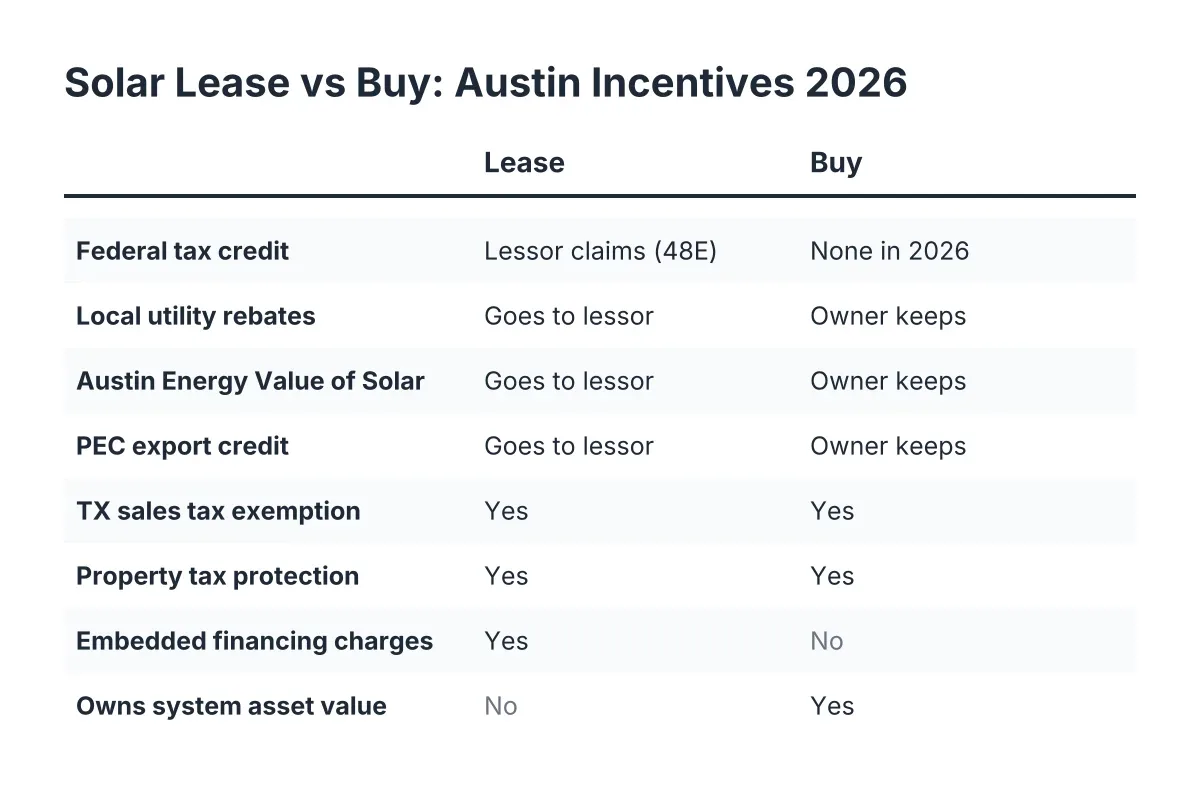
Here is the tax-credit piece, because it shifted the whole comparison in 2026. The federal purchase credit (the old 25D credit, worth 30% to homeowners who bought their systems) has ended for residential purchases. The lease credit path (48E) survives, but it goes to the leasing company, not to you. Additionally, the lessor may pass some of that value through in a lower monthly payment, or may not. That single change is why a plain "buying always wins" answer, which was true for a decade, now needs a second look in every utility territory.
Solar Financing Options: Loans, Leases, and Ownership Compared
Before matching financing to utilities, get the three structures straight. Each answers three questions differently: who owns the equipment, who carries the risk, and who keeps the savings.
Cash Ownership
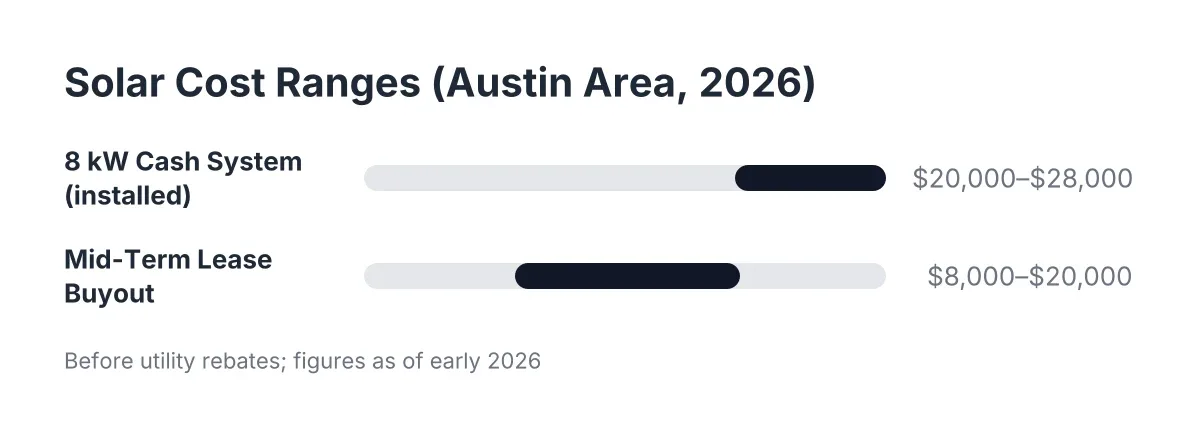
You pay the full price up front and own everything from day one. As of early 2026, solar panels for home installation in the Austin area typically run $2.50 to $3.50 per watt installed, so a 8 kW system lands between $20,000 and $28,000 before any utility rebate. Your numbers will differ based on roof complexity, equipment, and installer.
Ownership gives you every dollar of bill savings and every export credit for 25 years or more. There is no monthly payment and no contract following the house when you sell. The trade-off is obvious for a retiree on a fixed income: that is a large withdrawal from savings, and with the purchase credit gone in 2026, nothing comes back at tax time to soften it.
Solar Loans
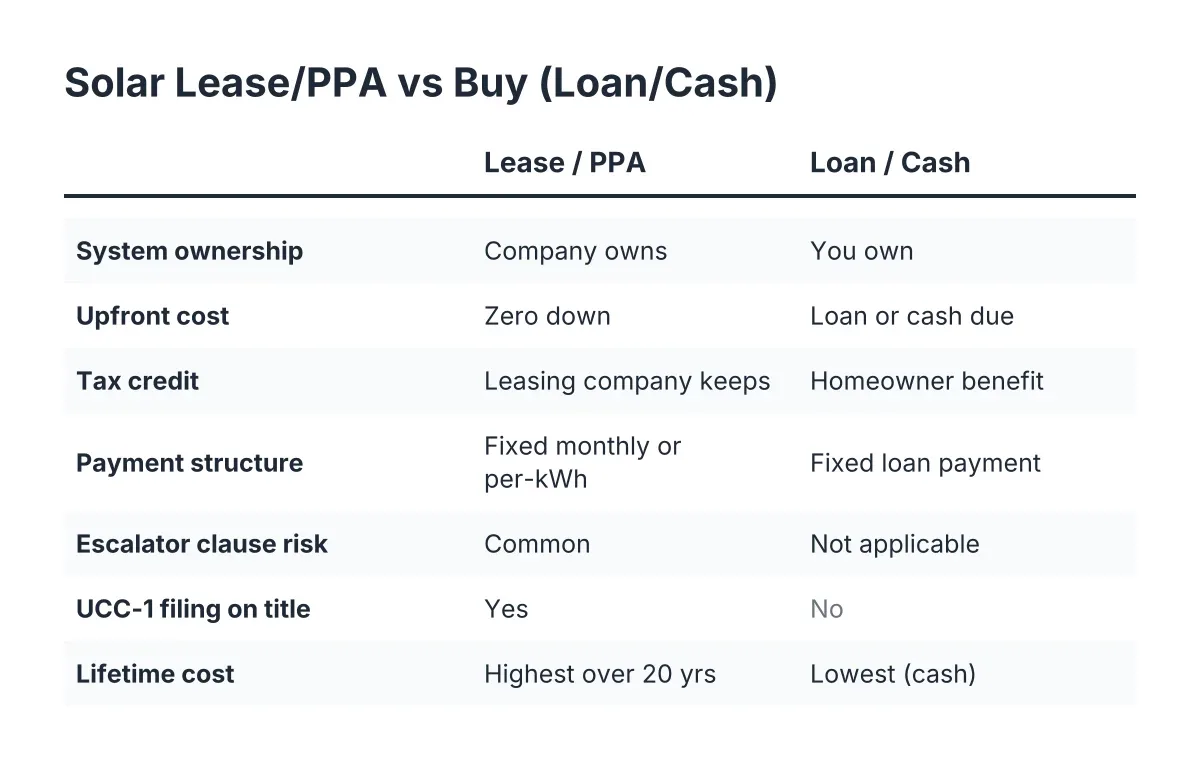
A solar loan buys you the same ownership, spread over 10 to 25 years. You own the system, you collect the utility rebate and export credits, and the lender holds a lien or a UCC filing on the equipment. Rates in 2026 vary widely; the headline low rates often hide dealer fees of 15% to 30% baked into the system price. Ask for the cash price and the financed price side by side. If they differ by more than a few percent, the fee is in there.
For the Bill-Shock Retiree, the honest test is simple. If the loan payment is higher than your average monthly bill savings, you have added a fixed cost to a fixed income. That can still make sense over 20 years, but only if you will be in the house and comfortable with the payment for the full term.
Solar Leases and PPAs
With a lease or power purchase agreement, a third party owns the system on your roof. You pay a monthly fee (lease) or a per-kilowatt-hour rate (PPA), usually for 20 to 25 years, often with an annual escalator of 1% to 3%. Because the leasing company owns the equipment, it claims the surviving 48E lease credit, and it may or may not pass that through in your rate.
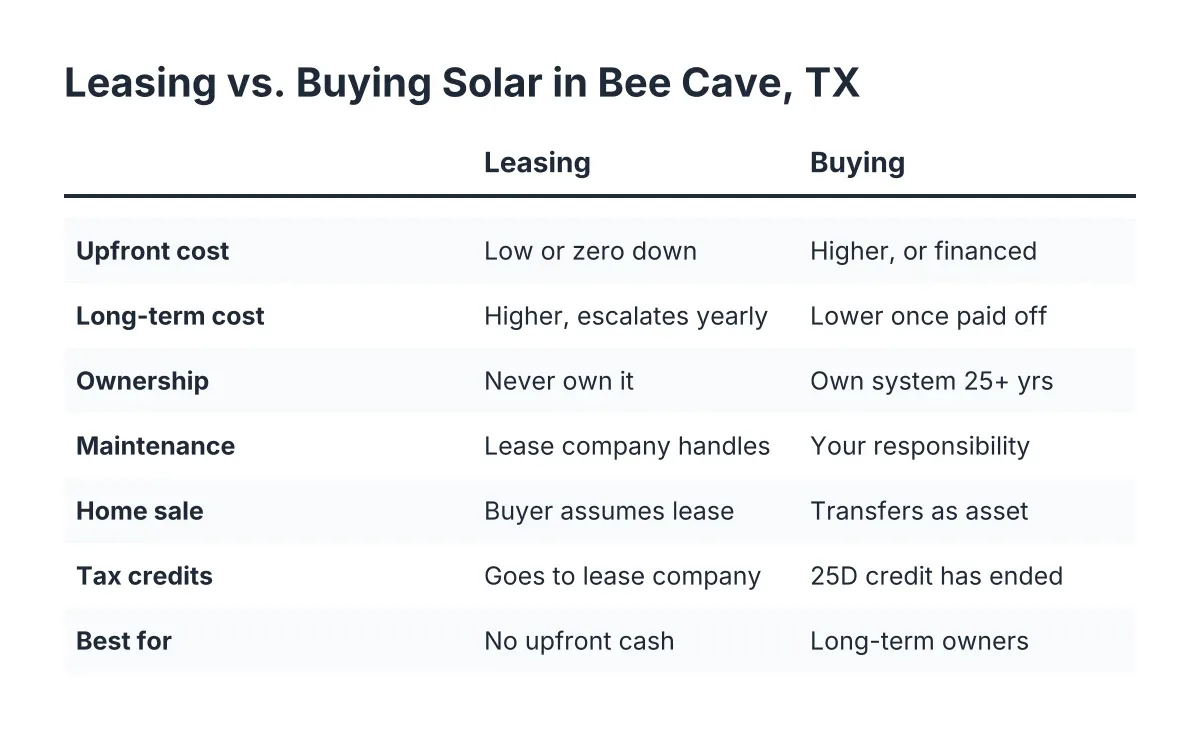
The downsides of a solar lease are well documented. You do not own anything at the end unless you buy the system out. The escalator can push your payment above your savings by year 12 or 15. Selling the house means the buyer must qualify for and accept the lease, or you pay a buyout that often runs $8,000 to $20,000 mid-term. Your numbers will differ; the buyout schedule is in the contract, so read it before signing, not after.
However, 2026 changed the lease's standing. In territories with a strong export credit, a lease from a company passing through the 48E credit can now beat a fee-loaded loan on monthly cost. That was rarely true when homeowners could claim the purchase credit themselves.
Matching Solar Financing to Each Utility Territory
Now the part the national comparison articles skip. The same financing choice produces different outcomes under each Austin-area utility, because the export credit and rebate structures differ.
Austin Energy: Value of Solar Favors Ownership
Austin Energy does not do net metering. It pays a Value of Solar tariff for every kilowatt-hour your panels produce, whether you use it or export it, and bills you for everything you consume at retail rates. According to Austin Energy, the Value of Solar rate is 12.89 cents per kWh for systems under 1 MW-AC, effective October 1, 2026, credited on all the solar a home produces. That rate is set by the utility and can change; check your current bill, and know your numbers will differ.
This structure rewards production, not self-consumption. Since every generated kilowatt-hour earns the same credit, an owned system's economics are clean and predictable, which suits a loan or cash purchase. Austin Energy has also run residential solar rebates over the years; its solar incentive programs are tracked in the DSIRE database maintained by the NC Clean Energy Technology Center, and rebates typically flow to the system owner. Under a lease, the leasing company is the owner. Confirm in writing who collects any rebate before you sign.
Suppose a retired homeowner in Allandale with a $220 average summer bill buys a 7 kW system for cash at about $21,000 as of early 2026. At the 12.89 cent Value of Solar rate, roughly 10,500 kWh of annual production earns about $1,350 a year in credits; the home is still billed for all the electricity it uses. That is an illustrative estimate, not a quote, and the payback stretches past ten years. A retiree should weigh whether they will own the house that long.
Pedernales Electric Co-op: A Lower Buyback Changes the Math
PEC serves much of the Hill Country west of Austin, including parts of Bee Cave, Dripping Springs, and Marble Falls. According to PEC, its regular interconnect rate credits surplus solar sent to the co-op at 7.1921 cents per kWh, only toward the Base Power Charge, and unused credits expire at the end of each calendar year. Rates and structures change; verify against your current PEC bill, and your numbers will differ.
An export credit that only offsets the Base Power Charge means exported power earns less than the full cost of buying power back at night. Solar financing through utility credits differs significantly in PEC territory, which rewards self-consumption over pure export value. Systems sized to match daytime use, or paired with a home battery, perform far better than oversized systems dumping cheap exports to the grid. As of early 2026, a Tesla Powerwall 3 price typically lands between $13,000 and $16,000 installed as an estimate; Enphase and Generac PWRcell options sit in a similar band. That addition strains a lease structure, because most leases price the panels alone and treat batteries as a separate contract.
For PEC homes, a right-sized owned system, cash or loan, usually beats a lease. A lease payment calculated on total production ignores that a third of that production may earn only the export credit. If a lease salesperson in PEC territory shows you savings based on full retail offset, the projection is wrong for this utility.
Oncor Retail Choice: Your Buyback Plan Is a Moving Target
Homes in Round Rock, Hutto, and other Oncor-delivery areas choose a retail electric provider, and the solar buyback plan comes from that provider, not from Oncor. Buyback plans change every contract cycle. A generous plan today can disappear at renewal in 12 months.
That volatility argues against long commitments priced on today's buyback. A 25-year lease with a 2.9% escalator, signed against a buyback plan that may not exist in 2028, stacks two unknowns. Ownership through cash or a short, low-fee loan keeps you flexible: when buyback plans shift, you re-shop providers without renegotiating a lease. A home battery also hedges here, letting you store midday production instead of selling it at whatever the current plan pays. Choosing between solar financing options at the utility level means evaluating how swiftly export rates may change.
Georgetown, Bluebonnet, and San Marcos
Georgetown Utility Systems, Bluebonnet, and San Marcos each set their own export credit rules, and each has changed them in recent years. The principle carries over: the weaker and less stable the export credit, the more the balance tips toward flexible ownership and self-consumption, and away from long escalating leases. Pull your utility's current buyback rate from your own bill or the utility's published tariff before running any projection a salesperson hands you.
Common Questions on Financing and Territory
Is It Cheaper to Lease or Buy Solar in 2026?
Buying solar is usually cheaper over 25 years, even after the purchase credit's end in 2026, because you keep every dollar of savings with no escalating payment. Leasing costs less in year one and can win when the lessor passes through the 48E lease credit and your utility pays a strong export rate. In PEC's export-credit territory, ownership almost always wins.
The full Solar lease vs buy comparison for Austin specifically gets its own treatment elsewhere on this site; the short version is that territory decides more than the contract type does.
Is a 25-Year Solar Lease Worth It for a Retiree?
A 25-year solar lease is a poor fit for most retirees on fixed incomes. The escalator raises the payment every year while your income stays flat, the contract complicates a home sale or an estate, and mid-term buyouts commonly run five figures. If you are 70 today, you are signing a contract designed to outlast you.
There are exceptions. A retiree with high daytime use, in Austin Energy territory, offered a no-escalator lease with the 48E credit passed through, might see a modest monthly gain with zero upfront cost. Read the buyout schedule and the transfer terms before anything else in the contract.
Can I Buy Out My Solar Lease Early in Texas?
Most Texas solar leases allow an early buyout, typically starting at year five or six, at a price set in a schedule inside your contract. Expect a mid-term buyout between $8,000 and $20,000 as an illustrative range as of 2026; your numbers will differ. If your utility has cut its export credit since you signed, run the buyout math again, because owning a paid-off system under a weak buyback often still beats paying an escalating lease on it.
A Word on DIY Kits and Cheap Alternatives
A home solar system kit from an online retailer looks tempting next to a $25,000 installed quote. In practice, every Austin-area utility requires an interconnection agreement, and Austin Energy's Value of Solar payments and PEC's export credits require utility-approved metering. An unpermitted kit can void your homeowner's insurance and disqualify you from the export credit entirely. Texas has more installed solar than any state, 34,907 MW as of Q2 2024 according to Go Solar Texas, and the permitting infrastructure here is mature; work within it.
How to Choose
Match the financing to your bill, your utility, and your timeline, in that order.
- Pull 12 months of bills and note your utility's current export credit or Value of Solar rate, with its date.
- If you are in Austin Energy territory and can pay cash or get a low-fee loan, ownership captures the production-based tariff cleanly.
- If you are in PEC, Bluebonnet, or Georgetown territory, size the system to daytime use, consider a home battery, and favor ownership over any lease priced on full production.
- If you are in Oncor retail-choice territory, avoid 25-year commitments priced on a buyback plan that renews annually; keep the financing flexible.
- If a lease is the only affordable path, demand the escalator rate, the full buyout schedule, and written confirmation of whether the 48E lease credit is reflected in your payment.
- If the loan payment exceeds your verified monthly savings, or the lease outlives your realistic time in the house, walk away. Solar is a poor fit for some homes and some situations, and saying so is cheaper than learning it.
One limitation worth naming: tax and estate consequences of leases and buyouts vary by household, and a CPA or elder-law attorney should review any 20-year contract before a retiree signs it. The comparison of solar loans, leases, and ownership above gives you the framework; your bill, your utility's current tariff, and your timeline supply the numbers that actually decide it.
For help with solar lease vs buy, Austin Solar FAQ is the place to start.
Prefer to talk it through? Call +15125571906 — a quick call is usually the fastest way to get a straight answer for your situation.