Tax Credits, Rebates, and Incentives: Solar Lease vs. Buy in Austin, TX for 2026
If you just closed on a new-build house in Georgetown, Hutto, or Leander and a solar mailer showed up within three weeks of move-in, this article is for you. The tax credits, rebates, and incentives available in the Austin area in 2026 depend on two things most sales pitches skip: whether you lease or buy the system, and which utility sends your bill. In plain terms, solar lease vs buy in Austin is a utility question before it is a tax question. The 2026 solar tax credits are fundamentally different from what many homeowners expect, so get either one wrong and your payback math falls apart. I work in this industry, and I am going to walk through it the way I would for a neighbor over the fence.
One thing up front. The ranking pages for this topic are national templates and IRS explainers. They will not tell you that the federal purchase credit for homeowners is gone, that the lease path kept its credit, or that Austin Energy credits solar differently than Pedernales Electric Co-op does. That gap is what this guide covers.
Understanding Solar Tax Credits in 2026
For years, the decision was simple. A federal tax credit of 30% historically applied to the total cost of a residential solar installation, significantly reducing out-of-pocket cost, according to the Internal Revenue Service. You bought the system, you claimed the credit on your own return, and ownership won the math almost every time.
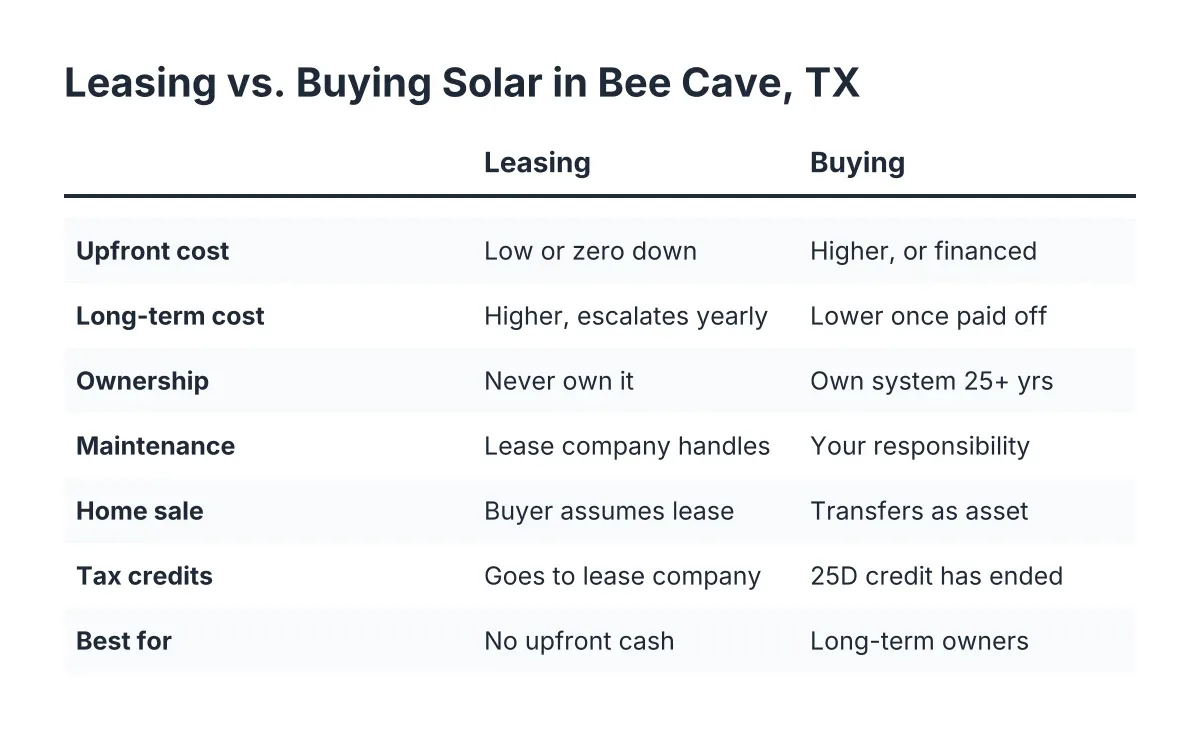
That credit, the one I call the purchase credit (the federal 25D residential credit), has ended for homeowner purchases. As of 2026, you cannot claim it on a system you buy for your own roof. Meanwhile, the lease credit survives. That is the 48E path, a commercial credit that a leasing company can claim because the company, not you, owns the system on your roof.
This flips the old advice on its head, but not as far as lease salespeople will tell you. The leasing company captures the tax benefit, then decides how much of it to pass through in your monthly payment. You never see the credit directly. Whether enough of it reaches you is the entire lease versus buy question in 2026, and the answer varies by utility territory.
How Tax Credits, Rebates, and Incentives Split Between Lessor and Owner
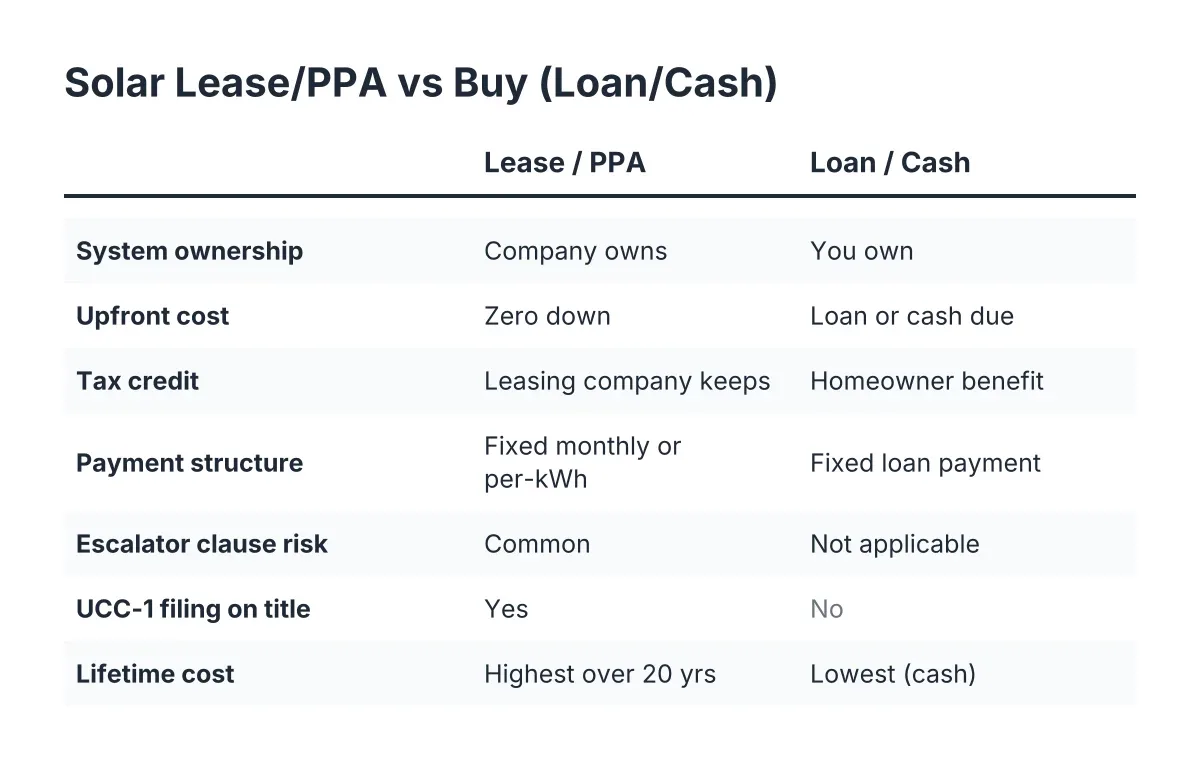
Here is the core mechanic. Whoever owns the system claims the incentives. The U.S. Environmental Protection Agency (EPA) describes a solar lease as working like an equipment lease, similar to a car lease: you pay a fixed monthly amount for the use of the panels regardless of how much energy they produce. The EPA also notes that with both leases and PPAs, the building owner gets a system installed with no upfront cost but never actually owns it.
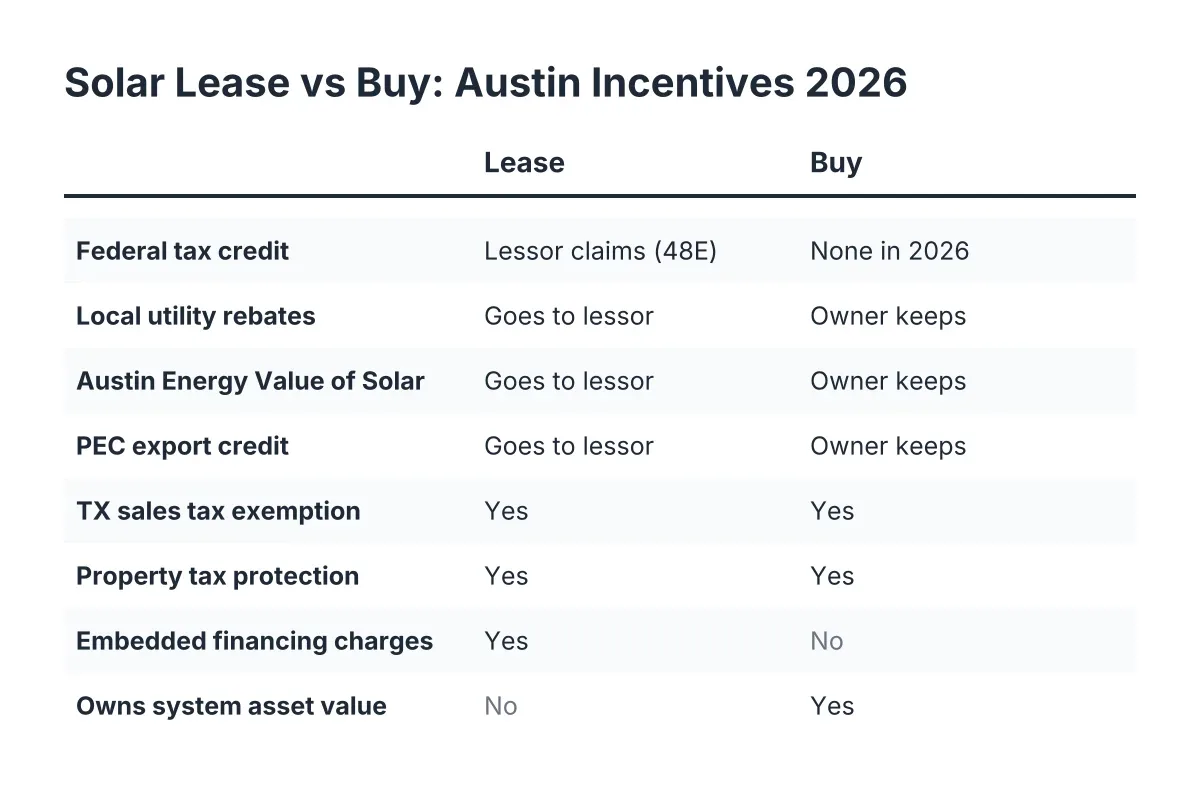
Because you never own it, you are generally ineligible for the ownership-based tax credits, rebates, and incentives. The leasing company claims them. In 2026 that means:
- Lease (third-party ownership): The leasing company claims the federal lease credit under 48E. It may or may not pass savings through in your rate. You get no line on your own tax return.
- Cash or loan purchase: No federal purchase credit remains for homeowners in 2026. However, you keep every local rebate, every export credit, and the full asset value of the system.
- Prepaid lease or structured purchase: A hybrid. You pay a chunk upfront, and rebates or credit value get applied immediately to reduce that upfront number rather than flowing through a tax return. These deals deserve a CPA's eyes before you sign.
Texas adds one incentive that applies either way. The state offers a sales tax exemption on solar equipment, which trims cost at the point of sale. Texas also protects the added home value from property tax increases. Neither depends on lease versus buy, so neither should sway your decision.
One more structural point. Solar leases carry embedded financing charges. Over a 20 or 25 year term, those charges raise the total cost of the electricity compared with owning the same hardware outright. A lease payment that starts below your utility bill can climb past it if the contract includes an annual escalator, often 1.5% to 2.9% per year. Read that clause before anything else.
Your Utility Decides Your Outcome, Not Your Town
This is the part the national templates get wrong. In the Austin area, the utility, not the city limits sign, determines what your exported solar power is worth. That value feeds directly into whether a lease payment or a loan payment pencils out.
Austin Energy: Value of Solar, plus a local rebate for owners
Austin Energy does not do retail net metering. It uses a Value of Solar tariff, which credits 12.89 cents per kWh on every unit a home's panels produce, for systems under 1 MW-AC effective October 1, 2026, and bills the home for all the electricity it uses, according to Austin Energy. That figure carries an as-of date of the source's publication; Austin Energy adjusts the Value of Solar periodically, so confirm the current rate before you model anything. Your numbers will differ.
Austin Energy also runs rebate programs for solar, which are tracked in the DSIRE incentives database maintained by the NC Clean Energy Technology Center. Rebates like these typically flow to the system owner. If you lease, the leasing company is the owner, and the rebate math belongs to them. If you buy, it belongs to you. In Austin Energy territory, buying keeps both the rebate and the Value of Solar payments in your pocket, which is why ownership still tends to win here even without the federal purchase credit.
Pedernales Electric Co-op: an export-only credit
PEC serves many of the fast-growing suburbs where new construction is booming. According to PEC, its regular interconnect rate credits surplus solar sent to the co-op at 7.1921 cents per kWh, only toward the Base Power Charge, and unused credits expire at the end of each calendar year. That export figure carries the source's as-of date, and PEC adjusts its rates; your numbers will differ.
That export credit is a meaningful haircut compared with what you avoid paying for power you use directly. In PEC territory, the winning design keeps solar production inside the house: size the system to your actual daytime load, or pair it with a home battery so excess production charges the battery instead of exporting for the lower credit. A lease sized for maximum roof coverage, which is how leases are often sold, can overproduce into a low export rate and hand the downside to you while the lessor keeps the lease credit.
Oncor retail choice, Georgetown Utility Systems, Bluebonnet, and San Marcos
In Oncor territory you buy electricity through retail providers, and in deregulated markets you can choose among multiple solar buyback plans that credit surplus energy sent to the grid, as Solar United Neighbors explains. That flexibility helps owners, who can switch buyback plans as offers change. A lease locks your production profile for 20 to 25 years while buyback plans turn over every year or two.
Georgetown Utility Systems, Bluebonnet, and San Marcos each set their own export credit or buyback terms, and in regulated utility areas homeowners typically have only one or a few options, per Solar United Neighbors. Before you sign anything, lease or loan, get the current export credit rate in writing from your utility, with a date on it. Stale 2022 buyback numbers still circulate in suburb guides, and they will flatter any payback spreadsheet.
Can You Get Tax Credits and Rebates If You Lease Solar Panels?
No, not directly. When you lease, the leasing company owns the system and claims the federal lease credit and any owner-directed rebates itself. You receive whatever portion the company builds into your monthly rate. Solar tax credits for 2026 in the lease path belong to the lessor, not the homeowner; in 2026, with the homeowner purchase credit ended, the lease credit is the only federal solar credit left in residential, and it never touches your tax return.
This is why the lease pitch sounds stronger in 2026 than it did in 2023. The salesperson can truthfully say the lease path still gets the 30% federal benefit and the purchase path does not. What the pitch omits is the pass-through rate. If the lessor keeps most of the credit's value and adds a 2.9% annual escalator, your 25-year cost can exceed what a straightforward loan purchase would have cost, even without any federal credit on the purchase side.
Therefore, judge a lease the way you would judge any long contract. Ask four questions and get the answers in writing:
- What is the effective rate per kWh in year one, and what is it in year 25 after escalators?
- What does the utility's current export credit or buyback rate do to that math, dated and in writing?
- What are the buyout terms if you want out early, and what happens at home sale?
- Will any claimed tax structure be documented in writing so your CPA can review it before signing?
Running the Solar Lease vs Buy Numbers on an Austin New-Construction Home
Suppose a hypothetical buyer closes on a 2,600 square foot all-electric new build in Georgetown in early 2026. Summer bills from Georgetown Utility Systems are projected around $280 a month. The builder stubbed in solar conduit from the attic to the electrical panel, which is what "solar-ready" usually means: a wire path and maybe a panel with space for a solar breaker, nothing more. No racking, no permits, no utility paperwork is done for you.
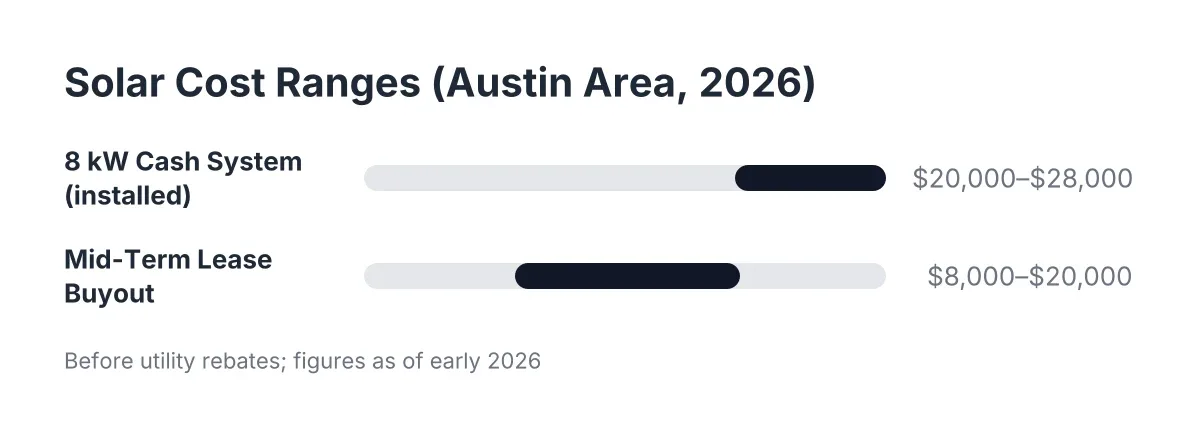
In that scenario, an illustrative 8 kW purchased system might run $22,000 to $28,000 installed as of early 2026, before the Texas sales tax exemption and any utility rebate. These are my estimates for modeling, not quotes; your numbers will differ by roof, equipment, and installer. With no federal purchase credit, a cash buyer in that range might see payback in the 9 to 13 year range depending on usage, rates, and the utility's export terms. A loan stretches the payback but keeps ownership and every incentive that comes with it.
The same roof under a 25-year lease might start near $140 a month with a 2.9% escalator. That looks painless against a $280 bill. However, by year 15 the payment approaches $210, the escalator keeps running, and you still owe a lease payment on top of whatever grid power you buy at night. Lease payments that start comfortable can converge on the old utility bill, which erases the promised savings. And when you sell, buyers taking over a lease often negotiate the home price down to offset the obligation they are assuming.
The broader market context matters here too. Texas leads the country in solar: the state installed 2.7 GWdc in the first quarter of 2025, 92% more than second-ranked Florida, according to the Solar Energy Industries Association (SEIA). And per SEIA data cited by Go Solar Texas, Texas had 34,907 MW installed as of Q2 2024, enough to power about 4 million homes. A big, competitive market means you can compare multiple ownership offers; a lease locks you out of that competition for decades.
Should You Add Solar Right After Buying a New House?
Adding solar immediately after closing on a new-construction home is optional, not urgent, in 2026. The federal purchase credit is already gone, so there is no expiring homeowner credit forcing your hand. Waiting six to twelve months to learn your real usage pattern, confirm your utility's export terms, and recover from closing costs is a defensible plan.
This matters because the old urgency pitch, claim the 30% before it drops, no longer applies to purchases. The lease credit under 48E belongs to the lessor either way. If anything, a new-construction buyer benefits from waiting one full summer. A spreadsheet built on twelve months of actual Georgetown Utility Systems or Bluebonnet bills beats one built on the builder's energy estimate every time.
In addition, use the waiting period to clear the non-financial hurdles:
- HOA rules. Texas law limits how far an HOA can restrict solar panels, but new subdivisions under declarant control can have more latitude. Get your HOA's solar guidelines in writing before you design anything.
- Interconnection. Utilities that support residential solar interconnection commonly require engineering documentation and drawings for review before installation is approved, as Arizona Public Service (APS) notes about the standard utility process. Budget two to eight weeks for utility approval depending on the territory.
- The solar-ready conduit. Have an electrician confirm the conduit actually runs where panels would go and the panel has capacity. Sometimes it does; sometimes it is a marketing checkbox.
One honest caveat: tax situations vary, and the structures some companies use around the lease credit are new and not uniformly documented. If anyone promises you a tax outcome on a lease, prepaid lease, or structured purchase, have a CPA review the paperwork before you sign. That is not optional diligence; it is the whole ballgame now.
Where Batteries and Equipment Choices Fit the Incentive Math
A home battery changes the lease versus buy calculation more in low-export territories than anywhere else. In PEC territory, where exports earn 7.1921 cents per kWh toward the Base Power Charge only (your numbers will differ), every kWh you store and use yourself avoids the full cost of buying it, which is more than the export credit. That spread is the battery's business case. In Austin Energy territory, where the Value of Solar credits all production at 12.89 cents per kWh whether the home uses it or not, storing solar does not raise the credit, and the battery case rests on backup power and Austin Energy's separate battery incentive, not arbitrage.
Equipment branding muddies pricing comparisons, so strip it out. People search for Tesla solar panels cost as if the brand sets the price, but what you are pricing is the same stack everywhere: panels, inverter, racking, labor, permitting, and interconnection. A packaged solar panel kit with battery and inverter from any major ecosystem, whether Tesla Powerwall, Enphase, or Generac PWRcell, should be compared on dollars per watt installed and on warranty terms, not on logo. Under a lease, you do not pick the equipment anyway; the lessor does, and the lessor's incentive is their cost, not your preference.
Solar Lease vs Buy in Austin: The Plain-English Bottom Line for 2026
Solar lease vs buy in Austin for 2026 comes down to who captures the remaining incentives and what your utility pays for exports. The federal purchase credit is gone for homeowners. The lease credit survives, but it lands on the leasing company's return, not yours, and escalators plus embedded financing charges can eat the pass-through. Ownership still keeps the Texas sales tax exemption, any utility rebate, the full export credit stream, and the asset itself.
My rule of thumb, stated plainly. In Austin Energy territory, ownership usually wins because the Value of Solar and local rebates reward the owner. In PEC, Bluebonnet, and Georgetown Utility Systems territory, right-sizing beats maximizing, and a lease sized for the lessor's revenue rather than your load is a red flag. Additionally, in Oncor retail choice areas, ownership preserves your freedom to chase better buyback plans as they appear.
For a new-construction buyer stretched thin from closing, the honest answer may be: not yet. Solar is a poor fit for some houses and some budgets, and 2026 has no expiring purchase credit to race. Collect a year of bills, get your utility's current export rate in writing with a date on it, and run the lease and buy columns side by side with the tax credits, rebates, and incentives assigned to whoever actually owns the panels. The spreadsheet will tell you the rest.
For help with solar lease vs buy, Austin Solar FAQ is the place to start.
Prefer to talk it through? Call +15125571906 — a quick call is usually the fastest way to get a straight answer for your situation.