How to Vet Solar Panel Installers in Austin: Questions to Ask Before Hiring
Choosing among solar panel installers in Austin is harder than it should be. The ranking pages are national templates, the suburb guides quote buyback rates from 2022, and the Reddit threads are full of people asking who to trust. I have worked inside this industry in the Austin area, and this is the vetting checklist I would hand a neighbor over the fence. It is organized as the questions you should ask, with the answers a good company gives and the answers that should make you walk.
One note before the questions. Your utility, not your town, decides most of your outcome. Austin Energy credits every kilowatt-hour a home's panels produce at its Value of Solar rate, 12.89 cents per kWh for systems under 1 MW-AC effective October 1, 2026, and bills the home for all the electricity it uses, according to Austin Energy. Pedernales Electric Cooperative credits surplus solar sent to the co-op at 7.1921 cents per kWh under its regular interconnect rate, applies that credit only toward the Base Power Charge, and expires unused credits at the end of each calendar year, according to PEC. Those rates carry as-of dates and change; your numbers will differ. Any installer who quotes savings without naming your utility and its current export credit has already failed the first test.
What Solar Panel Installers in Austin Should Include in Residential Jobs
A complete residential solar installation in Austin, TX includes site assessment, system design, engineering drawings, permitting, utility interconnection paperwork, the physical install, inspection, and activation. Utilities commonly require engineering documentation submitted for review before installation is approved, according to Arizona Public Service. If a company treats interconnection as your problem, that is not a full-service installer.
Ask the company to list, in writing, what is in scope. The usual extras that surface later are main panel upgrades, trenching for detached garages, roof repairs discovered during install, and tree trimming. None of those are scams, but a good company flags them before you sign, not after the crew arrives.
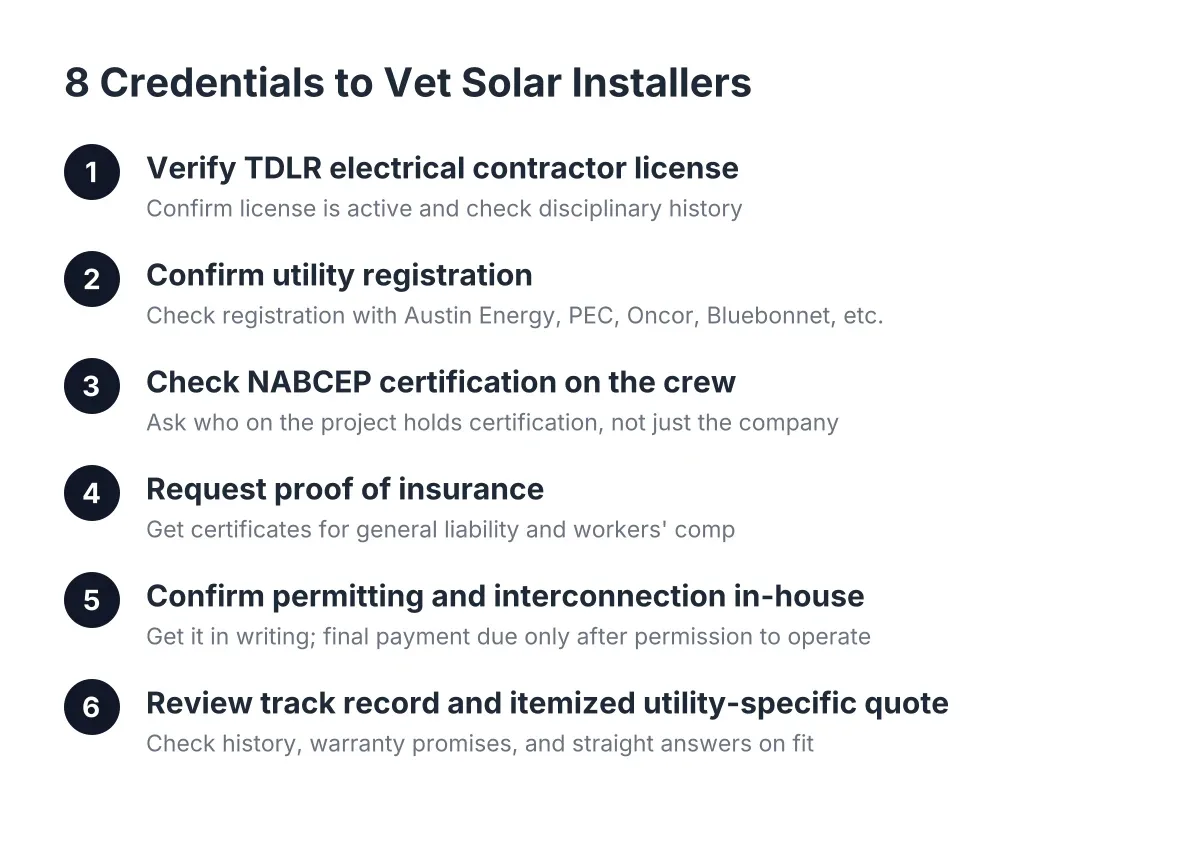
Also ask who handles the utility rebate paperwork, if a rebate applies. Some utility rebate programs require the homeowner to use a contractor registered with that utility. Hiring an unregistered company can forfeit the rebate entirely, so confirm registration before anything else.
How do I check whether an installer is registered with my utility?
Confirm installer registration by calling your utility's solar program directly or checking its published participating contractor list, not by taking the salesperson's word. Austin Energy runs its own solar program with its own contractor requirements. PEC, Bluebonnet, Georgetown Utility Systems, and Oncor-territory retail providers each have their own interconnection rules.
This matters because the registration check does two jobs at once. It protects any rebate you might qualify for, and it filters out-of-town sales operations that subcontract the actual work. In my experience watching this market, the companies that cannot answer "are you registered with Austin Energy" in one sentence are the ones to avoid.
How much does solar panel installation in Austin cost in 2026?
Residential solar panel installation in the Austin area in 2026 generally runs in the tens of thousands of dollars before incentives for a typical home system, with home battery add-ons often falling in the $8,000 to $25,000 range. These are illustrative ranges, not quotes; your roof, your usage, and your utility will move the number.
Be careful with federal credit claims in 2026. The purchase credit, the federal 25D credit that historically covered 30% of a purchased system's cost according to the Internal Revenue Service, has ended for homeowner purchases. The surviving path is the lease credit under 48E, which flows to the leasing company, not to you. Any installer still pitching "the 30% tax credit" on a cash or loan purchase in 2026 is either behind or misleading you. Ask them to put the incentive math in writing with dates.
What Questions Separate Good Residential Solar Panel Installers in Austin From Sales Operations?
The strongest vetting questions force the company to show its work on your specific house and your specific utility. A sales operation answers with averages and urgency. A real installer answers with documents.
Ask these, in this order:
- Which utility sends my bill, and what export credit will I earn per kWh, as of what date?
- Who does the physical installation, your own crews or a subcontractor?
- How long have you operated under this business name in Texas, and who services the warranty if you close?
- What is the production estimate for my roof, and what happens if the system underproduces?
- Is my system sized for my actual usage history, or for a round number?
- What does my HOA require? Under Texas solar rights law, HOAs can require approved panel colors such as silver, bronze, or black, and can restrict mounting methods that would void manufacturer warranties.
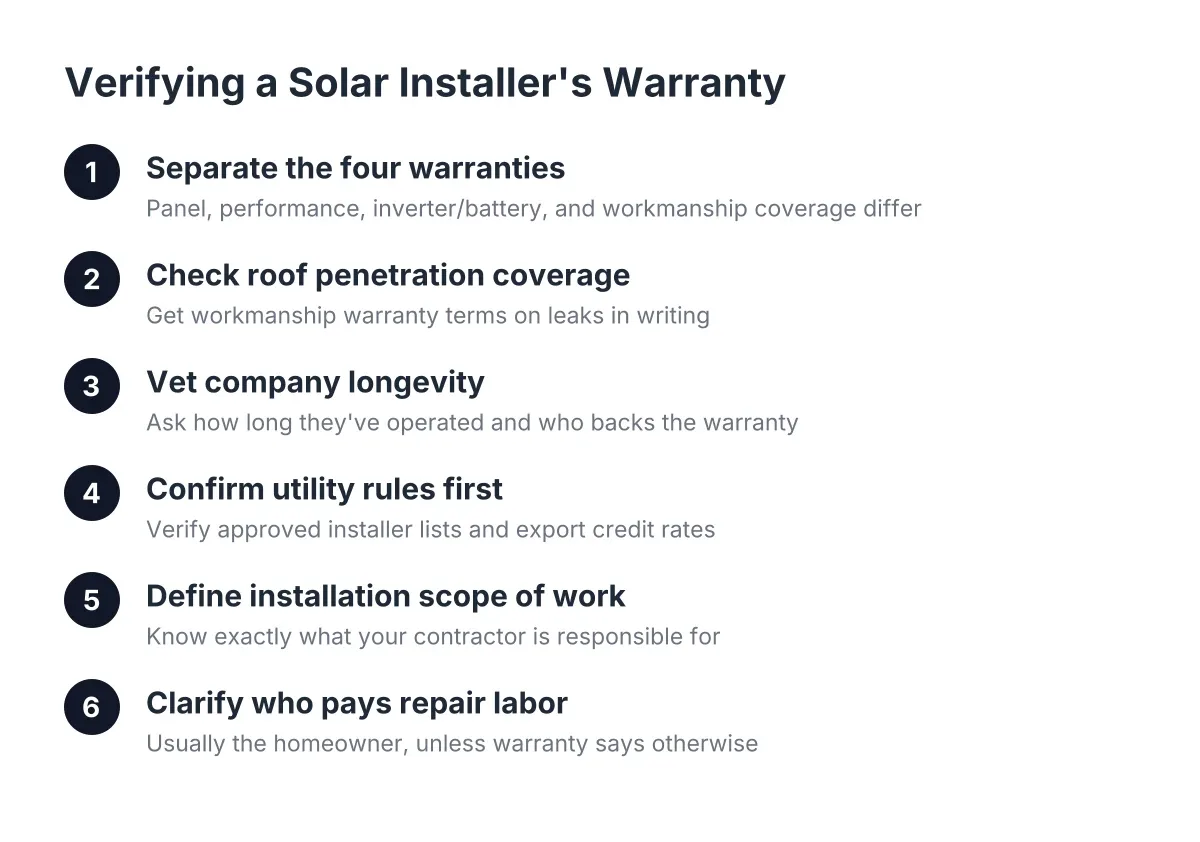
The warranty question deserves extra weight. Solar companies fail at a high rate. If you buy a system and the installer disappears within the warranty period, repair and maintenance responsibility can land on you. Ask whether the equipment warranties are backed by the manufacturer directly and how a claim works without the original installer.
Is a solar lease a bad idea for a retiree on a fixed income?
A solar lease is a fixed monthly payment for the use of panels you do not own, regardless of how much energy they produce, according to the U.S. Environmental Protection Agency. The EPA also notes that under both leases and power purchase agreements, the building owner never owns the system. For a retiree, that means a payment obligation that can outlast your willingness or ability to pay it.
Leases are not automatically scams, and in 2026 the lease credit makes third-party ownership the only path to federal incentive value. However, scrutinize three clauses before signing: the annual rate escalator, the buyout terms, and what happens to the lease if you sell the house. Those three provisions decide whether the deal saves money. If the salesperson cannot explain them in plain English, do not sign.
Suppose a retiree in a PEC neighborhood signs a 25-year lease at age 72 with a 2.9% annual escalator. By year ten the payment has grown about a third, PEC's export credit may have changed, and selling the house now requires the buyer to assume the lease or the seller to pay a buyout. None of that was in the pitch. That is the hypothetical scenario the fine print exists to create, and it is why you read the escalator clause first.
How many quotes should I get, and can I negotiate?
Get at least three quotes from different solar panel installer companies before committing, and never sign under same-day pressure. Comparing quotes is the only way to see what each company charges per watt and how much of any incentive actually reaches you. A legitimate price does not expire when the salesperson leaves your kitchen.
You can also negotiate. If the equipment, production estimate, and company reputation already look right, asking for a lower price after reviewing the quote is normal and often works. In addition, watch the financing. Most installers partner with fintech lenders who bundle the loan into the solar contract, sometimes with deferred payments that reamortize into a higher payment later. On a fixed income, a payment that jumps in month 18 is a budget problem you should see coming before you sign.
What should existing solar owners ask before hiring a company again?
Existing solar owners re-engaging the market in 2026 should ask about battery retrofit compatibility, inverter replacement options, and how their utility's current export credit changes the math on storage. If you installed under an older, richer buyback arrangement and your utility has since moved to a lower export credit, a home battery can recapture value by storing exports you would otherwise sell cheap.
Ask any installer quoting a retrofit three things: whether the battery works with your existing inverter brand, whether adding storage triggers a new interconnection review with your utility, and whether the work affects your original warranties. When solar panel installers in Austin are handling panel repairs, also confirm the company will service equipment it did not install; many will not, and finding that out early saves weeks.
Can I install solar myself, or does this need a licensed pro?
Residential solar installation in Austin requires licensed electrical work, permits, engineering review, and utility interconnection approval, so this is not a DIY project for almost any homeowner. What you can safely handle yourself is the homework: pulling twelve months of bills, reading your utility's current export credit, and comparing quotes line by line.
You do not need to become an expert on wiring and interconnection. The practical goal is choosing a knowledgeable company that is easy to work with, because they handle the technical details for the next 25 years. Call a professional now, rather than later, if an existing system shows error codes, a sudden production drop, or scorching near the inverter or panel connections.
Is solar even worth it in Austin, TX right now?
Solar can work in Austin, TX in 2026, but the answer depends on your utility, your roof, and your timeline, and for some houses the honest answer is no. Texas leads the country in solar; the state installed 2.7 GWdc in the first quarter of 2025, 92% more than second-ranked Florida, according to the Solar Energy Industries Association. Scale does not make every roof a good candidate.
A heavily shaded roof, a roof due for replacement in five years, or a short ownership horizon all weaken the case. For a retiree, the payback period question is legitimate; a system that breaks even in year twelve is a different decision at 68 than at 45. For complex situations, financing structures, and incentive questions, talk to an experienced energy consultant before signing anything, because the programs change and the details decide the outcome.
Where to go from here
Start with your bill, not with a brand of panel. Find which utility serves you, look up its current export credit with a date attached, and only then start comparing residential solar panel installers against the questions above. If you are searching for a solar panel installation company near me and getting national call centers, narrow the field to companies registered with your specific utility.
This site exists to give you the current, local version of those answers, organized by utility territory, because Austin Energy, PEC, Oncor retail choice, Georgetown Utility Systems, Bluebonnet, and San Marcos each produce different outcomes. Read the guide for your utility before you sit down with any salesperson. Every rate quoted here carries an as-of date, and your numbers will differ.
For help with solar with Austin Energy, Austin Solar FAQ is the place to start.
Prefer to talk it through? Call +15125571906 — a quick call is usually the fastest way to get a straight answer for your situation.