Vetting Solar Panel Installers in Texas: 8 Credentials That Actually Matter
If you are comparing solar panel installers around Austin in 2026, the paperwork matters more than the pitch. Texas does not license solar contractors the way it licenses plumbers, so the burden of checking credentials falls on you. That is uncomfortable, especially if the trigger for all this was a summer bill that jumped $100 over last year. The good news: you can verify almost everything on this list yourself, from your kitchen table, before anyone sets foot on your roof.
I have worked inside this industry in the Austin area. I am not an installer, and I am not selling you anything. What follows is the checklist I would hand a neighbor over the fence, in the order I would check it. Texas installed 2.7 GWdc of solar in the first quarter of 2025, more than any other state, according to the Solar Energy Industries Association (SEIA). That growth brings in good crews. It also brings in companies that will not exist in three years. The credentials below help you tell them apart.
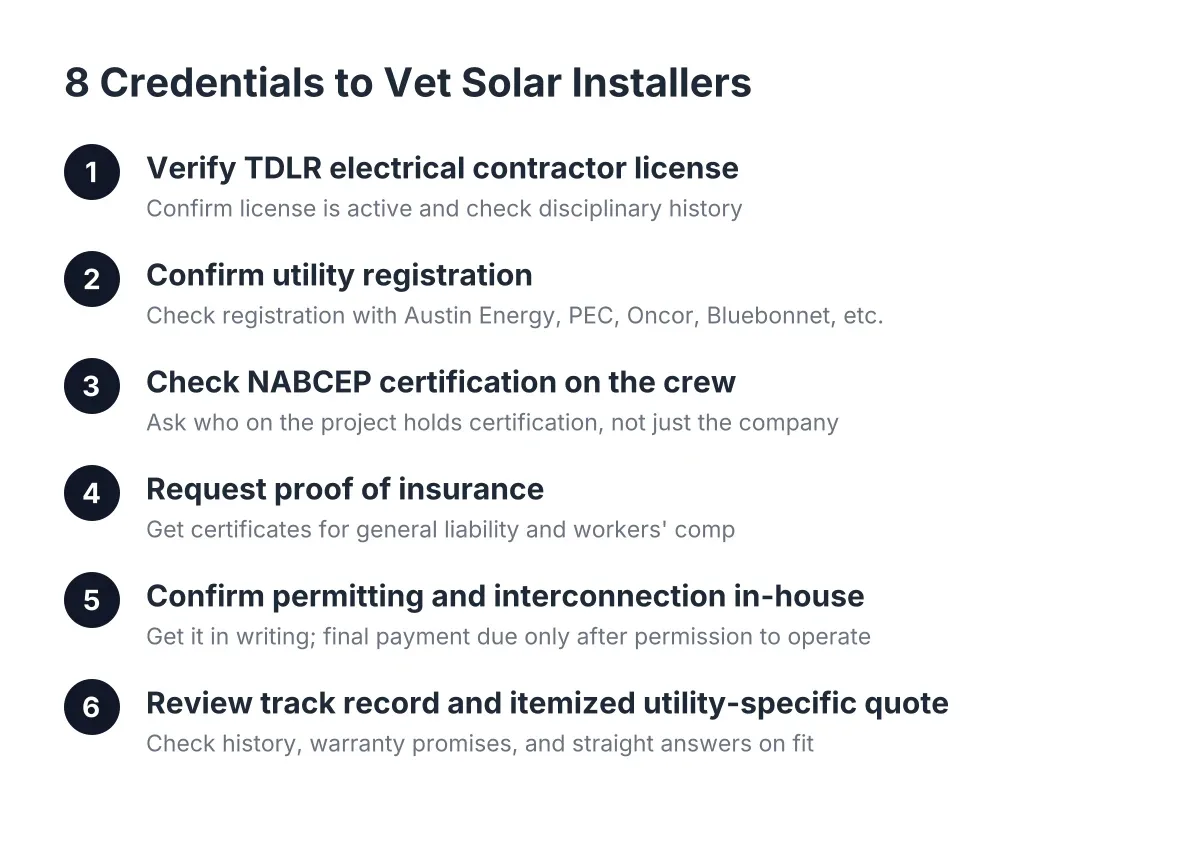
1. A Texas Electrical Contractor License, Verified by Number
Texas has no statewide "solar installer license." What the state does require is that the electrical work on your system falls under a licensed electrical contractor, with a master electrician responsible for the job. Ask the solar installation company for its Texas Department of Licensing and Regulation (TDLR) electrical contractor license number, then look it up yourself on the TDLR website.
Check two things while you are there: that the license is active, and whether the company has disciplinary history. A company that hesitates to give you this number has told you something useful. Walk away.
Watch for one common arrangement. Many solar panel installation companies subcontract the electrical work. That can be fine, but then you want the subcontractor's license number too, and you want to know who warranties the workmanship if the two companies point at each other later.
2. Registration With Your Utility, Not Just "Experience in Your Area"
Your outcome depends on your utility, not your town. Austin Energy, Pedernales Electric Co-op (PEC), Oncor territory with retail choice, Georgetown Utility Systems, Bluebonnet, and San Marcos each handle solar differently. Utility rebate programs commonly require that you use a contractor registered with that utility, and using a non-registered installer can forfeit the rebate entirely.
Therefore, before you compare prices, ask each company one direct question: are you a registered or participating contractor with my specific utility, and can you show me a recent project interconnected there? In Austin Energy territory, that registration gates rebate eligibility. In PEC or Bluebonnet territory, it determines whether the company knows the co-op's interconnection paperwork cold or is learning on your house.
A related detail on the money side. Effective October 1, 2026, Austin Energy credits all of a home's solar production under its Value of Solar tariff at 12.89 cents per kWh for systems under 1 MW-AC and bills the home for all the electricity it uses, according to Austin Energy, rather than retail-rate net metering. PEC credits surplus solar sent to the co-op at 7.1921 cents per kWh, only toward the Base Power Charge, according to PEC. Those rates carry those as-of dates, and your numbers will differ. An installer who quotes you savings using a stale or wrong buyback rate has failed a credential check you can run yourself.
3. NABCEP Certification on the Crew, Not Just the Brochure
The North American Board of Certified Energy Practitioners (NABCEP) runs the most recognized voluntary certification for solar professionals. It is not legally required in Texas, which is exactly why it is a useful signal; a company that invests in it is spending money on competence it did not have to spend.
However, read the fine print on how it is used. Some companies hold one NABCEP-certified person at headquarters and never send that person to a job site. Ask who on your specific project holds the certification, and what their role is. "Our designer is NABCEP PV Installation Professional certified and stamps every design" is a real answer. "We're NABCEP certified" with no name attached is marketing.
4. Proof of Insurance You Can Hold in Your Hand
Residential solar panel installers put crews on your roof and tie equipment into your main electrical panel. You want two documents before work starts: a certificate of general liability insurance and proof of workers' compensation coverage. Texas does not require employers to carry workers' comp, so some crews skip it. If an uninsured worker falls off your roof, the claim can land on your homeowner's policy.
Ask for the certificates directly from the insurer or with the insurer's contact information on them, and confirm the dates cover your installation window. This takes ten minutes. For a retiree protecting a paid-off house, it may be the most important ten minutes in the whole process.
5. Permitting and Interconnection Handled In-House, in Writing
A legitimate solar installation company pulls the building and electrical permits, prepares the engineering drawings, and files the interconnection application with your utility. Utilities that support residential solar commonly require engineering documentation and drawings for review before installation is approved, according to Arizona Public Service (APS), and the Austin-area utilities are no exception.
Consequently, your contract should state in writing that the installer handles permits, inspections, and interconnection, and that you owe final payment only after the utility grants permission to operate. Any company that suggests skipping permits, or asks you to pull an owner's permit yourself, is shifting legal risk onto you. That is a firing offense in this process, not a negotiating point.
The scope of a complete job also includes a site survey, a shading analysis, racking and flashing appropriate to your roof type, and a monitoring setup you can read on your phone. Main panel upgrades, trenching for detached garages, and roof repairs are usually priced as extras, so ask what is excluded.
6. A Track Record Longer Than Its Warranty Promises
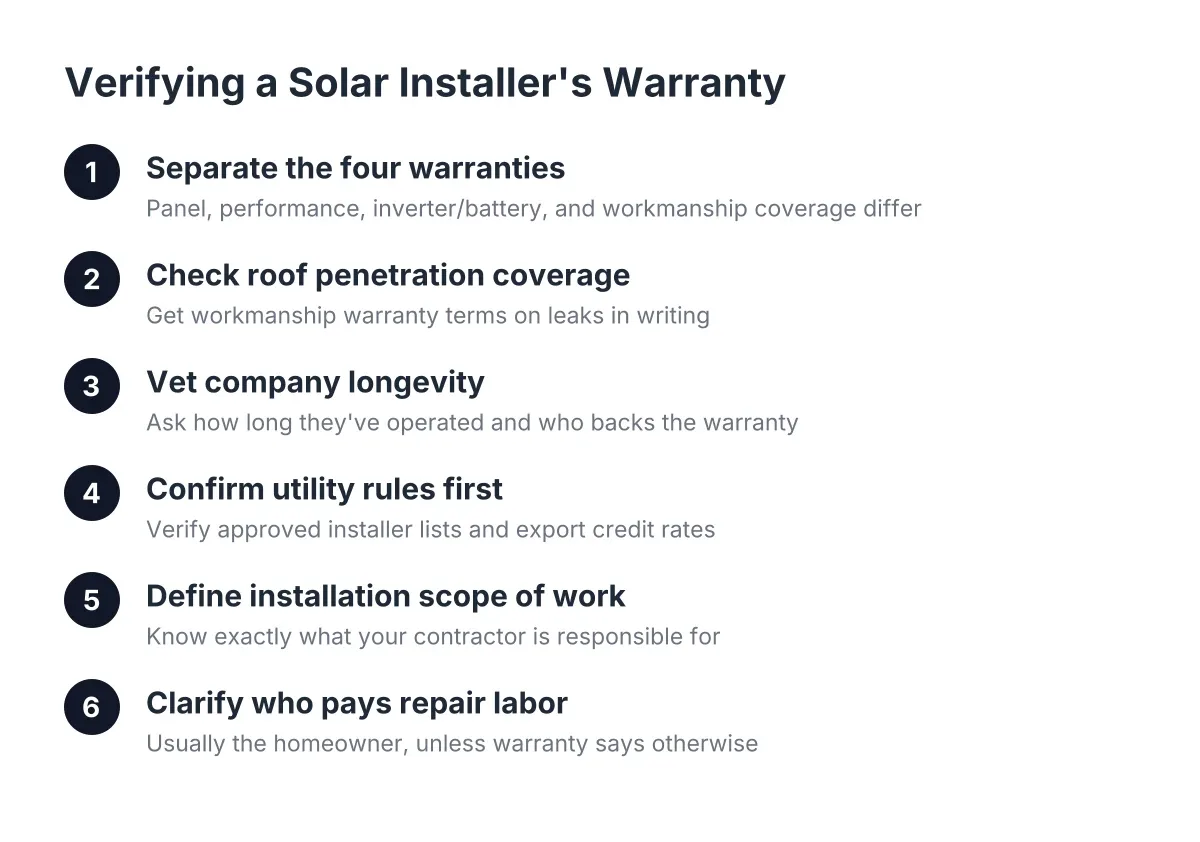
A 25-year workmanship warranty from a company founded 18 months ago is a promise written in disappearing ink. Solar contractors fail at a high rate, and when a company closes, the homeowner who financed a purchased system often inherits repair and maintenance responsibility for the rest of the warranty period. The panel manufacturer may still cover the hardware; nobody covers the labor to diagnose and swap it.
So weigh three things together: years in business under the same name, local installation volume in your utility's territory, and whether the equipment carries manufacturer-backed labor coverage that survives the installer. For home battery projects, ask whether the company is certified by the battery manufacturer, whether that is Tesla Powerwall, Enphase, or Generac PWRcell, because manufacturer certification usually determines who can perform warranty service later.
7. A Quote That Shows Its Math for Your Utility
The credential you can test most easily is honesty in the numbers. A fair quote in 2026 shows, line by line:
- System size in kW and estimated annual production in kWh, with the shading assumptions stated.
- Your utility named, with the current export credit or buyback rate used in the savings model, and its as-of date.
- Total price, any rebate assumptions, and who files the rebate paperwork.
- Financing terms in full if it is a loan, including any dealer fee built into the price.
- Warranty terms for workmanship, panels, inverter, and battery, each with its length.
For example, suppose a retired couple in Georgetown with a $280 summer bill gets two quotes. One models savings using "net metering" at the full retail rate. The other names Georgetown Utility Systems, states its current export credit with a date, and shows a payback estimate near 11 years with a note that the figure moves if rates change. The second company has shown you a credential no certificate can: it did the local homework. In that scenario, the first quote is not cheaper or more expensive yet; it is unverifiable, which is worse.
One more math point for 2026. The federal purchase credit for homeowner-owned systems, which historically returned 30% of system cost according to the Internal Revenue Service, has ended for purchases. A lease credit path survives for third-party-owned systems, which is one reason leases are being pitched harder. An installer still quoting the purchase credit on a cash sale in 2026 has failed the homework test.
8. Straight Answers About Leases, HOAs, and Poor-Fit Houses
The last credential is a willingness to say no. A solar lease works like an equipment lease, similar to a car lease; you pay a fixed monthly amount regardless of production, and you never own the system, according to the U.S. Environmental Protection Agency (EPA). For a retiree on a fixed income, a 20-year payment obligation deserves slow, skeptical reading, especially around what happens if you sell the house or pass it to your kids.
A trustworthy company will also tell you when solar is a poor fit: heavy oak shading, a roof due for replacement in five years, or usage under 600 kWh a month where the payback math simply does not close. It should know that Texas solar rights law limits how far an HOA can go, while HOAs can still require approved panel colors, parallel-to-roof mounting, and compliance with safety codes. And it should mention that Texas exempts residential solar from property tax increases, so the added home value does not raise your tax bill.
How Solar Panel Installers Compare Once the Credentials Check Out
Checking credentials narrows the field; it does not pick the winner. Get at least three written quotes from companies that passed every item above, and compare them on identical assumptions: same utility, same export rate, same usage history from your last 12 bills. Where quotes disagree on production estimates by more than about 10%, ask each company to explain the other's number. The one that can is usually the one that designed your system instead of templating it.
Expect the full process to take longer than the sales call implies. Between the site survey, engineering, permitting, utility review, installation, inspection, and permission to operate, weeks or a few months is normal in the Austin area, and the utility review step is the part no installer controls.
Finally, know your own limits. You can verify licenses, insurance, and buyback rates yourself. You cannot safely evaluate structural roof capacity or panel-to-grid wiring; that is what the licensed professionals and the utility's engineering review are for. If a quote still confuses you after the company explains it twice, that confusion is data. The right solar power installers make the math boring, the paperwork visible, and the decision yours.
If you are starting this process in Austin Energy, PEC, Oncor, Georgetown, Bluebonnet, or San Marcos territory, begin with your own utility's current export rate and rebate rules, then run every installer you talk to through the eight checks above. The guides on this site walk through each utility's numbers in plain English, with dates attached, so you can verify what you are told before you sign anything.
For help with solar with Austin Energy, Austin Solar FAQ is the place to start.
Prefer to talk it through? Call +15125571906 — a quick call is usually the fastest way to get a straight answer for your situation.