Solar Panel Installers — Complete Guide
Choosing between solar panel installers is the single biggest decision you'll make in your entire solar project. The panels matter less than you think, and the installer matters more than anyone in a sales pitch will admit. This guide covers how to vet residential solar panel installers in the Austin area, what a real consultation should look like, and why your utility territory changes which company is actually right for you. It comes from someone who has worked inside this industry and knows exactly where the shortcuts get taken. If you're comparing quotes right now, or about to request them, start here before you sign anything.
What You'll Find in This Guide
Coming soon — we're building out this topic cluster.
How to Vet Solar Panel Installers Before You Sign Anything
The Austin solar market is crowded, and not everyone in it deserves your roof. Texas installed 2.7 GWdc of solar capacity in the first quarter of 2025 alone, more than any other state and 92% more than second-ranked Florida, according to the Solar Energy Industries Association (SEIA). That growth attracts good companies. However, it also attracts sales organizations that subcontract the actual installation to whoever is cheapest that week.
Your first job is separating the two. Ask every company one direct question: who physically installs the system? Some firms employ their own crews, train them, and stand behind the work for decades. Others sell the contract and hand it to a third party you'll never meet until installation day. Neither model is automatically bad. That said, you need to know which one you're buying, because it changes who answers the phone when an inverter fails in year six.
Questions That Reveal Experience in Your Territory
In Texas, check that the company holds a Texas Electrical Contractor License through the Texas Department of Licensing and Regulation, and confirm the license is active, not just claimed on a website. Beyond that, ask how long the company has operated under its current name. Solar companies fold and relaunch under new names with unusual frequency. As a result, a "ten-year warranty" from a two-year-old company deserves scrutiny.
Then dig into local experience. A national installer might have thousands of installs, but few in your specific utility territory. For example, an installer who works mostly in Oncor's retail choice area may not know Austin Energy's interconnection process or its rebate paperwork. That gap costs you weeks of delays and sometimes real money. Ask for three recent addresses in your utility territory, not just three references. Happy customers from 2021 tell you nothing about how the company performs today.
Finally, pay attention to how the salesperson handles hard questions. A good rep answers "what happens if you go out of business" without flinching. A bad one changes the subject to how much your neighbor is saving. In practice, the quality of the answer predicts the quality of the install.
Why Your Utility, Not Your Zip Code, Decides Your Outcome
Here's what most guides and nearly every solar panel installation contractor's pitch gets wrong: they quote savings numbers as if Austin were one market. It isn't. The Austin area splits across at least six utility situations, including Austin Energy, Pedernales Electric Co-op, Oncor's retail choice territory, Georgetown Utility Systems, Bluebonnet, and San Marcos. Consequently, the same house with the same system produces very different financial results depending on who sends the bill.
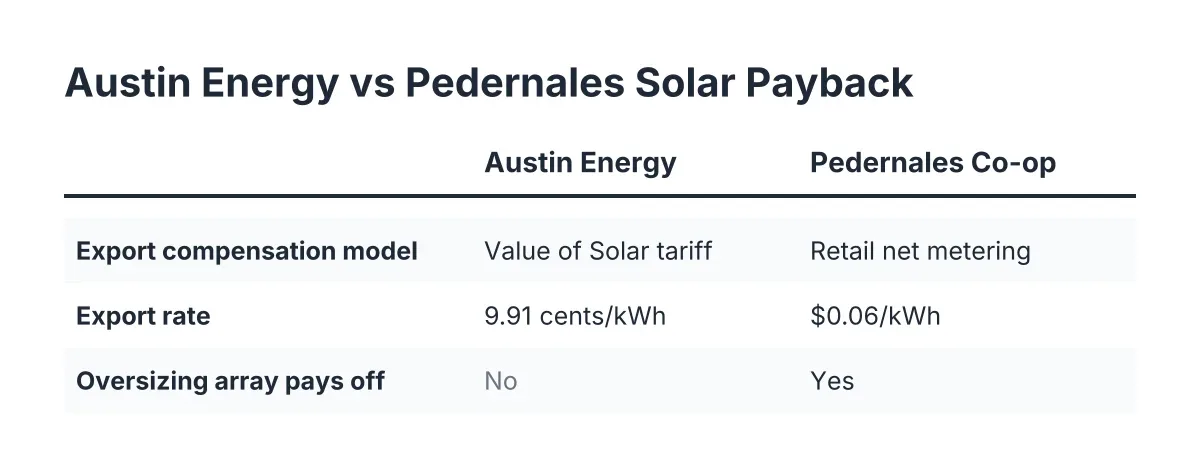
Consider the two biggest players. Austin Energy pays residential solar customers through its Value of Solar tariff at 9.91 cents per kWh for every unit of electricity the panels export, in place of retail-rate net metering, according to NuWatt Energy. Meanwhile, Pedernales Electric Cooperative offers full retail-rate net metering to its roughly 375,000 customers and credits solar exports at $0.06/kWh, per SolarSavingsAI. Those structures reward different system designs. Under one, oversizing your array might make sense. Under the other, it can be money thrown at the grid for pennies back.
The Territory Test for Any Installer You Interview
This gives you a fast, honest way to test any solar installation company. Ask the rep to explain, in plain terms, how your specific utility compensates exported power. Then ask how that shaped the system size they're proposing. If the answer is a generic "the utility buys back your extra power," you're talking to a script, not an expert. However, if they can walk you through your utility's actual rate, export credit, and interconnection timeline, you've found someone who does real work in your territory.
The same test applies to incentives. Rebates and programs vary by utility, and formal databases like DSIRE (Database of State Incentives for Renewables & Efficiency), maintained by the NC Clean Energy Technology Center, track Austin Energy's solar rebate programs alongside dozens of others. A competent local installer knows which programs apply to your address and handles the paperwork. Additionally, they'll tell you when a program's budget has run dry for the year, because pretending otherwise only creates an angry customer later. Experienced solar panel installers worth hiring will volunteer this territory-specific detail before you even ask.
What a Real Solar Consultation Should Look Like
The consultation is your best preview of the company. To put it simply, if the sales process feels rushed or evasive, the installation and service will feel worse. A legitimate solar panel consultation starts with your actual usage data, not a guess. The rep should ask for twelve months of electric bills, or pull usage directly from your utility account with your permission. Anyone who quotes a system size before seeing your consumption is designing for their commission, not your home.
Next comes the site assessment. Good companies evaluate your roof's age, orientation, shading, and structural condition before finalizing a design. Some do this remotely with satellite imagery, which works fine for an initial quote. However, someone qualified must verify conditions before installation day. If your roof needs replacement within five years, an honest installer says so now, because removing and reinstalling panels later costs thousands.
Pressure Tactics and How to Neutralize Them
Watch for three classic pressure moves. First, the "today only" discount, which almost always reappears if you say no. Second, the inflated utility inflation assumption, where savings projections assume electricity prices rise 5% or more every year to make the numbers look irresistible. Third, the vague answer on total system cost when the pitch centers entirely on monthly payments. Each tactic works because it rushes you past comparison shopping.
The counter is simple: never sign at the first meeting, and always get at least three quotes. As a result, the pressure evaporates and the honest companies rise to the top. They're the ones comfortable with you taking two weeks to decide. Beyond that, ask each company for the same information in the same format: total cash price, system size in kW, panel and inverter brands, estimated year-one production, and warranty terms for both equipment and workmanship. When quotes share a common structure, the outliers expose themselves.
One more thing worth asking about: what happens after installation. Who monitors the system? Who files the interconnection application with your utility?Additionally, who shows up if production drops? The best installers treat the install as the start of a relationship, not the end of a transaction.
Warranties, Service, and What Happens in Year Seven
Almost nobody thinks about year seven when signing a solar contract. You should, because that's roughly when the first service calls tend to happen and when the difference between installers becomes painfully visible. Panels themselves rarely fail. Inverters, monitoring systems, roof penetrations, and wiring connections are where real-world problems show up. Therefore, the workmanship warranty matters as much as the equipment warranty, and they are not the same thing.
Equipment warranties come from manufacturers and typically run 10 to 25 years depending on the component. Workmanship warranties come from the installer and cover the labor, the roof penetrations, and the quality of the install itself. Here's the catch: a workmanship warranty is only as durable as the company behind it. Consequently, a 25-year workmanship warranty from a company with thin margins and no service department is a marketing line, not a promise.
Questions That Separate Service Companies from Sales Companies
Ask how many people the company employs in service roles, as opposed to sales. Ask what a typical service call costs after the warranty period, and how quickly they respond to a production drop. Additionally, ask whether they monitor your system proactively or wait for you to notice a problem on your bill. The answers reveal whether you're hiring an installation company or a sales operation with an installation subcontractor.
Roof warranty coordination deserves its own question. Every solar install penetrates your roof, and a sloppy job voids some roofing warranties. For this reason, ask the installer to explain exactly how they flash and seal penetrations, and whether they coordinate with your roofing manufacturer's requirements. A company that installs hundreds of systems a year answers this in specifics. A company that resells other people's labor answers in generalities.
None of this requires you to become an engineer. It requires you to ask the same handful of pointed questions of every company that installs solar panels in your territory, then compare the answers side by side. The companies that welcome the scrutiny are the ones you can trust with a 25-year asset bolted to your house.
Ready to Get Started?
You now know more about vetting solar panel installers than most homeowners who have already signed contracts. Start by confirming which utility serves your address, then request quotes from at least three companies with real experience in that territory. Take your time, ask the hard questions, and let the honest installers prove themselves.