Solar With Austin Energy Terms Explained: A Plain-English Glossary
If you are reading solar quotes in Austin Energy territory and keep tripping over the same jargon, this page is for you. This solar with austin energy glossary defines the words that show up in quotes, bills, and contracts, in plain English, so you can read a proposal line by line and ask the right questions. Each entry stands alone, so you can skip straight to the term that confused you. None of this is official utility or government language; it is one experienced person translating.
- Value of Solar: how Austin Energy pays you for solar
- Export credit: money for power you send out
- Buyback rate: the price per exported kilowatt-hour
- Buy-all, sell-all: you sell every kilowatt-hour you make
- Interconnection: permission to connect to the grid
- Bidirectional meter: a meter that counts both directions
- Kilowatt (kW) vs. kilowatt-hour (kWh): power vs. energy
- Inverter: turns panel power into house power
- Home battery: stored power for outages or evenings
- Standby generator: fuel-powered backup, no panels needed
- Production estimate: how much your system should make
- Offset: how much of your usage solar covers
- Price per watt: the standard way to compare quotes
- Solar loan: borrowed money to buy the system
- Solar lease: paying to use a system you do not own
- Lease credit (48E): the federal tax path that survives for leases
- Purchase credit (25D): the ended federal credit for buyers
- Utility rebate: money the utility pays toward your system
How Austin Energy Pays You
These are the billing and paperwork terms specific to how your utility treats solar. Half the confusion in any solar with austin energy glossary request comes from this section, because Austin Energy does not use traditional net metering, and quotes written for other utilities get it wrong.
Value of Solar
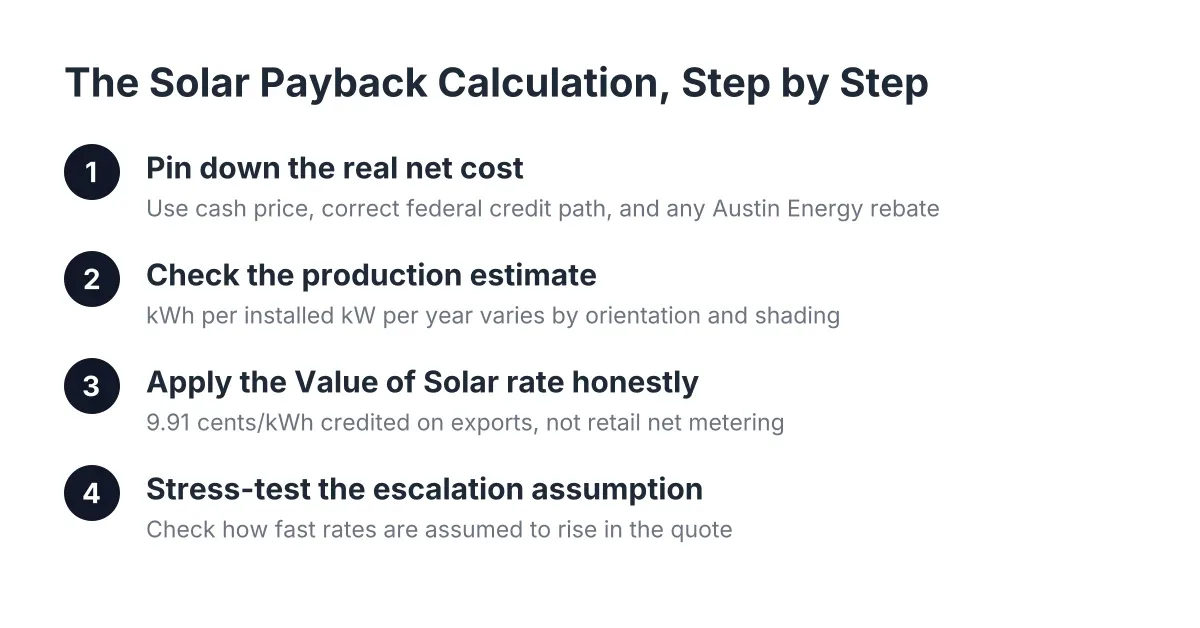
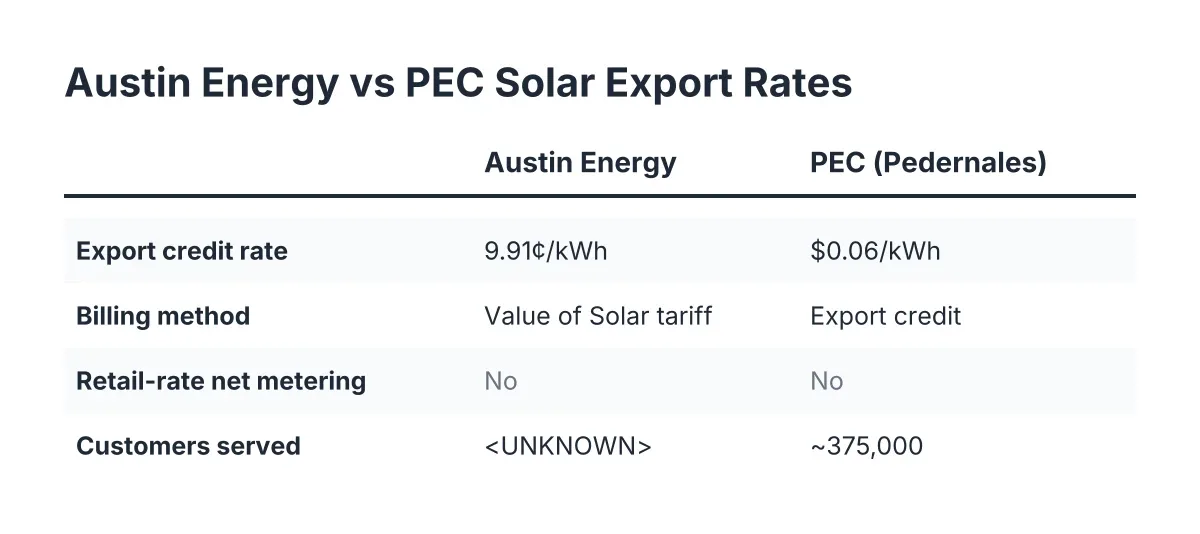
Value of Solar is Austin Energy's tariff that sets the rate you are paid for every kilowatt-hour your panels produce. It replaces traditional net metering: instead of your meter simply running backward, Austin Energy credits your production at its own published rate, which it updates over time. The rate can be higher or lower than what you pay for power, so your payback math depends on it. If a quote assumes one-for-one net metering in Austin Energy territory, that is a red flag. The mechanics are covered in detail in how Value of Solar buyback credits actually work.
Export credit
An export credit is the money or bill credit a utility gives you for electricity your solar system sends to the grid. Different utilities around Austin handle this differently, which is why the utility on your bill matters more than your zip code. Under Austin Energy's Value of Solar approach, you are credited for all production, not only the surplus. When a salesperson says "net metering" without naming your utility, ask them to say exactly how your exports are credited.
Buyback rate
A buyback rate is the price per kilowatt-hour a utility pays for solar power you export. Quotes and online guides often cite stale buyback rates, sometimes years old, and the rate drives your payback period directly. Always ask for the as-of date on any rate in a quote, and expect your numbers to differ from any example you read online, including here.
Buy-all, sell-all
Buy-all, sell-all is a billing arrangement where you sell every kilowatt-hour your panels produce to the utility and buy every kilowatt-hour your house uses at the retail rate. Austin Energy's Value of Solar works this way in effect: production is credited separately from consumption. This matters because the usual advice to "shift usage to sunny hours" does less for you here. Your savings come from the credit rate, not from avoiding purchases.
Interconnection
Interconnection is the utility's formal approval to connect your solar system to the grid. It involves an application, a technical review, and usually an inspection before you get permission to operate. Your installer typically handles the paperwork, but the timeline is the utility's, not the installer's. Ask any provider who files the interconnection application and how long Austin Energy approvals are running right now.
Bidirectional meter
A bidirectional meter is an electric meter that measures power flowing in both directions: into your house and out to the grid. The utility installs or reprograms it as part of interconnection, and your system cannot earn export credits without it. If your system is installed but the meter swap has not happened, you may be producing power with no credit for it. It is a fair question to ask before you sign: who schedules the meter change, and when.
Equipment
Kilowatt (kW) vs. kilowatt-hour (kWh)
A kilowatt (kW) measures power, the rate of energy flow at one moment, while a kilowatt-hour (kWh) measures energy, the total delivered over time. Your system size is quoted in kW; your bill and your Value of Solar credits are counted in kWh. Mixing the two up is the most common first-timer confusion, and some sales pitches lean on it. A 7 kW system does not make 7 kWh per hour all day; production rises and falls with the sun.
Inverter
An inverter is the device that converts the direct current (DC) your panels make into the alternating current (AC) your house and the grid use. Every solar system has one, either a single central unit (a string inverter) or small units under each panel (microinverters). The choice affects how shade on one panel impacts the rest and how easy future expansion is. A quote should name the inverter type and its warranty length.
Home battery
A home battery is a rechargeable unit that stores electricity for use during outages or in the evening. Under Austin Energy's billing, a battery is mostly an outage and backup decision, not a savings play, because your production is already credited whether you store it or not. That changes the math compared with utilities that pay little or nothing for exports. Decide what you actually want backed up, the whole house or a few circuits, before pricing one.
Standby generator
A standby generator is a fuel-powered unit, usually running on natural gas or propane, that starts automatically when the grid goes down. It is an alternative or a companion to a home battery: it runs as long as it has fuel, but it makes noise, needs maintenance, and does nothing for your electric bill. Some homeowners in the Austin area pair a modest solar system with a generator instead of a battery. It is a legitimate option, not a consolation prize.
Reading a Quote
Production estimate
A production estimate is the installer's projection of how many kilowatt-hours your system will make per year. It depends on your roof's direction, tilt, and shade, and honest estimates state their assumptions. Under Value of Solar, this number times the credit rate is the core of your savings, so an inflated estimate inflates everything downstream. Ask what software produced the estimate and whether shade was measured or guessed.
Offset
Offset is the percentage of your annual electricity use that your solar production is expected to cover. A 100 percent offset sounds tidy, but under Austin Energy's billing the right size depends on the credit rate versus the retail rate, not on hitting a round number. Bigger is not automatically better. An installer pushing maximum roof coverage should explain why that size pays, not just that it fits.
Price per watt
Price per watt is the total installed cost of a solar system divided by its size in watts, and it is the standard way to compare quotes. It lets you compare a 6 kW quote against an 8 kW quote on equal footing. It does not capture equipment quality, warranty terms, or workmanship, so use it as a starting point, not a verdict. Current local pricing is covered in solar installation costs in Austin Energy territory, with the as-of dates noted there; your numbers will differ.
Solar loan
A solar loan is borrowed money used to buy a solar system outright, repaid in monthly installments. You own the system from day one, which matters for incentives and for selling the house later. Watch for dealer fees baked into the loan, which raise the cash price to buy down the interest rate. Ask for the cash price and the financed price side by side; the gap tells you the real cost of the financing.
Solar lease
A solar lease is an arrangement where a company owns the system on your roof and you pay a monthly fee to use its power. You avoid the upfront cost, but you do not own the equipment, and the lease can complicate a home sale. Since the federal purchase credit ended, leasing became the main path to federal tax benefits, which the leasing company claims and may or may not pass through in pricing. Read the escalator clause: a payment that rises every year can erase the savings.
Incentives and Credits
Lease credit (48E)
The lease credit is the surviving federal tax credit, under section 48E, that a solar leasing company can claim when it owns the system on your roof. You do not claim it yourself; the leasing company does, and competitive pricing should reflect some of that value. This is why lease pricing can look better than loan pricing on paper after the purchase credit ended. Ask how much of the credit shows up in your monthly payment.
Purchase credit (25D)
The purchase credit was the federal tax credit, under section 25D, that homeowners who bought their systems could claim directly, and it has ended. If a quote or an older article still counts it in your payback math, the numbers are stale. Its end shifted the buy-versus-lease decision, which is part of why 2026 quotes look different from 2023 ones. Any figure you see tied to it needs an as-of date, and your numbers will differ.
Utility rebate
A utility rebate is money the utility pays toward the cost of your solar system, usually with conditions such as using an approved installer or completing a required step first. Austin Energy has offered residential solar rebates with such conditions; amounts and rules change, so check the current terms with their as-of dates and expect your numbers to differ. How rebates combine with federal credits is laid out in stacking federal and utility incentives in 2026. A quote that lists a rebate should also state the condition attached to it.
Using These Terms
What this solar with austin energy glossary gives you is the vocabulary to read a quote line by line instead of trusting the summary page. You can now ask what export crediting a proposal assumes, whether the production estimate measured your shade, and who files the interconnection paperwork. Solar with Austin Energy follows its own rules, and knowing the words is how you catch a quote written for somebody else's utility.
For help with solar with Austin Energy, Austin Solar FAQ is the place to start.
Prefer to talk it through? Call +15125571906 — a quick call is usually the fastest way to get a straight answer for your situation.