Solar with Austin Energy — Complete Guide
If you are researching solar with Austin Energy, the single most important fact is this: the utility on your bill, not your town or your installer, decides how your panels pay back. This guide covers the whole Austin area in 2026, organised by utility territory, because a home in Pflugerville on Austin Energy has a completely different solar outcome than a neighbour two streets over on Oncor. Here you will find plain-English explanations of the Value of Solar tariff, export credits, batteries, rebates, and how to read a quote without getting played. Every claim comes from someone with hands-on residential solar experience in this market, not a national template quoting 2022 rates.
What You'll Find in This Guide
- Solar With Austin Energy in Austin, TX
- Solar With Austin Energy in Buda, TX
- Solar With Austin Energy in Kyle, TX
- Solar With Austin Energy in Leander, TX
- Solar With Austin Energy in Georgetown, TX
- Solar With Austin Energy in Hutto, TX
- Solar With Austin Energy in Cedar Park, TX
- Solar With Austin Energy in Pflugerville, TX
- Solar With Austin Energy in Round Rock, TX
- Solar With Austin Energy in Bastrop, TX
- Solar With Austin Energy in Lakeway, TX
- Solar With Austin Energy in Dripping Springs, TX
- Solar With Austin Energy in San Marcos, TX
- Solar With Austin Energy in Bee Cave, TX
Prefer to have a pro handle it? Solar with Austin Energy is one call away.
How Solar With Austin Energy Pays You Back
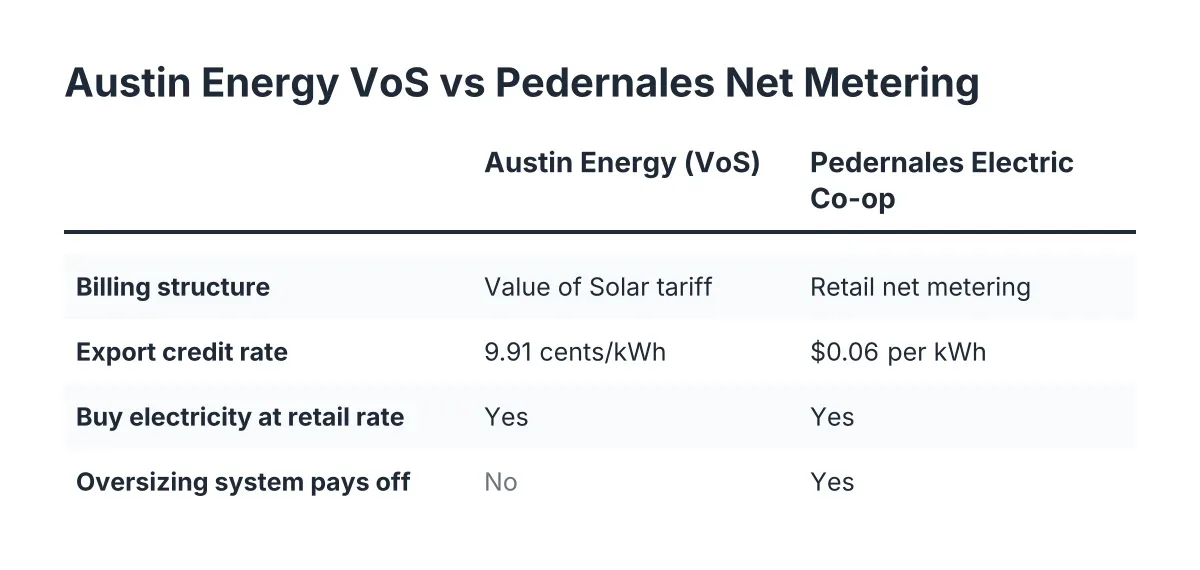
Austin Energy does not use net metering. That surprises almost everyone who starts researching, because national solar sites assume net metering by default. Instead, Austin Energy runs a Value of Solar tariff, usually shortened to VoS. Under this model, you still buy every kilowatt-hour your home consumes at the normal retail rate. Separately, the utility credits you for every kilowatt-hour your panels produce.
According to NuWatt Energy, Austin Energy's Value of Solar tariff pays residential solar customers 9.91 cents per kWh for exported electricity, in place of retail-rate net metering. That single number shapes everything. It determines whether a bigger system makes sense, whether a battery improves your economics, and whether the payback estimate on a sales proposal holds up.
In practice, the VoS structure has two big consequences. First, self-consumption matters less than it does under some other utilities, because the credit rate applies to your production rather than netting against usage hour by hour. Second, any installer proposal that models your savings using retail-rate net metering is wrong for an Austin Energy home. That error can inflate projected savings by thousands of dollars over the life of a system. The full mechanics, including how the credit appears on your bill and how the rate gets reviewed, live in the core guide to solar with Austin Energy in Austin, TX.
What Makes Austin Energy Solar Economics Different
Homeowners often obsess over panel brands and efficiency ratings. However, the tariff moves your payback far more than any hardware choice. A mid-tier panel under a well-understood tariff outperforms a premium panel sized wrong for the VoS model. For example, homeowners in Lakeway and Bee Cave on Austin Energy bills face the same VoS math as central Austin, even though door-to-door pitches in those areas often skip it entirely. With this in mind, always ask any installer to show which tariff their savings model assumes. If they cannot answer, keep shopping.
Your Utility, Not Your Town, Decides the Outcome
Here is the mistake that costs Austin-area homeowners the most money: assuming your city name tells you which solar rules apply. It does not. Utility boundaries in Central Texas ignore city limits, and the differences between utilities are enormous. Two houses on the same street can sit in different territories, with different export rates, different rebates, and different interconnection processes.
For example, Pedernales Electric Cooperative serves roughly 375,000 customers across the region and offers full retail-rate net metering, crediting solar exports at $0.06/kWh, according to SolarSavingsAI. That is a fundamentally different deal from Austin Energy's VoS structure. Meanwhile, homes in Oncor territory buy power through retail electric providers, so their solar buyback depends on which plan they choose. Georgetown Utility Systems, Bluebonnet, and San Marcos each run their own rules on top of that.
This is why several guides on this site exist mainly to deliver bad news kindly. Most of Kyle is not Austin Energy territory. Neither is most of Bastrop or Dripping Springs, where Pedernales Electric usually sends the bill. Similarly, Georgetown homes mostly fall under Georgetown Utility Systems or PEC. Knowing that before a salesperson arrives protects you from a proposal built on the wrong assumptions.
Border Towns Where Both Answers Are Common
Some cities genuinely split between utilities. In Round Rock, Leander, Hutto, and San Marcos, your neighbour's solar experience may tell you nothing about your own. As a result, the first step for any homeowner in these areas is simple: pull out your electric bill and read the utility name at the top. Then read the guide that matches that utility. Cedar Park illustrates the point well, because going solar there is a different decision than next door in Leander, despite the shared border. The same applies to Buda and Pflugerville, where Austin Energy serves some homes but not all.
Batteries, Rebates, and Reading Your Solar Quote
Texas leads the country in solar growth. The state installed 2.7 GWdc in the first quarter of 2025 alone, 92% more than second-ranked Florida, according to the Solar Energy Industries Association. That growth brings competition, which helps you. However, it also brings a flood of national sales operations that do not know Central Texas tariffs. Three areas deserve your attention before you sign anything.
First, batteries. Home storage from Tesla Powerwall, Enphase, or Generac PWRcell changes your solar math under a VoS tariff, because stored energy shifts when and how you consume your own production. Beyond that, batteries provide backup during outages, which matters after the grid failures Texans remember well. Whole-house standby generators fill a similar role for homeowners who want backup without the solar pairing. Neither is automatically the right choice. The right answer depends on your utility, your usage pattern, and your outage tolerance.
Second, incentives. Austin Energy has historically run residential solar rebate programmes alongside its multifamily and commercial offerings, which the DSIRE incentives database maintained by the NC Clean Energy Technology Center tracks and formally lists. Rebate budgets and requirements change, so verify the current programme status directly before you build it into your payback math. Federal tax credit rules also shift, and a quote that bakes in an incentive you cannot claim is a quote you should question.
How to Compare Quotes Without Getting Played
Third, the quotes themselves. Solar proposals vary wildly in how they present price, production, and savings. To put it simply, compare the price per watt, the assumed export rate, and the annual production estimate across every quote. If one proposal assumes net metering on an Austin Energy home, discard it. If a financing offer buries dealer fees in the loan, ask for the cash price and calculate the difference yourself. Leases and loans each have legitimate uses, but only when the underlying tariff assumptions are honest. This site never claims independence from the industry, and it never claims affiliation with any utility or government. What it offers is the current, local answer in a market full of stale suburb guides and national templates.
Frequently Asked Questions
What are the incentives for installing solar panels with Austin Energy?
Austin Energy pays 9.91 cents per kWh for exported electricity through its Value of Solar tariff, rather than retail-rate net metering. Rebate programmes tracked in the DSIRE database may apply, but budgets and eligibility change—confirm current status with Austin Energy before counting on a rebate. The federal solar tax credit may also apply depending on current rules and your tax situation.
How much does solar installation cost in Leander, TX with Austin Energy?
Costs depend on which utility serves your address, since Leander splits between territories and your utility sets your export rate. System size, roof complexity, equipment choice, and financing method drive price more than location does. The Leander guide helps you evaluate local quotes against your actual tariff.
Does Austin Energy offer net metering for solar customers?
No. Austin Energy uses a Value of Solar tariff instead, crediting production at a set rate while you buy consumption at retail rates. Any savings model built on net metering assumptions is incorrect for Austin Energy homes. Always confirm which tariff your installer's model uses.
What if my home is not in Austin Energy territory?
Different rules apply. Pedernales Electric offers retail-rate net metering at $0.06/kWh for roughly 375,000 customers, while Oncor territory customers choose retail providers with varying buyback plans. Check your city's guide and confirm the utility name on your actual bill.
Is a battery worth adding to a solar system on Austin Energy?
Sometimes. Under the Value of Solar tariff, a battery's main value comes from shifting your consumption and providing outage backup. Tesla Powerwall, Enphase, and Generac PWRcell fit different needs and budgets. Run financial scenarios with and without storage rather than accepting bundled quotes at face value.
How do I know if a solar quote is fair?
Compare price per watt, assumed export rate, and annual production across at least three quotes. Ask for the cash price on financed offers to see dealer fees. A fair quote names your actual tariff and models it correctly.
Ready to Get Started?
Start with your electric bill, not a sales call. Find the utility name at the top, then open the guide above that matches your city and territory. Ten minutes of reading now will save you from the most expensive mistake in Central Texas solar: signing a contract built on the wrong utility's math.