Solar Payback Timeline in Austin: Calculating ROI on Austin Energy’s 2026 Rates
If you have two or three solar quotes sitting in your inbox, each one probably promises a different payback year. One says seven years. Another says eleven. The honest answer to your solar payback timeline in Austin depends on numbers the sales reps rarely show side by side: Austin Energy's Value of Solar rate, your actual usage pattern, the real price per watt you are being charged, and whether the federal credit math in the proposal is from 2024 or from today. Understanding the solar payback calculation with current figures helps you run it yourself before you sign anything.
One note before we start. I work in this industry. This site is not an installer, not a directory, and not a lead generator, and nothing here is affiliated with Austin Energy or any government program. Every dollar figure below carries its as-of date, and your numbers will differ from every example on this page.
How Austin Energy Pays You, and Why It Changes the Math
Austin Energy does not offer retail-rate net metering. It uses a Value of Solar tariff instead, and this one fact reshapes the entire solar payback timeline for Austin homeowners compared to what national calculators assume.
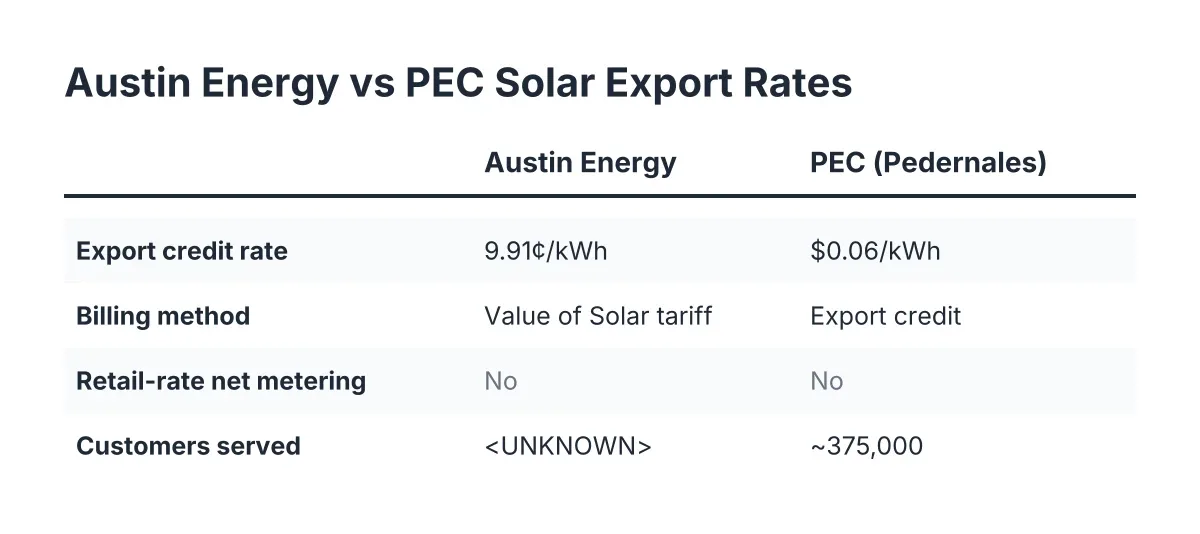
Here is how it works. Your meter tracks everything your panels produce. Austin Energy credits all of that production at the Value of Solar rate, and you buy all of your consumption at the regular retail rate. The two transactions happen on paper at the same time. According to Austin Energy, the Value of Solar rate is 12.89 cents per kWh for systems under 1 MW-AC, effective October 1, 2026, credited on all production in place of retail-rate net metering. Austin Energy reviews the rate, so confirm the current number on your own bill before you model anything. Your numbers will differ.
Why does this matter for payback? Because most national payback calculators assume net metering, where every kWh you send to the grid offsets a kWh you buy at full retail price. Under net metering, oversizing a system costs you little. Under Value of Solar, the credit rate and the retail rate are different numbers, and the gap between them changes how much each panel is worth to you.
For contrast, Pedernales Electric Cooperative, which serves parts of the Austin area, credits surplus solar sent to the co-op at 7.1921 cents per kWh, only toward its Base Power Charge, with unused credits expiring at calendar year-end, according to PEC. Different utility, different rules, different payback. The utility on your bill, not your zip code, decides your outcome. That is why this site organizes everything by utility territory.
In addition, the Value of Solar structure has one upside that salespeople undersell: because Austin Energy credits all production rather than only exports, your payback does not depend on timing your dishwasher to run at noon. The rate is what it is, whether you consume the power or export it.
Understanding the Solar Payback Calculation Step by Step
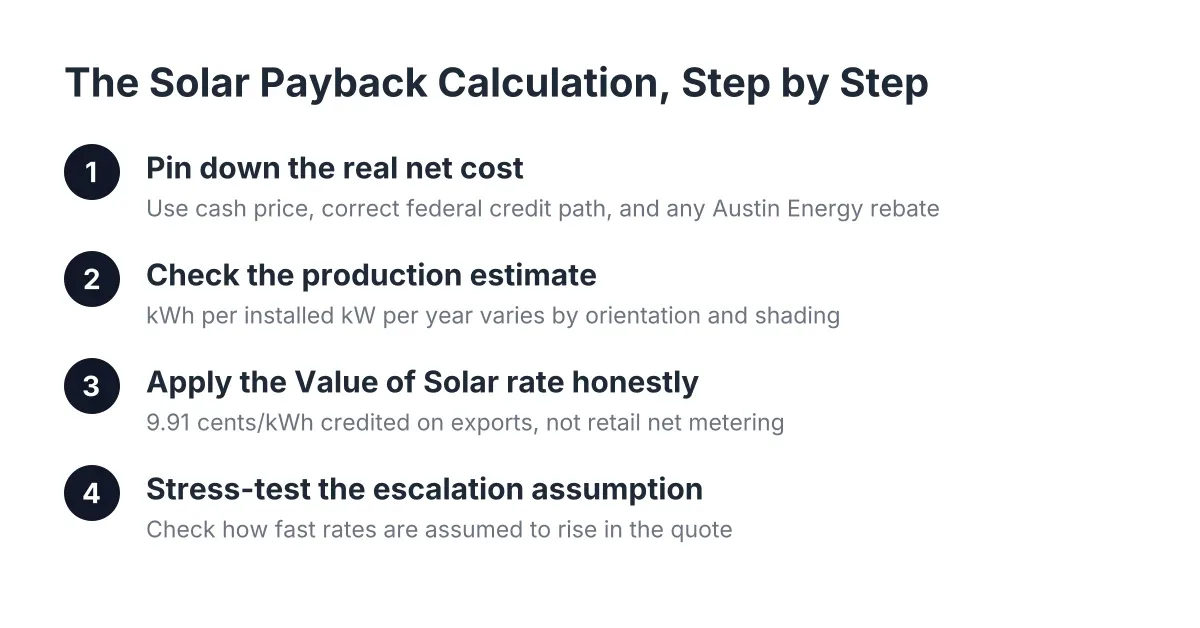
The solar payback calculation has four inputs. Get these four right and you can check any quote in your inbox in about twenty minutes with a spreadsheet.
- Net system cost. The contract price minus any rebate and any surviving federal credit that actually applies to your deal.
- Annual production. The kWh per year your specific roof will generate, which depends on orientation, shading, and system size.
- The credit rate. For Austin Energy residential customers, the Value of Solar rate, 12.89 cents/kWh for systems under 1 MW-AC, effective October 1, 2026 per Austin Energy.
- Annual rate escalation. How fast Austin Energy's rates and the Value of Solar rate change over time. This is the number quotes most often inflate.
Divide net cost by first-year dollar savings, adjust for escalation, and you have a payback year. The sections below walk through each input, because each one is a place where a quote can quietly tilt the answer.
Step One: Pin Down the Real Net Cost
Start with the gross contract price, not the monthly payment. A monthly payment hides the dealer fee baked into most solar loans, which can add 20 to 30 percent to the cash price. If two quotes show the same monthly payment but different system sizes, one of them is carrying a larger hidden fee. Ask every installer for the cash price and the financed price on the same sheet of paper.
Next, handle the federal credit correctly, because this is where 2026 proposals go wrong most often. A federal tax credit of 30 percent has historically applied to the total cost of a residential solar installation, according to the Internal Revenue Service. The purchase credit, the old 25D path for homeowner-owned systems, has ended. The lease credit, the 48E path, survives for third-party-owned systems; the leasing company claims it and may or may not pass savings to you in the lease rate. If a 2026 quote for a system you would own still shows a 30 percent credit deduction, that is a dated proposal, and the payback year printed on it is wrong.
Then subtract any Austin Energy rebate you qualify for. Austin Energy has run residential solar incentive programs, tracked in the DSIRE incentives database maintained by the NC Clean Energy Technology Center. Rebate amounts and requirements change, and most require you to complete Austin Energy's solar education course and use a participating installer. Confirm the current rebate directly with Austin Energy before you plug it into your math. Your numbers will differ.
Step Two: Check the Production Estimate
Production drives payback more than price does. A system that produces 1,500 kWh per installed kW per year pays back faster than an identical-priced system producing 1,250, and both numbers show up on real Austin roofs. South-facing, unshaded roof planes produce the most. East and west faces produce 10 to 20 percent less. Shade from a live oak can take another large bite.
Therefore, compare the production estimates across your quotes, not just the prices. Divide each quote's estimated annual kWh by its system size in kW. If one installer projects 1,600 kWh per kW on a roof where the others project 1,350, someone is being optimistic, and optimism in the production line becomes years added to your real payback. Free tools like PVWatts let you run your own estimate from your address.
Step Three: Apply the Value of Solar Rate Honestly
Multiply your annual production by the Value of Solar rate to get first-year dollar savings. Using the 12.89 cents/kWh figure effective October 1, 2026, an 8 kW system producing 11,500 kWh per year generates about $1,480 in first-year credits. That is an illustrative estimate, not a quote; your production, your rate, and your bill will differ.
However, watch what rate the proposal uses. Some quotes apply the full retail rate to all production, which is net metering math applied to a utility that does not offer net metering. That single substitution can shave two to four years off the printed payback. Ask the installer directly: what credit rate per kWh does this proposal use, and where did it come from?
Step Four: Stress-Test the Escalation Assumption
Every proposal projects savings over 25 years, and the engine behind those big cumulative numbers is an assumed annual utility rate increase. Some proposals assume 4 or 5 percent escalation every year. Check that assumption against Austin Energy's actual rate history rather than accepting it at face value. If the proposal will not show you the escalation rate it used, that is a red flag by itself.
Escalation does cut both ways, and this part is legitimate. Utility rates tend to rise faster than panel output degrades, so the value of your savings grows over the system's life even as production slowly declines. A loan payment that exceeds your bill savings in year one can still win over 20 years for exactly this reason. The question is not whether to include escalation, but whether the number used is defensible.
A Worked Example: What the Solar Payback Timeline Looks Like for a High-Usage Austin, TX Home
Suppose a homeowner in Circle C has a 2,400 square foot house with a pool pump and an EV, and an Austin Energy bill averaging $280 a month. Say three quotes arrived last week: a 9 kW system at $27,000 cash, an 11 kW system at $31,000 cash, and a lease at $165 a month. This scenario is hypothetical, built to show the math; your numbers will differ.
Run the 9 kW system. At 1,400 kWh per kW on a decent south-facing roof, it produces about 12,600 kWh per year. At the Value of Solar rate of 12.89 cents/kWh effective October 1, 2026, that is roughly $1,620 in first-year credits against the bill. Divide $27,000 by $1,620 and the simple payback is about 17 years before escalation, and somewhat shorter once modest rate growth compounds the savings. If an Austin Energy rebate applies and brings the net cost down, the timeline shortens accordingly.
Compare that against the lease. A solar lease works like an equipment lease, similar to a car lease, where you pay a fixed monthly amount regardless of production, according to the U.S. Environmental Protection Agency. The EPA also notes that with both leases and power purchase agreements the building owner never owns the system. No upfront cost, but also no asset at the end, and the payback question becomes a different question: does the monthly lease payment plus your remaining Austin Energy bill beat your current bill? Often the answer in year one is barely, and the long-term win depends entirely on the lease escalator clause.
For the serious spreadsheet builder, the better comparison is net present value. Model the cash purchase, the loan, and the lease against what the same money would earn in an index fund over the same period. A loan can beat cash on net present value because you keep your capital working while the bill savings cover the payments. Payback year is the headline number, but NPV is the decision number.
Why Payback Timelines in Austin Vary So Much Between Quotes
Two installers quoting the same roof should land within a year or two of each other on payback. When they land five years apart, one of these levers is being pulled:
- Different credit rates. One uses the Value of Solar rate, the other uses full retail. This is the single biggest distortion in Austin Energy territory quotes.
- Different escalation assumptions. A 5 percent annual escalator versus 2.5 percent roughly doubles the projected 25-year savings.
- Hidden dealer fees. The financed price is divided by cash-price savings, making the loan look as cheap as cash.
- Optimistic production. Shading losses understated, or degradation ignored.
- Stale incentives. A 30 percent purchase credit applied to a 2026 owner-purchased system, or a rebate figure from an old program year.
As a result, the fastest way to compare quotes is to normalize them yourself. Put every quote's gross price, net price, system size, annual production estimate, credit rate, and escalation rate into one table. The installer whose numbers survive that table without adjustment is the one worth a second conversation.
One more honest caveat. If your Austin Energy bill runs under $100 a month and your usage is flat, the solar payback timeline for your Austin home may stretch past 20 years, and solar is probably a poor fit. The math rewards high-usage households. It does not reward small bills.
Does a Home Battery Help or Hurt the Payback?
In Austin Energy territory, a home battery usually lengthens the payback timeline rather than shortening it. Because Value of Solar credits all production at one rate, there is no rate arbitrage to capture by storing power and exporting later. A battery here is a resilience purchase, not a payback purchase, and a proposal that folds a battery into the solar payback math is blending two different decisions.
That said, resilience is a real reason. Texans experienced a 17 percent increase in power outage frequency between 2017 and 2022, a trend Tesla cites as a driver for home battery adoption in Texas. If backup power matters to your household, price the battery as its own line item and judge it on outage protection, not on ROI. For whole-home backup across multi-day outages, a standby generator is sometimes the cheaper tool for the job; compare both before assuming the battery.
The same separation applies to premium products. A Tesla Solar Roof, for example, is a roofing decision bundled with a solar decision, and its payback math will never compete with conventional panels on the same house. If a quote includes one, evaluate the roof replacement value and the solar value as two separate purchases.
What the Process and Timeline Look Like Once You Sign
Payback starts when the system turns on, not when you sign, so the interconnection timeline is part of your ROI. Expect this sequence in Austin Energy territory in 2026:
- Design and engineering review. Utilities that support residential solar interconnection commonly require engineering documentation and drawings for review before installation is approved, according to Arizona Public Service, and Austin Energy's process follows the same pattern. Allow two to four weeks.
- HOA approval, if applicable. Texas law limits what HOAs can block, but the paperwork still takes time. Budget two to six weeks in a slow association.
- Permitting. City of Austin permitting varies with workload.
- Installation. A typical crew finishes a residential roof in one to three days.
- Inspection and permission to operate. The city inspects, Austin Energy swaps or reprograms the meter, and the system goes live. This final step commonly takes two to six weeks after installation.
Therefore, if a salesperson pressures you to sign this week because a rebate or credit expires soon, check whether the full timeline, often two to four months end to end, even fits before the stated deadline. Deadline pressure attached to a timeline that cannot be met is a sales tactic, not a fact.
Reading Your First Post-Solar Bill Without Panic
A common post-install surprise: the bill does not drop to zero. Under Value of Solar, you still buy all your consumption at retail and receive credits for all production at 12.89 cents/kWh effective October 1, 2026. In a hot August with the AC running, consumption can outpace production value, and a bill arrives. That is the tariff working as designed, not a broken system.
For example, if your bill stays stubbornly high after install, check three things in order. First, confirm the system is producing what the proposal projected; monitoring apps show this. Second, check whether your usage rose after install, which happens with new EVs and pool seasons. Third, confirm the Value of Solar credit is appearing on the bill at all, since interconnection paperwork errors do happen in the first billing cycle.
Scale is on your side here. Texas had 34,907 megawatts of solar installed as of Q2 2024, enough to power about 4 million homes according to Go Solar Texas, so the interconnection process is well worn. Billing errors get fixed; they just require you to read the bill.
The Bottom Line on Payback in Austin Energy Territory
Solar with Austin Energy pays back on a different clock than solar in net metering territory, and any quote that ignores the Value of Solar tariff is quoting a different utility's math. For a high-usage household with a good roof and a current rebate, realistic paybacks in 2026 tend to land in the low-to-mid teens in years, shorter with strong incentives, longer with shade or financing fees. Those are illustrative ranges, not promises; your roof, your rate, and your contract will set your actual number.
Run the four-input calculation on every quote you hold. Demand the credit rate, the escalation assumption, the cash price, and the production estimate in writing. The installer who hands those over without flinching is telling you something the printed payback year cannot.
Finally, know the limits of a spreadsheet. Roof condition, panel placement around vents and shade, and electrical panel capacity all need a professional site assessment, and a structural or electrical surprise can move the numbers. The math in this guide gets you to an informed conversation. The site visit finishes the job.
For help with solar with Austin Energy, Austin Solar FAQ is the place to start.
Prefer to talk it through? Call +15125571906 — a quick call is usually the fastest way to get a straight answer for your situation.