Energy Efficient Home Improvement Credit 2026: Solar vs. Other Upgrades in Austin
If you have two or three solar quotes in your inbox, at least one sales rep has probably told you about a tax credit. Here is the problem: the federal energy efficient home improvement credit landscape changed hard going into 2026, and most of the scripts have not caught up. The old 30% purchase credit for homeowner-owned solar is gone. The separate credit for insulation, heat pumps, and windows is gone too. What survives is narrower, and the solar tax credit 2026 situation depends on how you finance the system and which utility sends your bill.
I work in residential solar in the Austin area. I am not an installer, not a directory, and not a lead service. This is a plain-English walkthrough of what the energy efficient home improvement credit situation actually looks like in 2026, how solar compares with other upgrades like insulation and heat pumps now that the federal math changed, and how to pressure-test the credit claims in the quotes you are holding.
What Happened to the Energy Efficient Home Improvement Credit
The energy efficient home improvement credit, known in IRS language as the Section 25C credit, covered things like insulation, exterior doors, windows, and heat pumps. It was a separate credit from the solar one. Both ended for homeowners after 2025, and in 2026 neither is available the way your quotes may assume.
Two federal credits mattered to homeowners, and people mix them up constantly:
- Section 25C, the energy efficient home improvement credit. This covered insulation, air sealing, heat pumps, efficient water heaters, windows, doors, and home energy audits. It expired for homeowners after 2025.
- Section 25D, the residential clean energy credit. This is the one solar reps mean when they say "the 30% credit." According to the Internal Revenue Service, a 30% federal tax credit has historically applied to the total cost of a residential solar installation. I call this the purchase credit. It also ended for homeowner-purchased systems.
So if a quote dated 2026 shows a line item for a 30% federal "solar tax refund" on a system you would own outright, stop and ask questions. The purchase credit is not available for new homeowner purchases in 2026. A rep who builds your payback math on it is either behind on the rules or hoping you are.
One path survives, and it changes the lease-versus-loan conversation. More on that below.
How the IRS Handled the Solar Tax Credit in 2026 and Beyond
Homeowners claimed both credits on IRS Form 5695, Residential Energy Credits, filed with their federal return. If you installed solar or completed qualifying work in 2025 and have not filed yet, Form 5695 is still how you claim it for that tax year. People also ask how the IRS verifies a solar credit. In practice you self-report on Form 5695 and keep your contract, invoices, and proof of payment in case of audit. You do not mail receipts with your return, but you do need them if asked.
I spell this out because a common sales line in early 2026 is "you can still file for it." That is true only if your system was placed in service during an eligible year. It is not true for a contract you sign today for a system you would own. Dates matter, and your tax professional, not your solar rep, is the right person to confirm your specific eligibility.
The Lease Credit: The One Federal Path Still Standing in 2026
Here is the part most of the stale guides miss. While the homeowner purchase credit ended, a commercial credit structure under Section 48E continues. When a leasing or financing company owns the system on your roof, that company can claim the credit itself, because it is a commercial entity that owns the equipment. I call this the lease credit, and in 2026 it is the remaining way the solar tax credit applies to residential systems.
In a lease or power purchase arrangement, you do not own the system. According to the U.S. Environmental Protection Agency, both solar PPAs and solar leases let a building owner get a solar system installed with no upfront cost, but in neither arrangement does the building owner actually own the system. The EPA also describes a solar lease as working like an equipment lease, similar to a car lease: you pay a fixed monthly amount for use of the panels regardless of production.
What this means for your quote comparison:
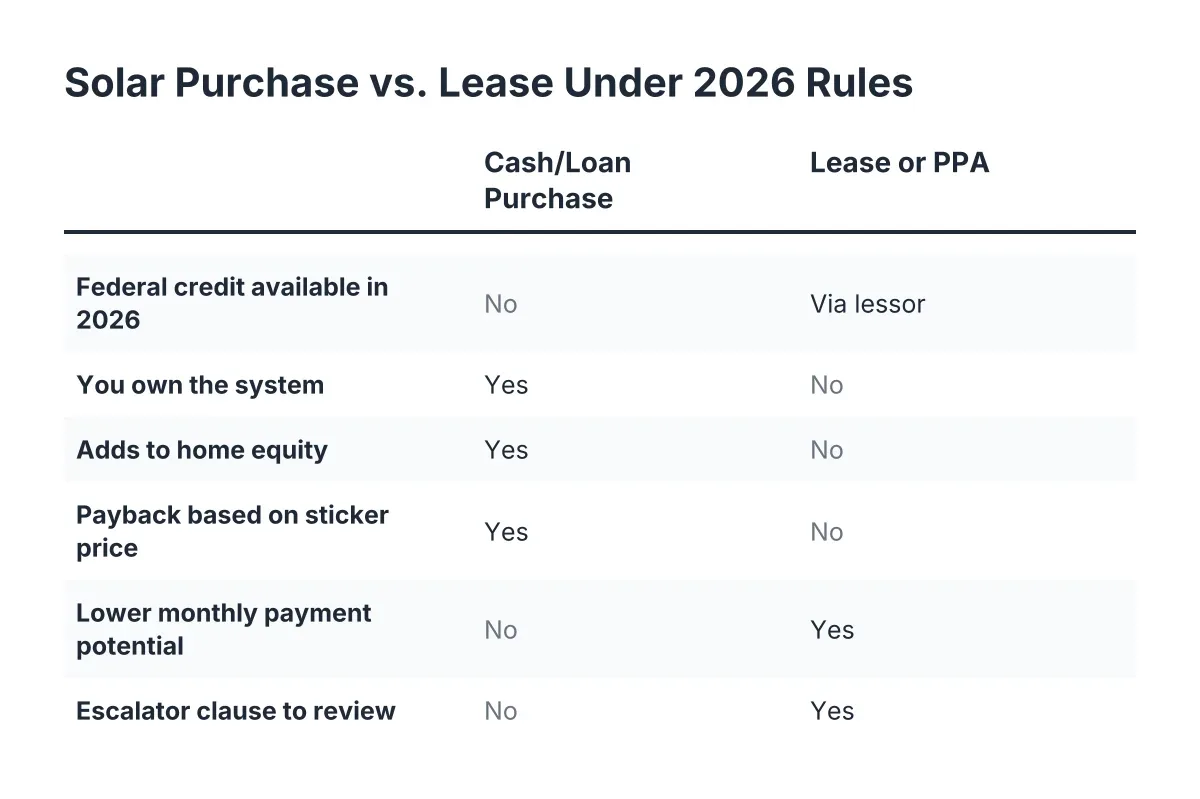
- Cash or loan purchase in 2026: no federal credit for you. Your payback math runs on the sticker price, your utility's export credit, and any local rebate.
- Lease or PPA in 2026: the financing company claims the lease credit. A well-structured lease should pass some of that value through as a lower monthly payment. Whether it actually does is the question to ask, in writing.
- Trade-off: with a lease you give up ownership, the system does not add to your home equity the same way, and you need to read the escalator clause and the transfer terms carefully before you sign. Ask what happens if you sell the house in year six.
If one of your three quotes is a lease with a monthly payment that looks too good next to the loan quotes, this is usually why. The lease priced in a credit the loan cannot. That does not automatically make the lease the better deal over 25 years. Run both to year 25, not year one.
Solar vs. Other Energy Efficient Home Improvements: Where the Math Lands Now
With both federal credits gone for homeowner purchases, solar and efficiency upgrades now compete on the same footing: local rebates, utility programs, and raw bill savings. For a lot of Austin-area homes, the right sequence in 2026 is efficiency first, solar second, and here is the reasoning.
Every kilowatt-hour you stop wasting is a kilowatt-hour you do not have to generate. Tighten the attic insulation, seal the ducts, and swap an aging resistance water heater for a heat pump unit, and your usage drops immediately. A smaller usage number means a smaller solar system, which means a lower upfront cost and a shorter payback. Suppose a homeowner in Buda with a $320 summer bill cuts usage 15% through insulation and duct sealing. The solar system she then needs might drop from roughly 11 kW to roughly 9 kW, which at an illustrative $2.80 per watt saves around $5,600 before she signs anything. Those are estimates; your numbers will differ.
For heat pumps, insulation, efficient appliances, and panel upgrades, the move in 2026 is to look at utility and local programs instead of the expired federal credits. Austin Energy runs efficiency rebate programs for its customers, and the other utilities in the region have their own offerings that change year to year. Check your utility's current program page, not a 2022 blog post.
There are also houses where efficiency should come first and solar should wait entirely. If your roof carries heavy oak shade, if your bills run under $100 a month, or if your utility's buyback is weak enough that the system only pencils with a home battery, spend the money on energy efficient home improvements now and revisit solar when the roof, the rates, or the budget change. Solar is a poor fit for some houses. Anyone who tells you it fits every house is selling.
What Solar Incentives Are Available in the Austin Area in 2026
The solar incentives available in the Austin area in 2026 are local and utility-specific, not federal, since the solar tax credit 2026 landscape shifted dramatically for homeowners. The two levers that decide your outcome are your utility's rebate, if it offers one, and your utility's export credit for the power you send to the grid. Your town does not decide this. Your utility does.
This is the single most useful reframe for a quote comparison. A quote that pencils beautifully in an Austin Energy neighborhood can look mediocre two miles away on Pedernales Electric Cooperative lines, and different again in Oncor territory where you shop retail buyback plans. Check whose name is on your bill before you compare anything else.
Austin Energy: Rebate Plus Value of Solar and the Tax Credit Landscape
Austin Energy customers have historically had access to a residential solar rebate, with the program tracked in the DSIRE incentives database maintained by the NC Clean Energy Technology Center. These utility programs commonly require an approved contractor, approved equipment, and sometimes a short homeowner education course before the rebate is released. If your installer is not on the utility's participating list, the rebate may not be available to you at all. Ask each bidder directly: are you an Austin Energy participating contractor, and is this rebate already netted into the price you quoted me?
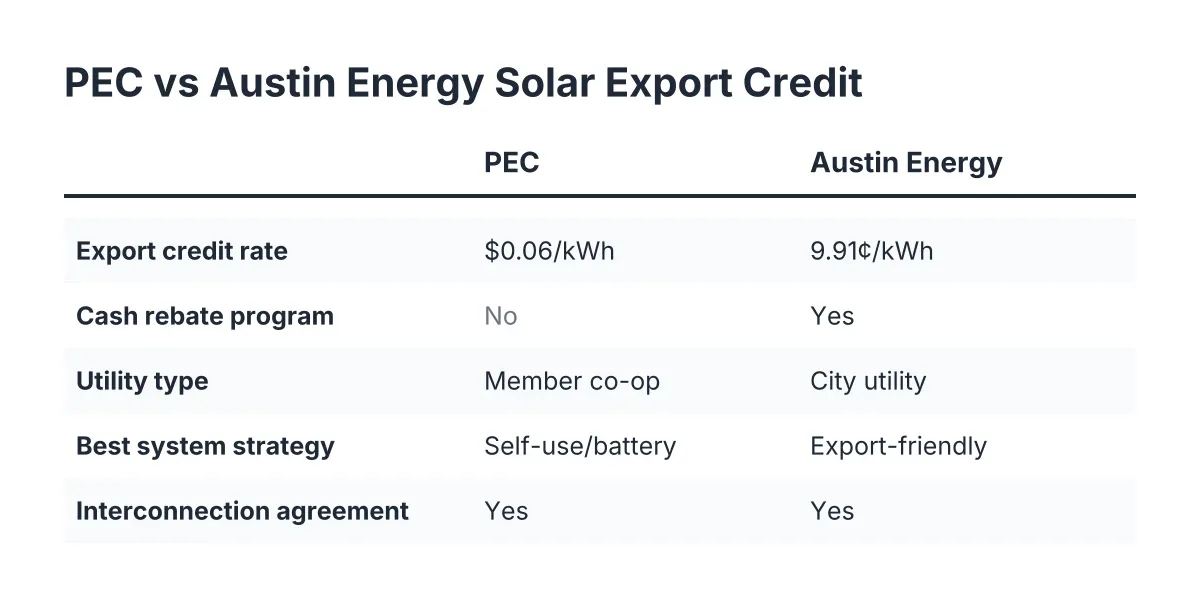
On the export side, Austin Energy does not use retail-rate net metering. It uses a Value of Solar tariff. In place of retail-rate net metering, Austin Energy credits every kilowatt-hour a home's panels produce at its Value of Solar rate, 12.89 cents per kWh for systems under 1 MW-AC effective October 1, 2026, and bills the home for all the electricity it uses, according to Austin Energy. That figure is as of the source's reporting; the tariff gets recalculated, so confirm the current rate and know your numbers will differ.
Pedernales Electric Cooperative: watch the export rate
PEC serves much of the Hill Country side of the metro, including parts of Dripping Springs and Lakeway. According to PEC, its regular interconnect rate credits surplus solar sent to the co-op at 7.1921 cents per kWh, only toward the Base Power Charge, and unused credits expire at the end of each calendar year. That is lower than what you pay for power, so a PEC quote that assumes full retail credit for exports is overstating your savings. As of early 2026, confirm the current rate with PEC directly; cooperative rates change, and your numbers will differ.
Oncor territory and retail choice: shop the buyback
If Oncor delivers your power, in Kyle, San Marcos, parts of Georgetown's edges, and other deregulated pockets, you buy electricity from a retail provider and you shop your buyback plan the same way. According to Solar United Neighbors, customers in deregulated markets can choose among multiple solar buyback plans, while homeowners in regulated utility areas typically have one or a few options. In Oncor territory, the buyback plan you pick can swing your payback by years. Make each installer show you which buyback plan their savings projection assumes.
Georgetown, Bluebonnet, and San Marcos
Georgetown Utility Systems, Bluebonnet Electric Cooperative, and the San Marcos municipal utility each set their own export credit and interconnection rules. None of them is obligated to match Austin Energy or each other. Before you believe any quote's savings line, pull your utility's current solar or distributed generation page and read the export credit yourself. It takes ten minutes and it is the highest-value ten minutes in this whole process.
How to Pressure-Test the Incentive Lines in Your Quotes
You have the quotes. Here is how to audit the incentive math in each one, line by line, in 2026:
- Circle every federal credit line. If a purchase quote shows a 30% federal credit or a solar tax refund, ask the rep to cite the current law in writing. For homeowner purchases in 2026, that line should not be there.
- Check who claims the lease credit. On a lease or PPA quote, ask how the financing company's 48E credit is reflected in your monthly payment, and get the escalator rate and buyout schedule in the contract.
- Verify the rebate is real and netted correctly. If a quote shows an Austin Energy rebate, confirm the installer is a participating contractor and whether the number shown is before or after the rebate. Two of your three quotes may be presenting the same system price differently.
- Match the export rate to your utility. Value of Solar for Austin Energy, the posted export credit for PEC or Bluebonnet, a named buyback plan for Oncor territory. A projection that does not name the rate and its date is a projection you cannot trust.
- Ask what happens if the rebate changes before installation. Utility rebate budgets run out. A contract should say who absorbs that risk, you or the installer.
In addition, ignore any deadline pressure tied to incentives. "Sign tonight before the rebate expires" is a script, not a fact. Utility programs publish their own timelines; check the source, not the rep.
Where Solar Still Makes Sense Without the Purchase Credit
Solar can still pay for itself in the Austin area in 2026, but the honest answer is that payback runs longer without the federal purchase credit, and the spread between utilities is wider than ever. Texas remains the most active solar market in the country; according to the Solar Energy Industries Association, Texas installed 2.7 GWdc in the first quarter of 2025, 92% more than second-ranked Florida. Scale has kept hardware prices competitive, which partly offsets the lost credit.
The households where the math still works tend to look like this: bills of $150 to $400 a month, heavy afternoon and evening usage from a pool pump or an EV charger, a reasonably unshaded south- or west-facing roof, and a utility with a workable export credit or rebate. Some utility programs even pay a higher incentive tier for west-facing systems because they produce more in the late afternoon when the grid is strained. If an installer told you your west roof is a compromise, it may actually be a feature under your utility's program. Ask.
Interconnection paperwork is also part of the timeline now. Utilities that support residential solar commonly require engineering documentation for review before installation is approved, as Arizona Public Service describes for its own process, and Austin-area utilities run similar reviews. Budget weeks, not days, between signing and permission to operate.
A final honest note. Solar rebates and incentives in Austin shift often enough that any article, including this one, ages. Every rate and rebate figure above carries its as-of date for a reason, and your numbers will differ. Before you sign, confirm the current rebate with your utility, confirm your tax position with a tax professional, and make every installer show the as-of date on every incentive line in the quote. The quote that survives that audit is usually the one worth signing.
For help with solar with Austin Energy, Austin Solar FAQ is the place to start.
Prefer to talk it through? Call +15125571906 — a quick call is usually the fastest way to get a straight answer for your situation.