Solar Rebates and Incentives in Austin — Complete Guide
Solar rebates and incentives in the Austin area changed dramatically heading into 2026, and most of what you'll read online is already out of date. The federal solar tax credit 2026 picture looks nothing like it did two years ago, and your local incentives depend entirely on which utility sends your bill, not which town you live in. This guide walks you through what's actually available right now, from Austin Energy's programs to the rules in Pedernales, Oncor, Georgetown, Bluebonnet and San Marcos territory. You'll leave knowing which incentives apply to your address, which ones vanished, and how to avoid quoting stale 2022 numbers back to a salesperson.
What You'll Find in This Guide
Coming soon — we're building out this topic cluster.
The Federal Solar Tax Credit 2026: What Changed and What's Left
For years, the 30% federal residential clean energy credit was the single biggest line item on any Austin solar quote. That era ended. Congress passed legislation in 2025 that terminated the Section 25D residential credit for systems placed in service after December 31, 2025. As a result, if you buy and own a rooftop system in 2026, you should not expect a 30% federal credit on your purchase. Any installer telling you otherwise is either behind the news or hoping you are.
However, the story has a second chapter, and it matters for how you finance your system. The commercial clean energy credit survived on a different timeline. In practice, this means third-party ownership arrangements, such as solar leases and power purchase agreements, can still capture federal value through the company that owns the equipment. A well-structured lease in 2026 may pass some of that value through to you as a lower monthly payment. That said, leases come with their own trade-offs around escalators, buyout terms and what happens when you sell the house. Read the contract, not the brochure.
The Solar Tax Credit 2026 and How It Changes the Math in Austin
The loss of the residential solar tax credit 2026 shifts the weight of your savings onto local factors. Your payback period now depends far more on three things: what your utility pays for exported power, what local rebates exist, and how much you pay per watt installed. To put it simply, the federal government used to do a third of the work. Now your utility territory does most of it.
This is exactly why organizing your research by utility matters. Two neighbors on opposite sides of a service boundary can see payback periods that differ by years, even with identical roofs and identical systems. Additionally, Texas still offers a property tax exemption for the added home value from solar, which survives regardless of federal changes. You can verify current federal and state programs yourself through DSIRE, the incentives database maintained by the NC Clean Energy Technology Center, which tracks every active program by state and utility. Bookmark it. It's the antidote to stale blog posts quoting numbers from three legislative sessions ago.
Austin Energy: Rebates and the Value of Solar Tariff
If Austin Energy sends your bill, you're in the most incentive-rich territory in the region. Austin Energy has run solar programs for decades, and DSIRE (Database of State Incentives for Renewables & Efficiency), maintained by the NC Clean Energy Technology Center, formally lists its residential, multifamily and commercial solar rebate programs. The catch is that program budgets, rebate amounts and requirements change, sometimes mid-year. Consequently, you should confirm current figures directly with Austin Energy before signing anything, and treat any rebate number in a quote as a claim to verify, not a fact.
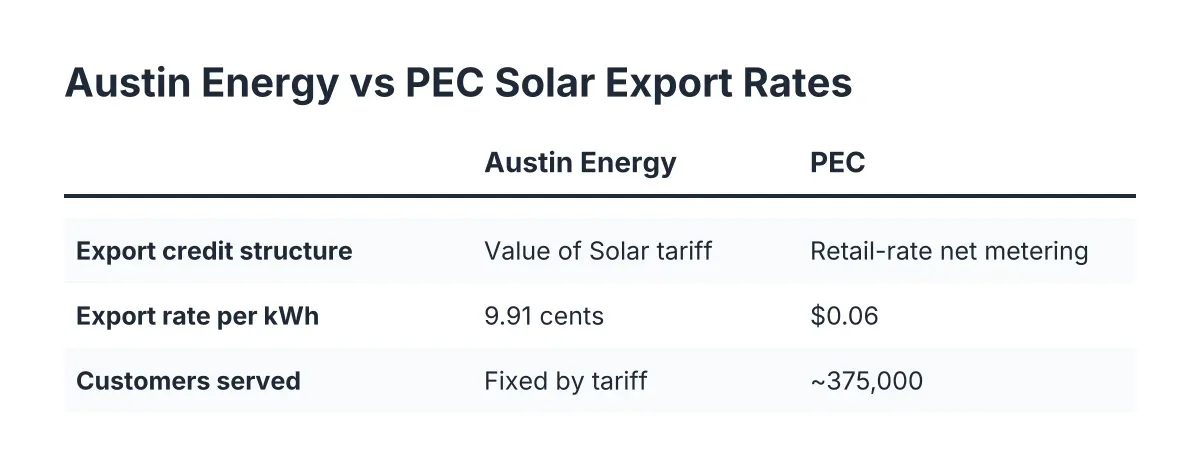
The bigger deal for your long-term savings is how Austin Energy pays for exported power. Instead of retail-rate net metering, Austin Energy uses a Value of Solar tariff. According to NuWatt Energy, the residential Value of Solar rate pays 9.91 cents per kWh for every unit of electricity your panels send to the grid. Notice the word "every." Under Value of Solar, all your production gets credited at that rate, and you buy all your consumption at retail. This is a fundamentally different structure from net metering, and it changes how you should size a system.
Why Value of Solar Changes Your Sizing Decision
Under traditional net metering, oversizing a system can make sense because every exported kilowatt-hour offsets a retail one. Under Value of Solar, the credit rate is fixed, so the payoff on extra panels depends on how that rate compares to your retail rate over time. For example, a household with heavy daytime air conditioning use gets a different result than one where everyone leaves for work at 7 a.m. With this in mind, don't let anyone size your system from a satellite photo and a sales target. Your 12 months of usage data should drive the design.
Batteries also interact with this structure. Because Austin Energy credits exports at a set rate, storing your own power for evening use can beat exporting it, depending on your rate plan. Beyond that, a battery adds backup during outages, which many Central Texas homeowners now treat as the primary reason to buy. Run both scenarios before you decide.
Outside Austin Energy: PEC, Oncor, Georgetown, Bluebonnet and San Marcos
Cross a utility boundary and the incentive landscape changes completely. This surprises a lot of homeowners in Cedar Park, Leander, Dripping Springs and Kyle, where the town name tells you almost nothing about your solar economics. The utility decides everything.
Pedernales Electric Cooperative serves much of the Hill Country west and north of Austin. According to SolarSavingsAI, PEC serves roughly 375,000 customers and credits solar exports at $0.06 per kWh. That export rate sits well below Austin Energy's Value of Solar rate, so a PEC household should prioritize self-consumption. In practice, that means sizing conservatively, shifting usage to daylight hours, or pairing panels with a battery so fewer kilowatt-hours leave the house at six cents.
Oncor territory works differently again. Oncor delivers power but doesn't sell it, so your buyback rate comes from whichever retail electricity provider you choose. Some retail plans pay generously for exports and some pay nothing. As a result, your plan choice can matter as much as your panel choice, and you can switch plans without touching your hardware.
Municipal Utilities and Co-ops: Georgetown, Bluebonnet and San Marcos
Georgetown Utility Systems, Bluebonnet Electric Cooperative and the City of San Marcos each set their own interconnection rules and export credits. These programs change more often than the big utilities' programs do, and they rarely make it into national solar articles. Therefore, if you live in one of these territories, call the utility directly and ask for the current distributed generation rate sheet before you accept any savings estimate.
The broader Texas context helps explain why these programs keep evolving. Texas installed 2.7 GWdc of solar in the first quarter of 2025 alone, 92% more than second-ranked Florida, according to the Solar Energy Industries Association (SEIA). Moreover, Go Solar Texas reports that as of Q2 2024, Texas had 34,907 MW of solar installed, enough to power an estimated 4,063,719 homes. Utilities are adjusting their programs in response to that growth. Yesterday's rate sheet may already be wrong, which is why verification beats memorization every time.
Frequently Asked Questions
What are the current solar incentives available in Austin, Texas?
Austin Energy customers benefit from the Value of Solar tariff, paying 9.91 cents per kWh for exported power, plus utility rebate programs tracked in the DSIRE database. All Texas homeowners receive a property tax exemption on added home value from solar. Verify current rebate amounts directly with your utility, as programs change frequently.
Outside Austin Energy territory, incentives vary by provider. Pedernales Electric Cooperative credits exports at $0.06 per kWh, while Oncor-area homeowners choose retail plans that set buyback rates. Georgetown, Bluebonnet, and San Marcos residents should request current distributed generation rate sheets directly from their utilities.
Is there still a 30% solar tax credit in 2026?
Congress ended the Section 25D residential credit for systems placed in service after December 31, 2025. However, third-party-owned systems (leases and PPAs) may still access federal value through the commercial credit, which can lower monthly payments. Consult a tax professional about your situation.
Additional incentive considerations:
Texas has no state income tax credit and doesn't offer one. However, the statewide property tax exemption ensures your appraisal won't rise due to solar panels. Your local utility program now represents most of your incentive value. For accurate details, contact your specific utility directly—one phone call reveals more than general articles about incentives in your area.
Ready to Get Started?
The end of the residential solar tax credit 2026 makes local knowledge more valuable, not less, because your savings now hinge on your utility's rules and your contract terms. Start by identifying who sends your electric bill, then pull their current export rate and rebate rules before you request a single quote. Once you know your territory's numbers, you can judge any proposal in minutes instead of taking a salesperson's word for it.