Pedernales Electric Co-op Solar Rebates 2026: Incentives and Stacking Rules
If Pedernales Electric Co-op sends your electric bill, the solar math on your house works differently than it does for your friends inside Austin city limits. The pedernales electric co op territory covers a wide swath of the Hill Country, from Dripping Springs and Johnson City out through Marble Falls and parts of Kyle and Leander. In 2026, the incentives available to a PEC member include a PEC solar export credit, a shorter list than the Austin Energy list, and the stacking rules changed when the federal purchase credit ended. This guide walks through what is actually on the table, with dates on every number, so you can check the math yourself before anyone sits at your kitchen table.
One thing up front. I work in this industry, I am not affiliated with PEC or any government program, and I am not here to sell you anything. Some houses in PEC territory pencil out well. Some do not. The point of this article is to help you tell which one yours is.
Why Your Utility Matters More Than Your Town
Your mailing address might say Austin, Kyle, or Dripping Springs, but the utility on your bill decides your solar outcome. Two houses a mile apart can face different buyback rates, different rebate lists, and different paperwork, because one is served by Austin Energy and the other by Pedernales Electric Cooperative.
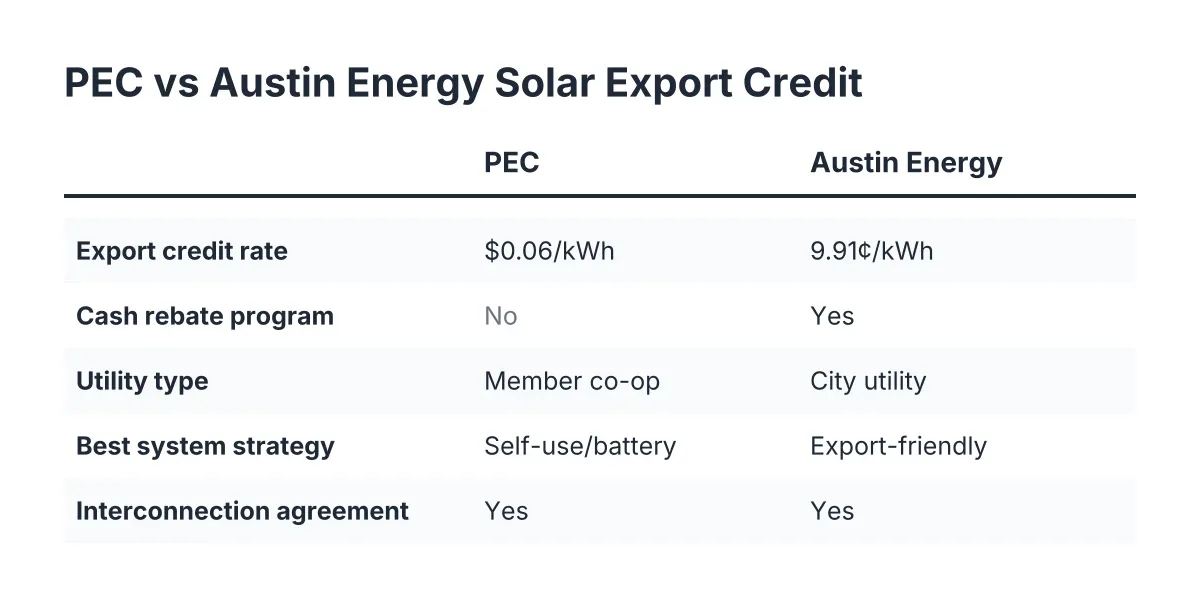
Here is the short version of the difference. Austin Energy credits every kilowatt-hour a home's panels produce at its Value of Solar rate, 12.89 cents per kWh for systems under 1 MW-AC effective October 1, 2026, and bills the home for all the electricity it uses, according to Austin Energy. Austin Energy also runs formal rebate programs tracked in the DSIRE incentives database maintained by the NC Clean Energy Technology Center. PEC takes a different path. It is a member-owned cooperative, not a city utility, and its incentive list is leaner.
Therefore, the first thing to do before reading any solar quote is to look at your bill. If the logo says Pedernales Electric Cooperative, Inc., the rest of this article is written for you. If it says Austin Energy, Bluebonnet, Oncor, or Georgetown Utility Systems, the numbers below do not apply to your house, and a quote built on Austin Energy assumptions will mislead you.
PEC Solar Export Credit: What Pedernales Electric Offers in 2026
PEC does not run a cash rebate program for residential solar the way Austin Energy does. That is the single most important fact in this article, and it is the one door-to-door salespeople most often blur. What PEC does offer is an export credit for the surplus power your panels send to the grid.
According to PEC, its regular interconnect rate credits surplus solar sent to the co-op at 7.1921 cents per kWh, only toward the Base Power Charge, and unused credits expire at the end of each calendar year. That figure is PEC's posted rate as read in November 2026; PEC adjusts its rates through its board process, so confirm the current credit on your own member account before you sign anything. Your numbers will differ based on your rate schedule and usage.
Notice the shape of that deal. That credit is below the full per-kWh cost of the power you buy from PEC, and it can only offset the Base Power Charge. The practical consequence is that solar in PEC territory rewards self-consumption. Every kWh your panels produce that you use in your own house offsets power at your full retail rate. Every kWh you export through the PEC solar export credit earns the lower rate. A system sized to dump large amounts of surplus onto the grid, for a credit that expires at year-end, will disappoint you.
In addition, PEC requires an interconnection agreement before your system can operate. A competent installer handles this paperwork, but you should ask to see the approved agreement before the system is switched on. Operating without one can create billing problems that take months to untangle.
How the PEC Export Credit Compares to Austin Energy
The gap is real. Austin Energy's Value of Solar rate credits 12.89 cents per kWh on all production, effective October 1, 2026 per Austin Energy, against PEC's 7.1921 cents per kWh on exports only, per PEC. On an identical roof, the Austin Energy house is credited on everything the panels produce, and at a higher rate than PEC pays for exports.
However, that does not automatically make solar a bad deal in PEC territory. It changes the design. In PEC territory, the winning systems are sized closer to daytime self-use, often paired with a home battery that soaks up afternoon surplus and discharges it in the evening instead of exporting it for the lower credit. Inside Austin Energy territory, modest oversizing is less punishing, because every kilowatt-hour produced earns the same credit. Same panels, different strategy, because the utility sets the rules.
The Federal Picture in 2026: Purchase Credit Gone, Lease Credit Alive
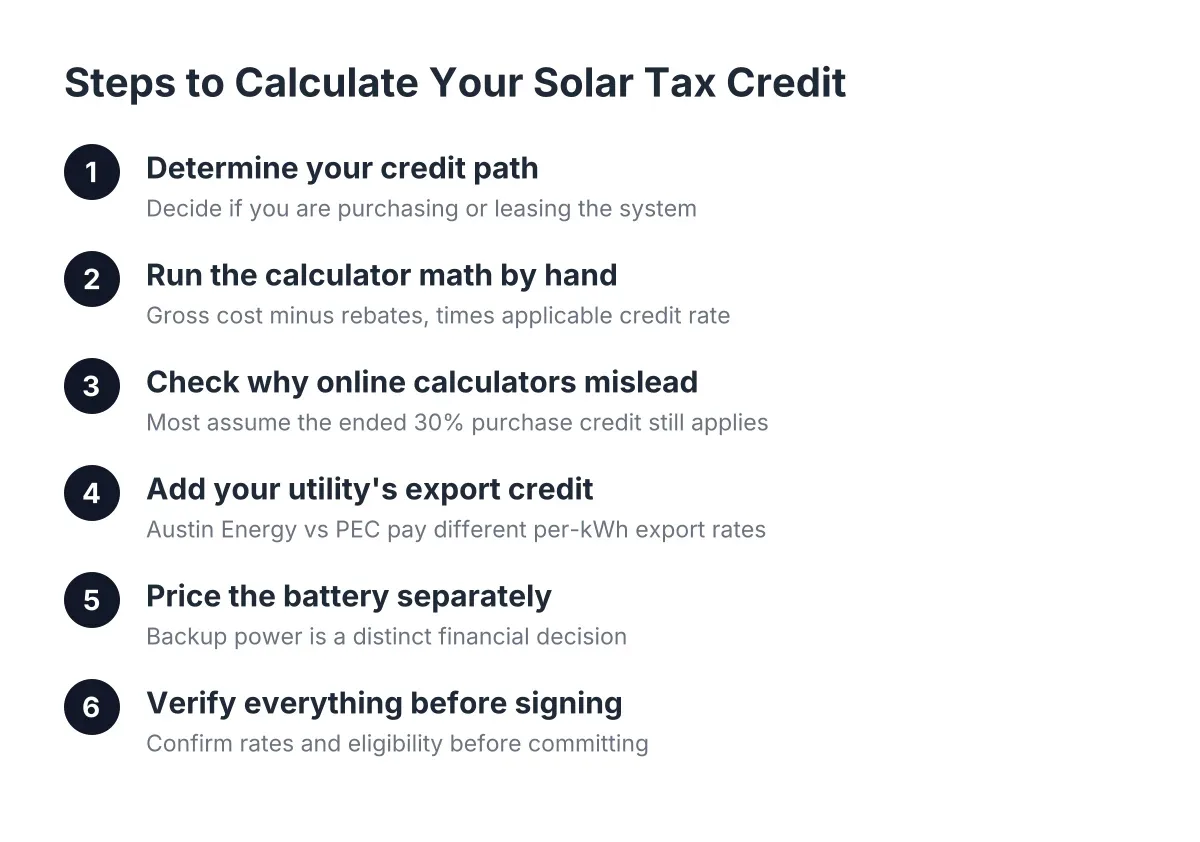
Is there still a 30% solar tax credit in 2026? For homeowners who buy their system outright, no. The federal purchase credit, the 25D Residential Clean Energy Credit, ended for residential purchases after 2025. The Internal Revenue Service confirms the credit historically covered 30% of a residential installation's total cost, but that path closed before 2026 installations.
What survives is the lease credit, the 48E path. A third-party owner, meaning a leasing company, can still claim a federal credit on systems it owns and leases to homeowners. In theory, some of that value flows to you through a lower monthly lease payment. In practice, how much flows through depends entirely on the lease terms, and the leasing company is not obligated to pass along any particular share.
This flipped the 2026 conversation. For years, the standard advice was that cash or loan purchases beat leases because the owner captured the 30% credit. Now the federal incentive sits only on the lease side, while ownership keeps other advantages. Neither answer is automatic anymore. You have to run both sets of numbers for your own house.
What Buying Still Gets You in PEC Territory
Ownership lost the federal purchase credit, but it kept everything else:
- Texas offers a property tax exemption for the added home value from a solar installation, so your appraisal does not climb because of the panels.
- Texas exempts solar equipment from sales tax, which trims cost at the point of purchase.
- You keep 100% of the bill savings and the PEC export credits, with no monthly payment to a leasing company.
- You control the system when you sell the house; a buyer inherits panels, not a contract.
For a retiree on a fixed income, that last point deserves weight. An owned system is an asset. A leased system is an obligation that a future buyer must qualify for and agree to assume.
What a Lease Means for a Retiree on a Fixed Income
A solar lease works like an equipment lease, similar to a car lease, where you pay a fixed monthly amount for the panels regardless of how much energy they produce, according to the U.S. Environmental Protection Agency. The EPA also notes that under both leases and power purchase agreements, the building owner never actually owns the system.
Be careful here. If you are 72 and the lease runs 25 years, you are signing a contract that will likely outlive your time in the house, and possibly you. Your estate or your buyer deals with it. In addition, in third-party ownership deals, the company that owns the system typically captures the direct incentives during its ownership period. You still benefit from the property tax exemption and the export credits tied to the home, but the federal lease credit lands on their books first.
A lease is not automatically a scam. Some 2026 leases in PEC territory may price out reasonably because the 48E credit lowers the owner's cost. But read the escalator clause, the buyout schedule, and the transfer terms before anything else. If a salesperson calls it "free solar," end the conversation. Nothing with a 25-year payment stream is free.
Stacking Rules: Combining PEC Solar Export Credit with Other Incentives
Can you combine incentives in PEC territory in 2026? Yes, but the stack is shorter than homeowners expect. The PEC export credit, the Texas property tax exemption, and the Texas sales tax exemption all combine on an owned system. The federal purchase credit no longer joins the stack, and PEC offers no cash rebate to add.
Solar incentives at the federal, state, and local levels are generally designed to stack, and that design still holds. The problem in 2026 is simply that two of the biggest layers thinned out. Here is the realistic 2026 stack for a PEC member who buys a system:
- Texas sales tax exemption on the solar equipment, applied at purchase.
- Texas property tax exemption on the added home value, applied at appraisal.
- PEC export credit of 7.1921 cents per kWh on surplus sent to the grid, per PEC's regular interconnect rate, confirmed against your own account before signing.
- Direct bill savings from self-consumed solar at your full PEC retail rate, which is the largest line in the stack by far.
For a leased system, swap items 1 and 2 for whatever share of the federal lease credit the leasing company builds into your payment, and read the fine print on who keeps the export credits. Utility rebate programs around the country frequently exclude leased systems; PEC has no cash rebate for either path, so in this territory the exclusion question matters less than it does elsewhere.
One more stacking note. Some utilities around the state pay richer incentives for systems paired with battery storage, or tier payments by panel orientation because west-facing arrays produce more during afternoon peak. PEC does not run a program like that for residential members as of early 2026, but this is exactly the kind of detail that changes with a board vote. Check PEC's current member programs the same week you sign, not the month before.
Running the Payback Math on a PEC Bill
Here is where the spreadsheet earns its keep. Suppose a hypothetical retired couple in Dripping Springs, PEC members, with a 2,400 square foot all-electric house and summer bills that jumped from $240 to $340 between 2024 and 2025. Say an installer quotes them an 8 kW owned system at $24,000 after the sales tax exemption, a realistic illustrative range for 2026, though your numbers will differ.
Without the old federal purchase credit, that $24,000 is the real number. Say the system produces about 11,600 kWh a year and the couple uses a little over half of it directly. Self-used power, at a full cost near 11 cents per kWh once PEC's posted base power, delivery and transmission charges are added together, saves roughly $700 a year, and exports at PEC's 7.1921-cent credit add about $375, for roughly $1,075 a year, or about $90 a month. The simple payback runs about 22 years. With no purchase credit, there is no shortcut around that math.
Is 22 years acceptable? For most households at that price, no. The math improves with a lower installed price, a smaller system sized to daytime use, or more of the usage moved into daylight; at $15,000 to $17,000 installed the same example lands near 14 to 16 years. If you expect to move within 5 years, or the $24,000 would strain your savings, the honest answer is that solar may be a poor fit for your situation right now. In that scenario, attic insulation and a heat pump upgrade often return money faster.
A home battery changes the equation in two directions. It raises upfront cost by an illustrative $10,000 to $15,000 in 2026, but it turns exports credited at the lower rate into power you use yourself and gives you backup power during Hill Country outages. For some PEC members, especially those with medical equipment or well pumps, the backup value alone justifies the battery. For others, a whole-house standby generator covers outages for less. Run both.
How to Vet a Quote and an Installer in Pedernales Electric Co-op Territory
How do you know a quote is honest? A fair quote for a pedernales electric co op member states PEC's actual export credit, models self-consumption rather than assuming one-to-one net metering, and shows payback with no federal purchase credit. If a 2026 quote shows a 30% federal credit on a purchased system, the installer is either careless or counting on you not to check.
Texas sits in an unusual position on buyback generally. The state has no standard net metering mandate; in deregulated areas, Solar United Neighbors notes customers choose among multiple buyback plans, while in regulated and cooperative areas like PEC's, you typically get one option, the utility's own. That means your installer cannot shop you a better export rate in PEC territory. Anyone implying otherwise does not know the territory.
Three questions separate the professionals from the door-knockers:
- "What export credit did you use in this model, and where is PEC's current figure published?" The right answer names a specific rate with a date.
- "What percentage of production does your model assume I self-consume?" A number above 80% for a house empty most afternoons deserves scrutiny.
- "Who handles the PEC interconnection agreement, and when do I see the approved copy?" The answer should be the installer, before system activation.
On DIY: a handy homeowner can safely handle energy monitoring, shading analysis, and the spreadsheet. The installation itself, the interconnection paperwork, and anything touching your main panel belong with a licensed installer. PEC will not interconnect a system that fails inspection, and a roof penetration done wrong costs more than the labor you saved. If a salesperson pressures you to sign the same day, or asks you to sign a utility document you have not read, that is your signal to stop, regardless of how good the numbers look.
Timeline expectations also differ here. Interconnection approval through a cooperative moves on the cooperative's schedule, and in my experience the full process from signed contract to permission to operate commonly runs several weeks to a few months in this area. Nobody can promise you a specific week, and anyone who does is guessing.
Where PEC Fits in the Wider Austin-Area Incentive Map
Context helps you judge whether to act now or wait. Texas leads the country in solar; the Solar Energy Industries Association reports the state installed 2.7 GWdc in the first quarter of 2025 alone, 92% more than second-ranked Florida, and Go Solar Texas cites SEIA data showing 34,907 MW installed statewide as of Q2 2024, enough to power an estimated 4 million homes. The industry here is mature. Equipment is available, installers are plentiful, and prices reflect a competitive market.
The broader landscape of solar rebates and incentives in Austin still tilts toward Austin Energy customers, who have the Value of Solar tariff and formal rebate programs tracked by DSIRE. PEC members have a thinner stack but a real one, and the self-consumption strategy with or without a battery remains sound. If your neighbor inside the city limits quotes you their deal, remember their utility wrote it, not yours.
Could PEC's terms improve? Cooperatives answer to their members, and PEC holds board elections and member meetings. The export credit, interconnection rules, and any future rebate all run through that process. If the current export credit frustrates you, a member vote is a more productive outlet than a 25-year lease signed in frustration.
The Bottom Line for PEC Members in 2026
Solar in Pedernales Electric Co-op territory in 2026 is a self-consumption game with a thin but genuine incentive stack: sales tax exemption, property tax exemption, and a PEC solar export credit of 7.1921 cents per kWh per PEC's regular interconnect rate, all dated and all worth verifying on your own account. The federal purchase credit is gone; the lease credit survives but flows through a company's books before it reaches yours.
If your bills run $150 or below and your usage is flat, solar is likely a poor fit, and I would tell you that over the fence too. If your summer bills clear $250 and you plan to stay put past the payback year, the math can work, provided the system is sized for your daytime use and the quote is built on PEC's real numbers. For tax questions, especially around the lease credit and your own filing situation, talk to a tax professional before you rely on any installer's summary.
Pull your last twelve PEC bills, add up the kWh, and start from there. The utility on the envelope decides the rules. Now you know what the rules in this territory actually are.
For help with solar with Austin Energy, Austin Solar FAQ is the place to start.
Prefer to talk it through? Call +15125571906 — a quick call is usually the fastest way to get a straight answer for your situation.