Solar Rebates and Incentives in Austin Terms Explained: A Plain-English Glossary
If you are reading solar quotes or utility programme pages around Austin and keep hitting words nobody defines, this page is for you. It is a solar rebates and incentives in austin glossary written in plain English for homeowners, so you can read a quote line by line, ask a salesperson the right question, and spot a number that looks stale. Every entry starts with a definition that stands on its own. None of it is a sales pitch, because this site does not sell anything.
- Rebate: money back after the system goes in
- Incentive: the umbrella word for every discount or credit
- Value of Solar: Austin Energy's rate for your solar power
- Net metering: the credit system most of the country has, Austin mostly does not
- Export credit: what your utility pays for power you send out
- Buyback: a retail plan that pays for exported power
- Purchase credit: the ended federal tax credit for systems you buy
- Lease credit: the surviving federal credit that flows through leases
- Interconnection agreement: the utility's permission to connect
- Permission to operate: the final green light to switch on
- Kilowatt-hour: the unit your bill and credits are measured in
- Tariff: the official rate document behind every programme
- Solar lease: paying monthly for a system someone else owns
- Solar loan: borrowing to own the system yourself
- Dealer fee: the loan cost hidden inside the system price
- Battery incentive: a programme that pays you for storage
- Utility territory: the single biggest factor in your outcome
Rebates, Credits, and Incentive Programmes
These are the words that decide what money, if any, comes back to you. They are also where a solar rebates and incentives in Austin glossary earns its keep, because the same word can mean different things depending on which utility sends your bill.
Solar Rebates and Incentives: Austin Glossary Guide
A rebate is money paid back to you, or to your installer on your behalf, after a solar system is installed and inspected. It is not a discount at the register; you or the installer usually front the full cost and the rebate arrives later. In the Austin area, rebate programmes come and go and their amounts change, so any dollar figure in a quote should carry a date. If a quote shows a rebate with no as-of date, ask when the figure was last confirmed with the utility.
Understanding Austin's Incentive Programmes and Solar Rebates Glossary
An incentive is any programme that lowers the real cost of going solar, including rebates, tax credits, export credits, and battery programmes. Salespeople use the word loosely, which is the problem. When a quote says "after incentives," ask for a line-by-line list: which incentive, from whom, how much, and as of what date. Your numbers will differ from your neighbour's, because the mix depends on your utility, your taxes, and when you sign.
Value of Solar
Value of Solar is Austin Energy's tariff for crediting the power your panels produce, and it works differently from classic net metering. Austin Energy bills you for everything your home uses, then credits you separately for everything your system generates, at a rate the utility sets and reviews. That rate can go up or down over time, so a payback estimate built on an old Value of Solar rate is wrong on day one. If your bill comes from Austin Energy, this one term shapes your whole economics.
Net metering
Net metering means your utility credits power you export at the same rate you pay for power you buy, running your meter backwards in effect. It is the system most national solar websites assume you have. Around Austin, most homeowners do not have true net metering; Austin Energy uses Value of Solar, and other utilities use their own export credit or buyback rules. When a salesperson says "net metering" without naming your utility, treat it as a flag to dig deeper.
Export credit
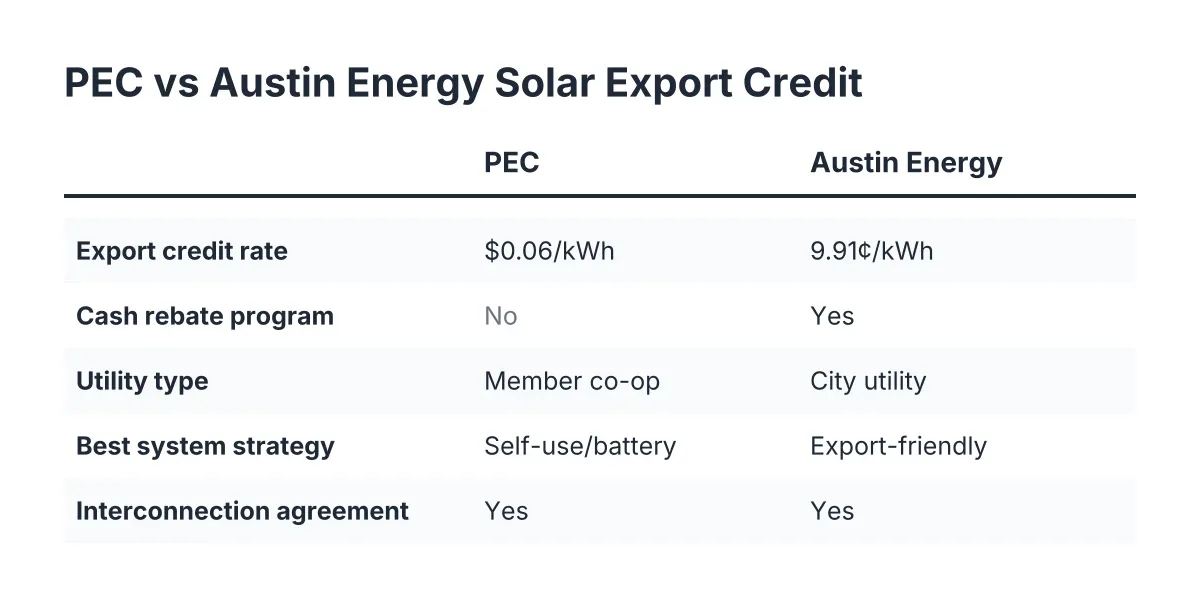
An export credit is what your utility pays or credits you for electricity your panels send to the grid instead of using in your house. The rate varies by utility: Austin Energy, Pedernales Electric Co-op, Bluebonnet, Georgetown Utility Systems, and retail providers in Oncor territory each handle it differently. Some pay close to the retail rate, some pay a wholesale-style rate, and some pay nothing. The export credit, more than panel brand or price per watt, often decides whether solar pays off at your address.
Buyback
Buyback is the common term in Oncor territory for a retail electricity plan that pays you for exported solar power. Because Oncor-area homeowners choose their retail provider, the buyback rate depends on the plan you pick, and plans change or close to new customers. A quote built on a buyback plan you cannot actually sign up for today is a stale quote. Ask which specific plan the projection assumes and confirm it is still open.
Purchase credit
The purchase credit is the federal residential tax credit, known as 25D, that applied to solar systems homeowners bought outright, and it has ended. Any quote or website still showing that credit on a purchased system is out of date. This matters because a large slice of old payback math leaned on it. If you buy or finance a system yourself in 2026, build your numbers without it.
Lease credit
The lease credit is the surviving federal tax credit, under section 48E, that a leasing company can claim on a system it owns on your roof. You do not claim it on your taxes; the lease company does, and a fair lease passes some of that value through as a lower monthly payment. This is why leases and purchases now sit on different footing than they did a few years ago. Ask a leasing company how the credit shows up in your payment, and get the answer in writing.
Battery incentive
A battery incentive is a programme that pays or credits you for installing a home battery, sometimes in exchange for letting the utility draw on it during peak demand. These programmes vary by utility and change often, so confirm current terms before a battery line item sways your decision. A home battery can also change how much power you export, which feeds back into your export credit math. If a quote bundles a battery "because of the incentive," ask for the maths with and without it.
Paperwork and Process
These terms show up between signing a contract and flipping the switch. They rarely appear in sales conversations, which is exactly why they cause surprises.
Interconnection agreement
An interconnection agreement is the contract between you and your utility that permits your solar system to connect to the grid. Every utility around Austin requires one, and each has its own forms, fees, and timelines. Your installer usually files it, but you sign it, and you are the one bound by it. Ask who files yours, with which utility, and how long that utility is currently taking.
Permission to operate
Permission to operate, often shortened to PTO, is the utility's final approval to switch your system on after installation and inspection. Until PTO arrives, your panels sit on the roof doing nothing, even though you may already be making loan or lease payments. Timelines differ by utility and season. A straight answer to "how long is PTO taking right now in my territory" tells you a lot about an installer's local experience.
Tariff
A tariff is the official document in which a utility publishes its rates, credits, and rules, including how it treats solar. It sounds like a tax but it is not; it is the rulebook behind every number on your bill. Austin Energy's Value of Solar lives in a tariff, and so do the export rules at the co-ops. When a projection cites a rate, you can ask which tariff it comes from and when that tariff was last updated.
Kilowatt-hour
A kilowatt-hour, written kWh, is the unit of electrical energy your utility bills you in and credits you in. One kilowatt-hour runs a 1,000-watt appliance for one hour. Every meaningful number in solar, your usage, your production estimate, your export credit, is priced per kilowatt-hour. Once you read your own bill in kWh, you can check a quote's savings claim yourself instead of taking it on faith.
Utility territory
A utility territory is the service area of the company that sends your electric bill, and around Austin it matters more than your town or zip code. Two houses on the same road can sit in different territories, one served by Austin Energy and one by Pedernales Electric Co-op, with different credits, different paperwork, and different outcomes. This site organises everything by utility for that reason. Before you compare quotes, confirm which utility serves your address; everything downstream depends on it.
Money and Contracts
Solar lease
A solar lease is an agreement where a company owns the system on your roof and you pay a monthly fee to use its power. You give up ownership and the purchase-style tax benefits, but the leasing company can claim the lease credit and may pass savings through. Leases run long, often 20 to 25 years, and can complicate a home sale, so read the transfer terms. A lease is not automatically bad; it is a different deal, and it deserves its own maths.
Solar loan
A solar loan is financing that lets you own the system while paying it off monthly, like a car loan secured in various ways. Ownership means production and any applicable credits belong to you, but it also means the interest rate and loan term drive your real cost. Compare the total of all payments against the cash price, not just the monthly figure. Your numbers will differ by credit profile and lender, so ask for both totals in writing.
Dealer fee
A dealer fee is a charge a solar lender adds to the system price in exchange for a lower advertised interest rate, often buried rather than itemised. It can inflate a "cheap" loan's true cost by a meaningful margin, which is why two quotes for the same hardware can differ sharply. A fair installer will tell you the cash price and the financed price side by side. If those two numbers match on a low-rate loan, ask where the dealer fee went.
Using These Terms
What this solar rebates and incentives in austin glossary gives you is a working vocabulary: you can now read a quote line by line, name your utility's actual programme instead of assuming net metering, and ask for the as-of date behind every dollar figure. Keep two questions handy for any conversation: which utility serves my address, and which tariff does this number come from. If the answers come back vague, that tells you something too.
For help with solar with Austin Energy, Austin Solar FAQ is the place to start.
Related guide: Solar rebates and incentives in Austin — Complete Guide
Prefer to talk it through? Call +15125571906 — a quick call is usually the fastest way to get a straight answer for your situation.