Reading and Comparing Solar Quotes Terms Explained: A Plain-English Glossary
If you have two or three solar quotes on the kitchen table and half the words mean nothing, this page is for you. It is a reading and comparing solar quotes glossary for homeowners in the Austin area, written in plain English by someone who has read a lot of these documents from the inside. Each entry tells you what the term means, why it shows up on your quote, and what to ask when it does. Use it to go line by line and spot the numbers that deserve a second look.
- System Size (kW DC): how big the array is on paper
- Production Estimate (kWh): what the system should generate in a year
- Price Per Watt: the number that lets you compare quotes
- Offset: how much of your usage the system covers
- Inverter: turns panel power into house power
- Microinverter vs. String Inverter: two ways to do the same job
- Panel Wattage: the rating stamped on each panel
- Home Battery: stored power for outages or evening use
- Export Credit (Buyback): what your utility pays for surplus power
- Value of Solar: Austin Energy's specific credit rate
- Degradation Rate: how panel output fades over decades
- Production Guarantee: the installer's promise in writing
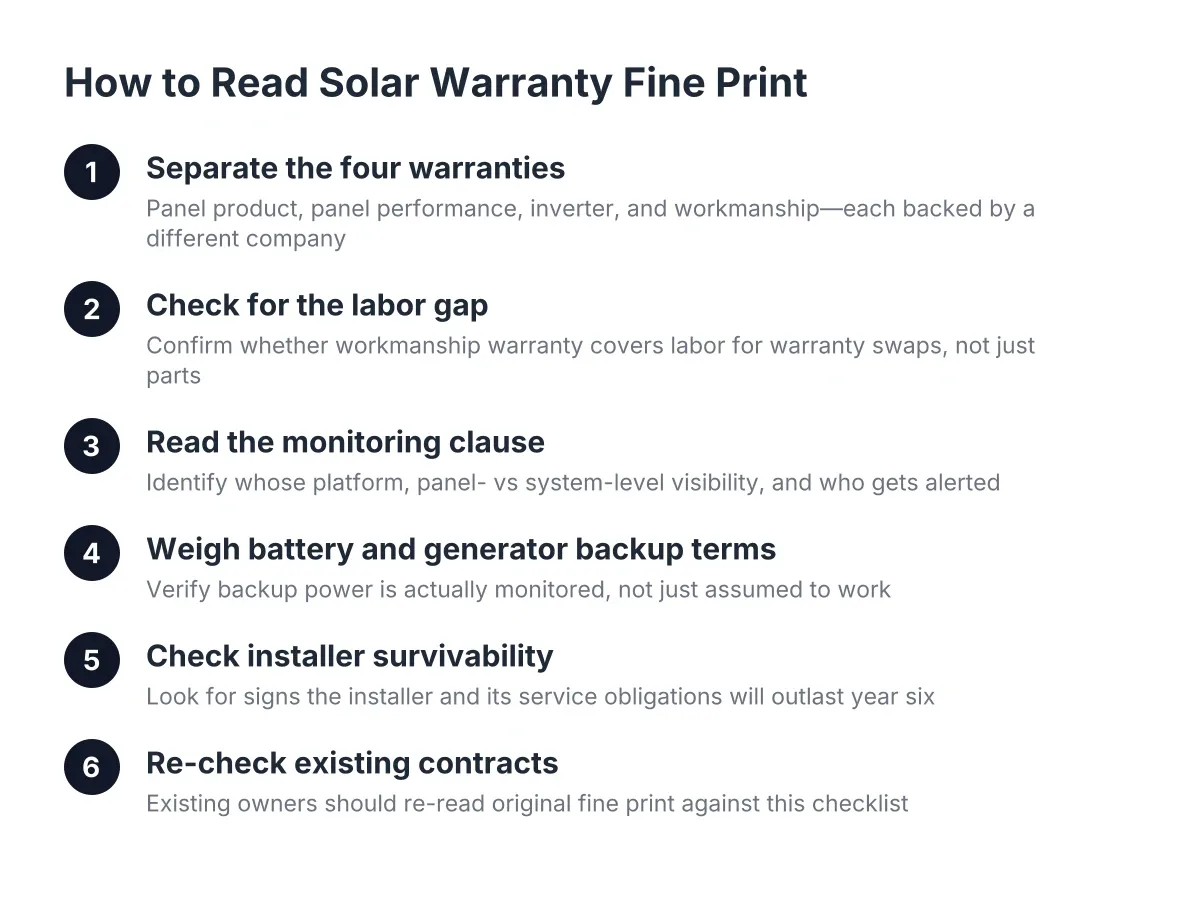
- Workmanship Warranty: who fixes a leak around the mounts
- Solar Loan vs. Solar Lease: own the system or rent it
- Dealer Fee: the loan cost hidden inside the price
- Escalator: the annual price increase in a lease
- Interconnection: permission to tie into the grid
- Permission to Operate (PTO): the final switch-on approval
Equipment and System Terms
These are the hardware words, the ones that describe what actually goes on your roof. Reading and comparing solar quotes gets easier once you can match each line item to a physical thing.
Reading and Comparing Solar Quotes: Hardware Essentials
System size is the total rated capacity of all your panels added together, measured in kilowatts of direct current. A quote for twenty panels rated at 400 watts each is an 8 kW system. Size drives price, roof space needed, and how much power you can expect. Two quotes with different sizes are not comparable until you adjust for that difference, which is where price per watt comes in.
Production Estimate (kWh)
A production estimate is the installer's forecast of how many kilowatt-hours your system will generate in its first year. It depends on your roof's direction, tilt, shading, and local weather, so the same panels produce different amounts on different houses. Ask every installer what shading analysis they used and whether the estimate assumes a clean, unshaded roof you do not have. A generous estimate makes the payback math look better than it is.
Price Per Watt
Price per watt is the total system cost divided by the system size in watts, and it is the single best number for comparing quotes. An 8,000-watt system quoted at $24,000 works out to $3.00 per watt; your numbers will differ. It strips out system size so you can compare a 6 kW quote against a 10 kW quote fairly. If a quote does not state it, calculate it yourself before anything else.
Offset
Offset is the percentage of your annual electricity use the system is expected to cover. A 100 percent offset means the production estimate equals your yearly consumption on paper, not that your bill goes to zero. Fixed charges and the gap between what you pay for power and what your utility credits for exports keep some bill alive. Treat a quoted offset above 100 percent as a question to ask, not a bonus.
Inverter
An inverter is the device that converts the direct current your panels make into the alternating current your house and the grid use. Every solar system needs one, and it is the component most likely to need replacement during the system's life. Your quote should name the inverter type and its warranty length. If it does not, ask.
Microinverter vs. String Inverter
Microinverters are small inverters mounted under each panel, while a string inverter is one central box handling the whole array. Microinverters usually cost more but handle shade better and let each panel work independently, so one shaded panel does not drag down the rest. String inverters are cheaper and simpler on open, unshaded roofs. Neither is wrong; the right pick depends on your roof, so ask the installer to justify their choice for your house specifically.
Panel Wattage
Panel wattage is the power rating of a single panel under standardized test conditions, such as 400 or 430 watts. Higher wattage means fewer panels for the same system size, which matters on a small or complicated roof. It is not a quality score by itself. A quote built on fewer high-wattage panels is not automatically better or worse than one with more lower-wattage panels of the same total size.
Home Battery
A home battery is a storage unit that holds solar power for use later, typically during an outage or in the evening. It adds meaningful cost to a quote, so a quote with a battery and one without are not comparable head to head. In the Austin area, whether a battery pays for itself depends on your utility's export credit; the worse the buyback, the stronger the case for storing power instead of selling it. Make sure the quote states the battery's usable capacity and what circuits it will back up.
Utility and Credit Terms
The utility that sends your bill, whether that is Austin Energy, Pedernales Electric Co-op, a retail provider on Oncor wires, Georgetown Utility Systems, Bluebonnet, or San Marcos, decides more of your outcome than the panels do.
Export Credit (Buyback)
An export credit, also called buyback, is what your utility pays or credits you for surplus solar power sent to the grid. It is not the same as net metering, and in much of the Austin area true net metering does not exist. The rate varies by utility and can change over time, so any rate on a quote needs an as-of date, and your numbers will differ. An installer who assumes a generous buyback in the savings math may be quoting a utility you do not have.
Value of Solar
Value of Solar is Austin Energy's specific tariff for crediting solar production, set by the utility and adjusted over time. If Austin Energy sends your bill, your quote's savings math should use the current Value of Solar rate, not a generic net metering assumption. Ask the installer which rate they used and its date. A quote built on a stale rate will overstate or understate your savings.
Degradation Rate
Degradation rate is the small percentage of output a panel loses each year as it ages. Panel warranties usually guarantee a minimum output after 25 years, and the quote's long-term savings projection should bake degradation in. If a 25-year savings chart assumes the system produces the same amount in year 25 as year one, the projection is inflated. It is a small number with a large compounding effect.
Production Guarantee
A production guarantee is a written promise that your system will generate a stated amount of energy over a set period, with compensation if it falls short. It is different from an equipment warranty, which covers broken hardware rather than underperformance. Not every installer offers one, and the ones that do define the terms differently. If a quote mentions it, ask to see the exact shortfall remedy in writing.
Workmanship Warranty
A workmanship warranty is the installer's coverage of their own labor, including roof penetrations, wiring, and mounting, separate from the manufacturer warranties on panels and inverters. If a mount leaks in year six, this is the warranty that answers the phone. Terms in the market range widely, so compare the years offered and read what is excluded. A long panel warranty from a manufacturer does not help if the installer's labor coverage is thin or the company is gone.
Pricing, Financing, and Paperwork
Solar Loan vs. Solar Lease
A solar loan means you borrow to buy the system and own it, while a solar lease means a company owns the system on your roof and you pay for the power or the equipment monthly. Ownership and leasing land differently on taxes and incentives; the purchase credit under the old federal 25D path has ended, while the lease credit under the 48E path survives for third-party owners, as of the 2026 landscape this guide covers. Your numbers will differ, so confirm current rules before you sign. The full walkthrough in Reading and Comparing Solar Quotes in Austin, TX covers how to weigh the two side by side.
Dealer Fee
A dealer fee is a charge the lender adds to a solar loan to buy down the interest rate, and installers usually fold it into the quoted system price rather than listing it. It can make a low advertised rate expensive in disguise. Ask every installer for the cash price and the financed price of the same system; the gap between them is roughly the dealer fee. If an installer will not give you both numbers, treat that as a signal.
Escalator
An escalator is the fixed annual percentage increase written into many solar leases and power purchase agreements. A payment that looks comfortable in year one compounds every year for the length of the contract, often 20 to 25 years. Ask for the total of all payments over the full term, not just the first monthly number. A zero-escalator contract costs more up front but is easier to predict.
Connecting Your System: Reading and Comparing Solar Quotes for Utility Approval
Interconnection is the formal process of getting your utility's permission to connect your solar system to the grid. Your installer files the application, and each utility, whether Austin Energy, PEC, Bluebonnet, Georgetown Utility Systems, or a retail setup on Oncor wires, has its own paperwork and timeline. The quote should say who handles it and whether any utility fees are included. Delays here are the most common reason a finished system sits idle.
Permission to Operate (PTO)
Permission to operate, or PTO, is the utility's final written approval to switch your system on after installation and inspection. Your system can be physically complete for weeks before PTO arrives, and you earn no export credits until it does. Ask the installer for their typical install-to-PTO timeline with your specific utility. If a loan payment starts before PTO, you could be paying for a system that is not yet running, so check the contract's start terms.
Using These Terms
You can now take any quote and read it line by line: size, production, price per watt, hardware, credits, warranties, and financing, in that order. When an installer uses one of these words, you will know what to ask next and what a missing detail implies. That is what this reading and comparing solar quotes glossary is for: not to make you an engineer, but to make you the person at the table who cannot be rushed.
Prefer to talk it through? Call +15125571906 — a quick call is usually the fastest way to get a straight answer for your situation.