Warranty and Monitoring in a Solar Quote: What the Fine Print Tells You
Most people compare solar quotes by price per watt and stop there. That works until something breaks in year six, the installer's phone number is disconnected, and you find out your 25-year warranty does not cover the labor to pull a dead panel off the roof. The warranty and monitoring sections of a solar quote are the parts that tell you what the next 20 years actually look like, and they are the parts almost nobody reads, yet the solar warranty fine print in these sections deserves close attention before signing. This guide walks through how to read the warranty and monitoring sections of a solar quote line by line, what the language signals about the company behind it, and how this plays out differently depending on whether Austin Energy, Pedernales Electric Co-op, Oncor, Georgetown Utility Systems, or Bluebonnet sends your bill.
If you lived through a multi-day outage last winter and you are adding a home battery, or you bought solar ten years ago and your inverter is starting to fail, this matters twice over. Backup power you cannot verify is working is not backup power. It is a guess.
Why the Warranty Pages Predict More Than the Price Page
The price page tells you what you pay once. The warranty pages tell you who pays for the next two decades.
Here is the pattern I see over and over in the Austin area. Two quotes land on a kitchen table in Pflugerville. One is $2,000 cheaper. The homeowner picks the cheaper one, and the first three years are fine. Then an inverter faults in July, the house loses production during the exact season when Austin Energy's Value of Solar credit, 12.89 cents per kWh on all production effective October 1, 2026 according to Austin Energy, would have been offsetting the biggest bills of the year. Your numbers will differ, and that rate can change, but the shape of the problem does not. The manufacturer will ship a replacement inverter under warranty. Nobody ships a free electrician.
A quote that is thousands below the others is often telling you something before you sign: thinner equipment, a weaker warranty, or subcontracted crews with no long-term service obligation. Cheap is not automatically bad, but cheap plus vague warranty language is a known combination, and it rarely ends well.
Texas installed 2.7 GWdc of solar in the first quarter of 2025 alone, 92 percent more than second-ranked Florida, according to the Solar Energy Industries Association (SEIA). That boom brought a wave of installers into Central Texas, and not all of them will exist in ten years. The warranty section of your quote is where you find out which risk you are taking.
The Four Warranties Hiding in One Solar Quote
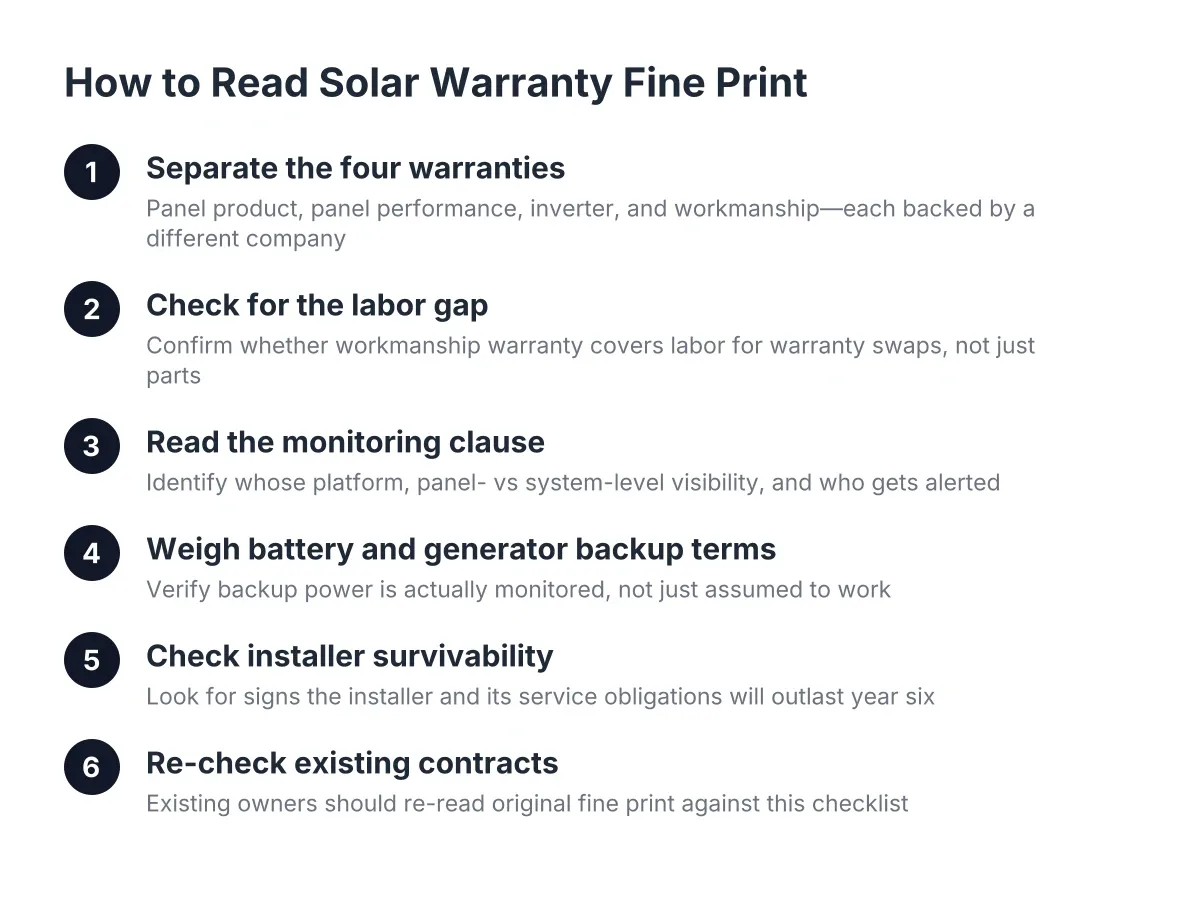
A solar quote usually says "25-year warranty" in large type. That single number is actually four separate promises from up to four separate companies. You need to find each one in the fine print and note who stands behind it.
- Panel product warranty. Covers manufacturing defects in the physical panel. Typically 10 to 25 years depending on the brand. Backed by the panel manufacturer, not your installer.
- Panel performance warranty. Guarantees the panel still produces a stated percentage of its rated output at year 25, usually in the low-to-mid 80s. Also backed by the manufacturer. Hard to claim in practice because you must prove underperformance.
- Inverter warranty. Usually 10 to 12 years for string inverters, often 25 for microinverters. The inverter is the component most likely to fail first, so this term matters more than the panel terms for most homeowners.
- Workmanship warranty. Covers the installation itself: roof penetrations, wiring, racking, and leaks. Backed by the installer. This is the one that dies if the installer does.
The quote should list exact model numbers for the panels and the inverter in writing. If it says "Tier 1 panels" or "premium inverter" without a model number, you cannot verify a single warranty term. Ask for the models in writing before you compare anything else. A company that will not commit to model numbers on paper is reserving the right to substitute cheaper equipment later.
The labor gap in solar warranty fine print
Here is the misconception that costs solar owners the most money. Manufacturer warranties cover the part. They generally do not cover the labor to diagnose the fault, remove the failed component, install the replacement, and recommission the system. Unless your installer's workmanship warranty explicitly includes repair labor for warranty swaps, or you bought a separate labor warranty, that bill is yours.
For a failed microinverter under a panel in the middle of a roof array, that labor can run several hundred dollars as an illustrative estimate; your numbers will differ by roof and installer. When you read a warranty monitoring section of a solar quote, search for the words "labor included" or "truck roll fee." If neither appears, ask the question in writing and keep the answer.
How to Read the Monitoring Clause in a Solar Quote
The monitoring clause in a solar quote tells you three things: whether anyone watches your system, who gets alerted when it stops producing, and how long that service lasts. Most quotes include an app. Far fewer include a human obligation to act on what the app shows. Those are different products, and the fine print is where you learn which one you bought.
Look for these specifics:
- Whose platform. Enphase, SolarEdge, Tesla, and Generac each run their own monitoring. The platform follows the inverter brand, so your inverter choice locks in your monitoring experience for a decade or more.
- Panel-level or system-level. Microinverter systems show you each panel. String inverter systems often show one combined number, which can hide a single dead panel for months.
- Who gets the alerts. Some installers commit in writing to monitor your system and dispatch service when production drops. Others hand you the app login and wish you luck. The quote should say which.
- How long monitoring lasts. Cellular monitoring kits sometimes carry a data plan that expires after 5 or 10 years. If the quote mentions a monitoring term, note the end date.
- What happens if the installer closes. Manufacturer monitoring platforms survive an installer failure. Installer-run monitoring portals do not.
Monitoring sounds like a convenience feature. For a storm-prepper, it is a safety feature. Suppose a homeowner in Georgetown adds a home battery for backup after the last multi-day outage. If a breaker trips in March and nobody notices, the battery sits at partial charge until the next grid event, which is exactly when the homeowner finds out. Monitoring with alerts is how you know your backup power is actually ready before ERCOT issues the next conservation alert, not during it.
What Warranty and Monitoring Fine Print Means for Battery and Generator Backup
Battery and generator warranties in a solar quote carry different terms than panel warranties, and the differences decide what your backup power costs over ten years. A home battery warranty is usually 10 years and is often conditioned on throughput, meaning total energy cycled, not just age. A standby generator warranty is shorter, commonly 5 to 10 years, and is conditioned on maintenance you must document.
Read the battery warranty for three clauses. First, the throughput or cycle cap; if you cycle the battery daily for bill savings, you can exhaust the warranty years before the calendar does. Second, the capacity retention guarantee, which states what percentage of original capacity the battery must hold at year 10. Third, the internet connection requirement; several battery warranties require the unit to stay online so the manufacturer can monitor it, and extended offline periods can void coverage. That last clause is where warranty and monitoring stop being separate topics. For a Tesla Powerwall, an Enphase battery, or a Generac PWRcell, the monitoring connection is part of the warranty itself.
Generators flip the equation. The warranty is shorter, but the service obligation is explicit: oil changes, load tests, and annual inspections, usually documented. A quote for a whole-house standby generator should state who performs that maintenance, what it costs per year, and whether skipping a service interval voids the warranty. A generator that was never exercised is the one that fails to start during the storm, which defeats the reason you bought it.
On sizing and expectations, one honest note. A single home battery typically cannot run central air conditioning through a multi-day summer outage on its own. Solar recharging the battery each day changes that math, which is one reason the battery question and the solar question are hard to separate. If your main goal is running the whole house, AC included, for days, have an installer run the load calculation rather than trusting a one-line promise in a quote.
Understanding Solar Warranty Fine Print by Utility
Your utility does not change what a warranty covers, but it changes what a warranty failure costs you, and it adds its own paperwork that the quote should acknowledge.
Under Austin Energy, all of your solar production is credited through the Value of Solar tariff rather than retail-rate net metering. Every month a system sits broken, you lose the solar credit that would have offset the bill. The quote should also show that the installer knows Austin Energy's interconnection and rebate process; utilities that support residential solar interconnection commonly require engineering documentation for review before installation is approved, according to Arizona Public Service (APS), and Austin Energy is no exception to needing pre-approval paperwork.
Under Pedernales Electric Co-op, which credits surplus solar sent to the co-op at 7.1921 cents per kWh according to PEC, the export credit is lower, so the financial sting of downtime is smaller but still real. Your numbers will differ; check your current PEC rate schedule before relying on any published figure.
In Oncor territory, you buy electricity through a retail provider, and in deregulated markets customers can choose among multiple solar buyback plans, as Solar United Neighbors notes. That freedom cuts both ways. Before enrolling in any buyback plan, read the Electricity Facts Label for exclusions and restrictions on solar credits. In regulated areas such as Georgetown Utility Systems or Bluebonnet, you get one or a few buyback options, so the installer's familiarity with that specific utility's program matters more than plan shopping.
The practical test: does the quote name your utility and its current export credit or buyback terms? A quote that assumes "net metering" for an Austin Energy house was written from a national template, and the warranty language in that same quote deserves equal suspicion.
When the Installer Disappears: Reading a Quote for Survivability
What happens if a solar company goes out of business after installation? The manufacturer warranties on panels, inverters, and batteries survive, because they come from the manufacturer. The workmanship warranty, any installer-run monitoring service, and any bundled labor coverage usually die with the company. You then pay another contractor out of pocket for diagnosis and repair labor, even on parts the manufacturer replaces free.
Given how many installers entered the Texas market during the recent boom, judging survivability is more useful than comparing stated warranty lengths. A 25-year workmanship warranty from a two-year-old company is a shorter promise than a 10-year warranty from a company with 15 years of local history. When evaluating a warranty, the question is not how long the paper says; it is whether the company backing the paper will exist to honor it.
A few checks you can run from the quote itself:
- The business name on the quote matches the Texas Electrical Contractor License number printed on it, and that license is active.
- The warranty names the entity responsible; some quotes route workmanship claims to a third-party warranty administrator, which can survive an installer failure and is worth confirming.
- The quote states whether installation crews are employees or subcontractors. Subcontracted labor is not disqualifying, but it weakens the chain of responsibility when a roof leak appears in year four.
- The monitoring platform named is manufacturer-run, so your visibility into the system outlives the installer.
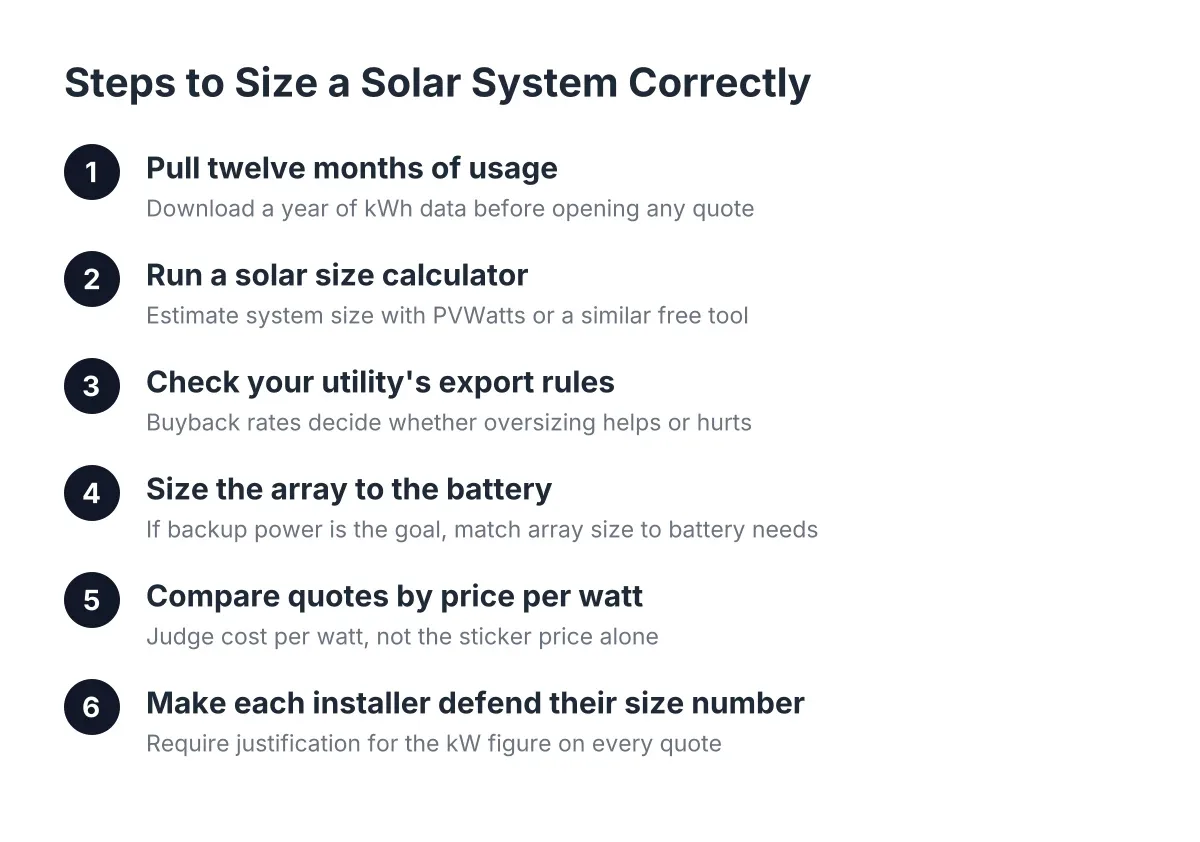
This is also where getting multiple quotes earns its keep. Reading and comparing solar quotes side by side exposes the outlier fast; when three quotes include labor in workmanship coverage and one is silent, the silence is the answer.
Re-Reading Your Original Contract: The Existing Owner's Checklist
If you bought or leased solar 5 to 15 years ago, the fine print you skipped then is now the document that decides your next move. Before adding a home battery, buying out a lease, or replacing an underperforming inverter in 2026, pull the original contract and check four things.
First, confirm what equipment warranties are still live. Find your panel and inverter model numbers on the original quote or the system labels, then check remaining coverage with the manufacturer directly, not the installer. A 12-year inverter warranty on a 2015 system has expired or is about to.
Second, if your system is leased or under a power purchase agreement, remember that you do not own it; a solar lease works like an equipment lease where you pay a fixed monthly amount regardless of production, as the U.S. Environmental Protection Agency (EPA) describes. Maintenance responsibility typically sits with the owner entity for as long as it owns the system. Read your buyout clause, any rate escalator, and the transfer terms before adding anything to the roof, because modifying a leased system without the owner's sign-off can void your agreement.
Third, check retrofit compatibility before accepting any battery quote. A new battery must work with your existing inverter architecture, and a quote that does not ask what inverter you have is a quote written without looking at your system. Any battery warranty in that quote will carry the same monitoring connection requirements described above, so ask how the new monitoring layers onto your old one.
Fourth, run your own production check before paying for a diagnosis. The free PVWatts calculator from NREL estimates what a system of your size and orientation should produce at your address; Google's Project Sunroof solar calculator offers a similar roof-level estimate. Compare the PVWatts NREL estimate against your monitoring history or your utility's export records. A gap of 15 percent or more that persists across seasons justifies a service call. These tools are estimates, and shading, soiling, and weather will move the numbers, so treat a flagged gap as a reason to investigate, not proof of a warranty claim.
One limitation worth stating plainly: warranty documents, lease buyout math, and interconnection rules get legal and technical fast. For a lease buyout decision or a disputed warranty claim, paying a licensed electrician or an attorney to review the paperwork is cheap compared to guessing wrong.
The Fine Print Checklist, In Order
When the next quote lands on your table, read it in this order and write the answers down:
- Exact model numbers for panels, inverter, and battery, in writing.
- Each warranty term and the company backing it: panel product, panel performance, inverter, battery, workmanship.
- Whether repair labor is covered for warranty replacements, and by whom.
- The monitoring platform, who receives alerts, and how long the service runs.
- For batteries: throughput caps, capacity retention guarantee, and any internet connection requirement.
- Your utility named correctly, with its current export credit, buyback, or Value of Solar terms acknowledged.
- Evidence the installer will survive the warranty: license, history, employee crews, and third-party warranty backing if any.
Price per watt tells you what solar costs today. The warranty and monitoring fine print tells you what it costs in year eight, during a July heat wave or a February freeze, when the system either carries your house or sits dark on the roof. Read those pages first. The rest of the quote is easier after that.
For help with reading and comparing solar quotes, Austin Solar FAQ is the place to start.
Prefer to talk it through? Call +15125571906 — a quick call is usually the fastest way to get a straight answer for your situation.