Solar in Pedernales Electric Co-op Territory — Complete Guide
Going solar in Pedernales Electric Coop territory is a different decision than going solar next door in Austin Energy or Oncor country, because PEC's export rate changes the math on how big your system should be. This guide covers what solar in Pedernales Electric Coop territory actually pays back, how PEC credits the power you send to the grid, and why the utility on your bill matters more than the town on your mailbox. You'll also find straight answers on system costs in Kyle, Pflugerville and the wider PEC service area, plus guidance on batteries, quotes and incentives. I work in residential solar around Austin, and I wrote this because most pages ranking for these questions quote stale rates or national averages that don't apply here.
What You'll Find in This Guide
Prefer to have a pro handle it? Solar in Pedernales Electric Co-op territory is one call away.
How Solar in Pedernales Electric Coop Territory Pays You Back
The single most important number for a PEC member considering solar is the export credit. When your panels produce more electricity than your home uses, that surplus flows to the grid and PEC credits you for it. The credit size determines whether oversizing your system makes sense.
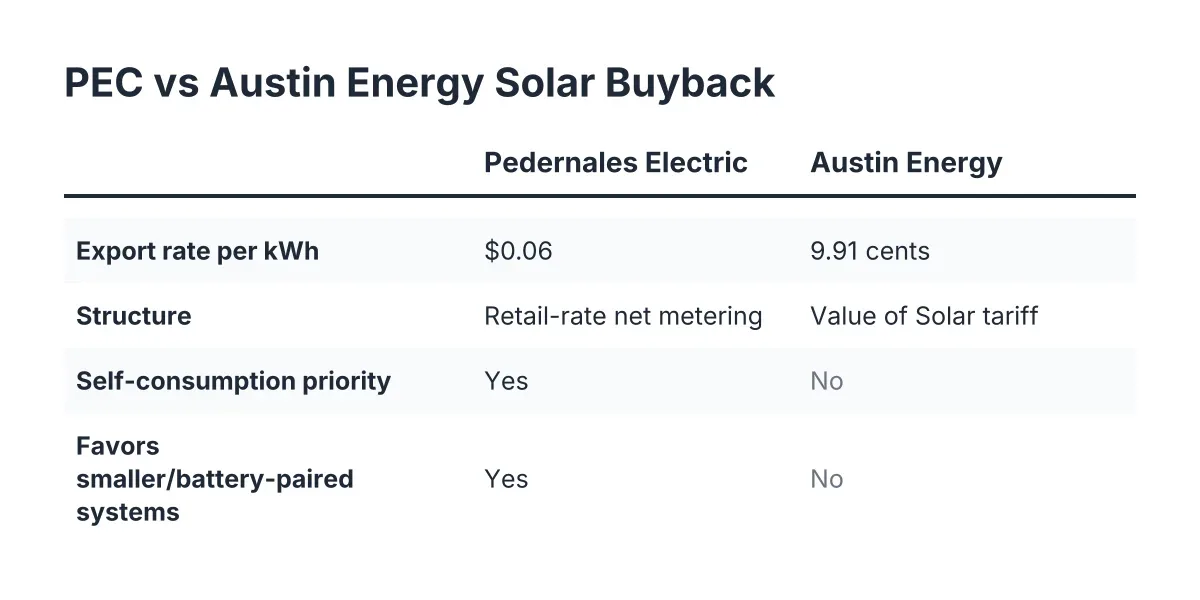
Pedernales Electric Cooperative credits solar exports at $0.06/kWh, compared to Austin Energy's 9.91 cents per kWh under its Value of Solar tariff. This gap matters significantly. Two neighbors in the same subdivision on different utilities should not buy the same system—the PEC member receives less for every exported kilowatt-hour.
In PEC territory, the goal is self-consumption. Every kilowatt-hour your panels produce and your home uses immediately is worth the full retail rate. Every kilowatt-hour exported is worth the lower credit. The smartest PEC systems are sized to match your daytime usage, not to zero out your annual bill on paper.
This is where many quotes go wrong. National sales templates assume one-to-one net metering everywhere. An installer sizing your PEC system as if you lived in Austin Energy territory will oversell you by 20 to 40 percent. The extra panels produce power exported at a discount, stretching your payback by years. The full guide to solar in Pedernales Electric Co-op territory walks through the sizing math with worked examples.
PEC solar still pays back well when sized correctly. Texas installed 2.7 GWdc of solar in Q1 2025, more than any other state and 92% more than Florida, according to the Solar Energy Industries Association. The economics work here—you just need to run the numbers for your utility, not for a generic Texas homeowner.
Sizing, Costs and Reading Quotes as a Pedernales Electric Coop Member
Because exports earn less in PEC territory, the sizing conversation should come before the pricing conversation. However, most homeowners get a price first and a sizing rationale second, if at all. Flip that order and you'll make a better decision.
Start with your usage, not your roof
Pull twelve months of PEC bills before you talk to anyone. Your annual kilowatt-hour consumption, and roughly when you use it, sets the ceiling on a sensible system size. For example, a household that runs the air conditioning hard from noon to 6 p.m. consumes a lot of solar production in real time. That household can justify a larger array than a family that's out all day and uses most of its power after sunset. In the second case, a smaller system or a battery makes more sense than extra panels.
Roof orientation matters too. West-facing panels produce later in the afternoon, when Central Texas usage peaks. In PEC territory, that afternoon alignment can beat a bigger south-facing array on pure payback, because more of the production gets used instead of exported.
What a fair quote looks like
Expect quotes to price per watt, before the federal tax credit. Beyond that, a good quote for a PEC home should show three things. First, a production estimate tied to your actual roof, not a generic irradiance number. Second, a self-consumption assumption, meaning the share of production your home uses directly. Third, a payback calculation that uses PEC's actual export credit, not retail-rate net metering. If a proposal shows your exports earning the same rate you pay PEC, the installer either doesn't know the territory or hopes you don't. For members considering solar, Pedernales, electric, and coop incentive structures should all factor into your quote comparison.
With this in mind, get at least three quotes and compare the assumptions, not just the bottom line. A cheaper system sized wrong costs more over ten years than a fairly priced system sized right. The PEC territory deep dive covers the specific red flags to watch for in proposals written for this co-op's rates.
Batteries, Backup Power and Incentives for PEC Households
The lower an export credit is, the stronger the case for a home battery. Instead of selling surplus power at a discount, you store it and use it after dark at full retail value. For PEC members, that shift changes the battery conversation from a luxury to a genuine financial question.
When a battery makes sense on PEC
Run the comparison honestly. A battery adds meaningful cost to your project, and it needs to earn that back through avoided purchases and backup value. In PEC territory, the arbitrage works like this: your panels charge the battery midday, and the battery powers your home in the evening. Every stored kilowatt-hour displaces power you would otherwise buy from PEC at retail. Additionally, the battery keeps your lights, refrigerator and internet running through outages, which matters in the Hill Country where storms and grid stress cause more interruptions than city dwellers expect.
The main options are the Tesla Powerwall, Enphase batteries and Generac PWRcell. Each pairs differently with different inverter setups, so the right choice depends on the system you're buying, not on brand loyalty. For homes with medical equipment or well pumps, a whole-house standby generator can complement or replace a battery. Generators run on propane or natural gas and handle multi-day outages better, but they do nothing for your daily bill.
Incentives available to PEC members
Here's the honest part most pages skip. PEC members do not get Austin Energy's rebates. Utility incentives follow the utility, so the rebate programs you see quoted in Austin-area articles usually don't apply outside Austin Energy's footprint. What you do get is the federal residential clean energy tax credit, which applies regardless of utility, plus any property tax exemption Texas offers on the added home value from solar. Verify current program details before you sign anything, because incentive terms change.
For scale, Texas had 34,907 megawatts of solar installed as of Q2 2024, enough to power an estimated 4,063,719 homes, according to Go Solar Texas citing SEIA data. The market is mature here. Consequently, you have leverage as a buyer. Installers compete hard for PEC-territory projects, and you should make them compete on accurate assumptions.
Frequently Asked Questions
Why is my electric bill so high if I have solar panels?
Usually because your system exports power at a lower credit than the retail rate you pay for imports, so evening and nighttime usage still costs full price. Undersized systems, new pool pumps or EV chargers, and seasonal air conditioning spikes are other common causes. Check your PEC bill's import and export lines to see where charges originate.
How much does solar installation cost for a home in the Pedernales Electric Co-op service area?
Costs depend on system size, roof complexity, and equipment; prices shift regularly so no single figure endures. Most PEC homes need smaller systems than Austin Energy customers with the same bill, because exports earn less credit and oversizing doesn't pay. Get quotes priced per watt before the federal tax credit and compare sizing assumptions between installers.
Why is my electric bill high if I have solar?
Solar credits nighttime exports at PEC's rate, which is below retail. Any power you buy after sunset gets billed at full price, keeping bills high if you use heavily in evenings. A battery or shifting when you run big appliances can close that gap.
How much does solar installation cost in Kyle TX with Pedernales Electric Co-op?
Kyle homes on PEC pay regional market rates. The key is sizing: size to daytime self-consumption because PEC's export credit is lower than retail. Collect three quotes and confirm each uses PEC's actual export rate in its payback math.
How much does residential solar cost in Pflugerville with Pedernales Electric Co-op?
Pflugerville sits on a utility boundary—confirm PEC sends your bill, as neighbors may be on different utilities with different economics. If you're on PEC, pricing matches the wider Austin-area market, and export credit should shape your system size. A quote based on retail-rate net metering will overstate savings.
How much is a solar system for a 2000 sq ft house?
Square footage is a weak predictor because usage drives system size, not floor area. A 2,000 sq ft home with a pool and an EV needs far more capacity than the same house without them. Size from twelve months of actual kilowatt-hour usage from your PEC bills instead.
Ready to Get Started?
If PEC sends your bill, the next step is simple: pull your last twelve months of usage and read the full territory guide before you request a single quote. You'll walk into every sales conversation knowing what the export rate means for your system size, and that knowledge alone can save you thousands. Start with the numbers, and the right system follows.