Solar Panel Inspection — Complete Guide
If you just bought a home with panels on the roof, or your electric bill stopped making sense, a solar panel inspection is how you find out what you actually own. This guide explains what a proper inspection should check, what it costs, and who is qualified to do it in the Austin area. Because your utility decides how your system gets paid, we also cover why an inspection here should look at your interconnection paperwork, not just your hardware. By the end, you will know how to hire an inspector, what red flags to watch for, and when an inspection is worth the money.
What You'll Find in This Guide
Coming soon — we're building out this topic cluster.
What a Real Solar Panel Inspection Should Actually Check
Most homeowners assume an inspection means someone climbs on the roof and looks at the panels. That is part of it, but it is the smallest part. A thorough solar panel inspection covers five areas, and skipping any one of them leaves you with an incomplete picture.
First, the electrical side. An inspector should open the combiner box and disconnect switch, check wire terminations for corrosion or heat damage, and confirm the system was grounded correctly. Loose connections are the most common cause of underperformance and the most common fire risk. In practice, this is where cheap installs from the 2020 to 2022 boom years show their age.
Second, the roof attachment. Every penetration through your shingles is a potential leak. A good inspector checks flashing, sealant condition, and whether the racking was bolted into rafters or just decking. Additionally, they should note whether the roof itself has enough life left to outlast the panels, because removing and reinstalling a system for a reroof costs thousands.
Third, production data. This is the insider's test that separates a real solar inspection from a visual once-over. The inspector should pull your monitoring history, compare actual output against what a system of that size and orientation should produce in Central Texas, and flag any strings or microinverters that dropped out months ago without anyone noticing. However, many home inspectors never do this, because they lack monitoring access or the training to interpret it.
The Paperwork Matters as Much as the Panels
Fourth, documentation. You want the original permit, the interconnection agreement with your utility, and the warranty registrations for panels, inverters, and any battery. If the previous owner leased the system or financed it with a lien, that agreement transfers to you and changes the math entirely.
Fifth, the utility relationship. This one is unique to our market. As a result of Austin's patchwork of providers, the same system earns very different money depending on who sends the bill. Austin Energy pays exports through its Value of Solar tariff at 9.91 cents per kWh, according to NuWatt Energy, while Pedernales Electric Cooperative credits exports at $0.06 per kWh under retail-rate net metering, per SolarSavingsAI. An inspection that ignores which program the system is enrolled in tells you what the hardware is worth, but not what it earns.
Solar Panel Inspection Cost and Who to Hire
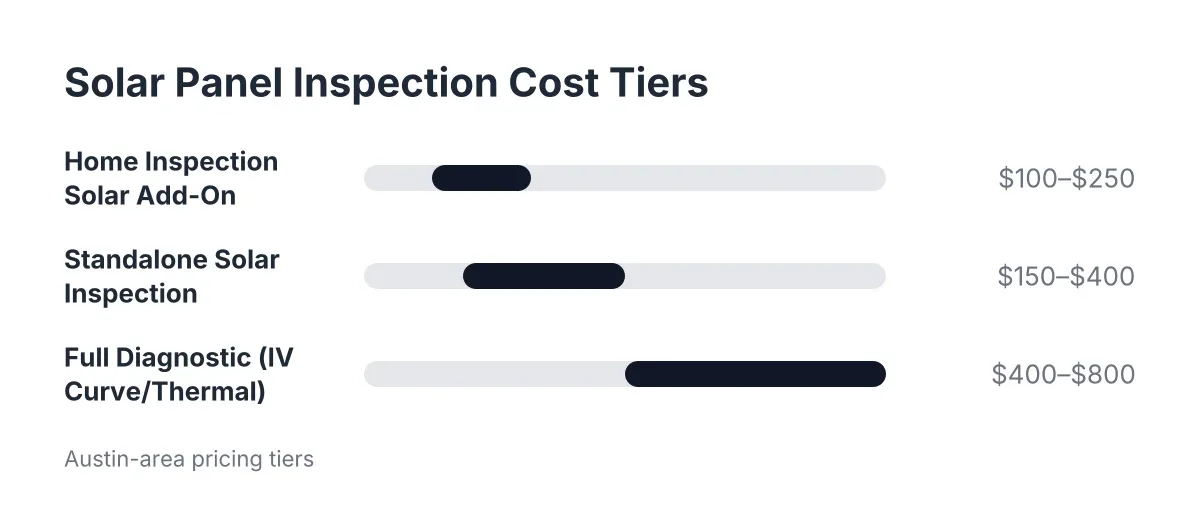
Pricing for a solar panel inspection in the Austin area runs in tiers, and the tier you need depends on why you are inspecting.
At the low end, some home inspectors offer a solar add-on to a standard home inspection for roughly $100 to $250. To put it simply, this buys you a visual review. The inspector confirms the panels exist, notes obvious physical damage, and checks that labels and disconnects are present. That said, most home inspectors are not licensed electricians and will not open equipment or analyze production data.
The middle tier is a standalone inspection from a solar company or an electrician with solar experience, typically $150 to $400 depending on system size and roof access. This should include electrical testing, a racking and roof check, and a monitoring review. For a home purchase, this is usually the right level of spend, because it catches the problems that cost real money.
At the top end, a full diagnostic with IV curve tracing or thermal imaging can run $400 to $800 or more. For example, if your system has a suspected ground fault, intermittent inverter errors, or a string that produces half of what it should, this level of testing pinpoints the failure instead of guessing. Beyond that, insurance claims after hail often require this depth of documentation anyway.
How to Vet Solar Panel Inspection Companies
Who does the work matters more than the price. Look for inspectors who hold a NABCEP certification, the trade association credential most installers respect, or a Texas electrical license with documented solar experience. Ask three questions before you book. Can you pull and interpret my monitoring data? Will you check my interconnection status with my specific utility? Do you install systems yourself, or only inspect?
That last question cuts both ways. An installer who inspects may find problems and quote you the repair, which is convenient but creates an obvious incentive. Conversely, a pure inspector has no repair revenue riding on the findings but may hand you a report and no path to fix anything. Neither model is dishonest by default. However, you should know which one you hired, and you should treat any inspection that ends in a hard sales pitch for a brand-new system with suspicion.
When an Inspection Is Worth It: Home Purchases, Performance Problems, and Utility Changes
Not every solar owner needs an inspection this year. With this in mind, here are the three situations where paying for one clearly beats skipping it.
The first is buying a home with an existing system. Texas leads the country in solar growth, installing 2.7 GWdc in the first quarter of 2025 alone, 92% more than second-ranked Florida, according to the Solar Energy Industries Association. As a result, thousands of Austin-area homes now change hands with panels attached and sellers who cannot answer basic questions about them. Before closing, you want to know four things. Does the system work at full capacity? Is it owned outright, leased, or under a loan with a lien? Do the warranties transfer to you? And which utility program is it enrolled in, since that enrollment does not always transfer automatically? A few hundred dollars of inspection during your option period is cheap insurance against inheriting a $25,000 liability that looks like an asset.
The second situation is a performance problem you cannot explain. If your bills crept up while your usage stayed flat, or your monitoring app shows production falling year over year faster than normal degradation, an inspection finds the cause. In many cases, the culprit is mundane: a failed microinverter, a tripped breaker, rodent-chewed wiring, or shading from a tree that grew. Occasionally it is the utility side, such as a meter swap or rate change that quietly altered how your exports get credited. An inspector who checks both sides saves you from replacing hardware when the real issue was billing.
Storm Damage and Insurance Timing
The third trigger is weather. Central Texas hail does not always crack glass visibly. Instead, it can create microcracks that cut output over months. Therefore, after any significant hail event, photograph your panels, pull your production data from before and after, and consider a documented inspection while your insurance claim window is open. Insurers respond to measured production loss and thermal images far better than to a homeowner's hunch. If you wait a year and then notice the decline, proving causation gets much harder.
If none of these three apply to you, a routine inspection every three to five years is reasonable, but not urgent. Meanwhile, checking your monitoring app monthly costs nothing and catches most failures early.
Ready to Get Started?
You do not need to become a solar technician to protect yourself. You just need to know what a real solar panel inspection includes, what a fair price looks like, and which questions expose an inspector who is really a salesperson. Start by pulling your monitoring data and your interconnection paperwork, then hire someone who can read both, because in this market the utility relationship is half the value of the system.