Tesla Powerwall 3 Cost and Installation Price in Austin, 2026: What You’ll Actually Pay
If you sat through the last multi-day outage with a dark fridge and a dying phone, you have probably already priced backup power. This guide covers what a Tesla Powerwall 3 costs installed in the Austin area in 2026, what drives that number up or down, and how your utility changes the math. I work in this industry locally. The short version: the sticker price of the battery is the smallest surprise in the project. The install scope, your panel, your utility territory, and what you expect the battery to run during an outage are where the real money moves.
One rule for everything below: every dollar figure carries its as-of date, and your numbers will differ. Treat the ranges here as a sanity check for the quotes you collect, not as a promise.
What a Tesla Powerwall 3 Costs Installed in Austin in 2026
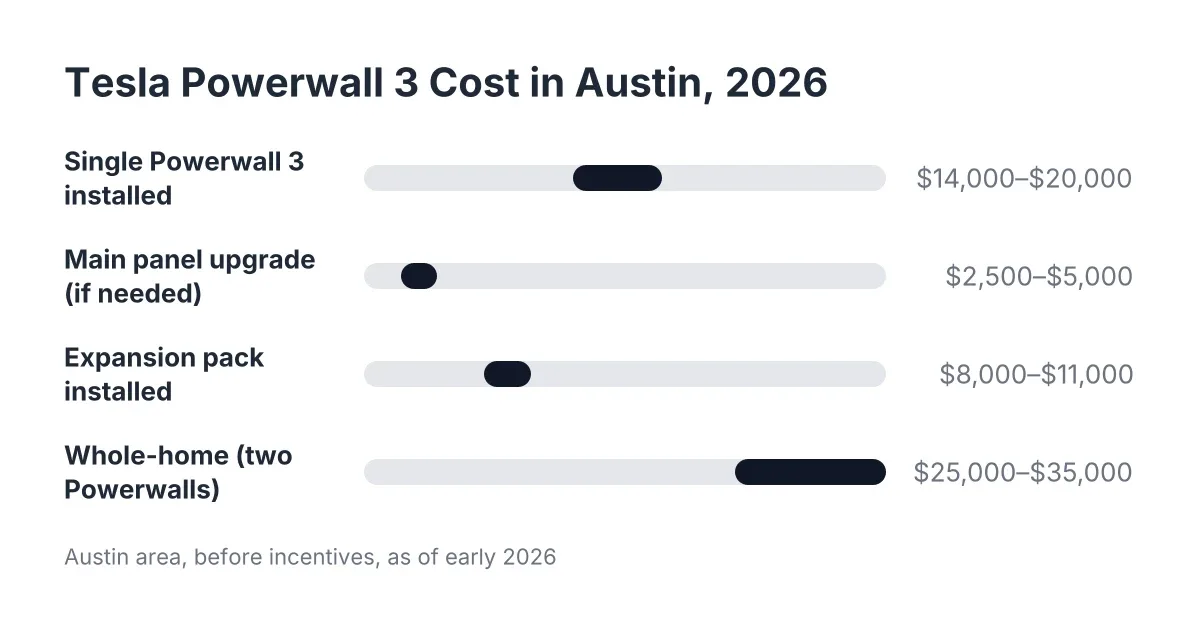
As of early 2026, a single Tesla Powerwall 3 installed in the Austin area typically lands between $14,000 and $20,000 before any incentives. The hardware itself is only part of that. Permitting, the gateway, electrical work, and sometimes a panel upgrade make up the rest. Your numbers will differ based on your home's wiring and your utility's requirements.
Here is why the range is that wide. The Powerwall 3 unit and its gateway carry a fairly consistent equipment price. The installed price moves with everything around it: how far the battery sits from your main panel, whether your main panel can accept the interconnection, whether you need a load management device, and what your city or county charges for permits and inspections.
Think of it the way you would think of any electrical or construction project. The total is set by the whole project scope, not the box on the wall. A straightforward garage install next to a modern 200-amp panel sits at the bottom of the range. A 1990s home in Leander with a crowded 150-amp panel, a long conduit run, and a required panel upgrade can push past the top of it.
A rough breakdown of where the money goes on a typical single-battery project, as illustrative estimates as of 2026:
- Battery and gateway hardware: usually 55 to 65 percent of the total
- Labor and electrical materials: 20 to 30 percent
- Permits, engineering drawings, and inspection fees: a few hundred to a couple thousand dollars
- Main panel upgrade, if needed: $2,500 to $5,000 on top of everything else
That last line item surprises people the most. If your installer tells you your panel needs work, that is not an upsell by default. Interconnection rules and load calculations often force it. Ask them to show you the load calculation either way.
Tesla Powerwall 3 Specs That Matter for the Price
The Powerwall 3 stores 13.5 kWh of usable energy and can deliver 11.5 kW of continuous power. Those two numbers decide whether one battery is enough for your house, which decides whether you are pricing a $16,000 project or a $35,000 one. Capacity is how long you can run things; power is how much you can run at once.
The 11.5 kW continuous output is the figure that matters for a Texas summer. That is enough to start and run one central air conditioner on most homes, along with the fridge, freezer, internet, and lights. It is generally not enough to run two AC units plus a pool pump plus an electric dryer at the same time. During an outage you would stagger those loads, or you would buy more capacity.
The Powerwall 3 also has an integrated solar inverter that accepts up to 20 kW of solar input. For a storm-prepper, that detail matters more than it sounds. If you add panels now or later, the battery recharges during a multi-day outage instead of just draining. That is the difference between 12 hours of backup and essentially indefinite backup for essential loads.
If you need more storage, the Powerwall 3 expansion pack adds 13.5 kWh of capacity without a second full inverter, at a lower cost than a second complete unit. As of 2026, expect an installed expansion pack to add roughly $8,000 to $11,000 to the project. Your numbers will differ, and the expansion unit still needs wall space, which brings up a practical point: confirm where the equipment will physically go before installation day. Multi-unit systems take more wall than people expect.
How Many Powerwalls Does an Austin Home Need?
Most Austin-area homes get meaningful backup from one Powerwall 3 and whole-home-style backup from two. One unit covers essentials for a day or more. Two units, or one unit plus an expansion pack, let a 2,200-plus square foot all-electric home run close to normally through a typical outage, with some discipline on the AC.
Sizing comes down to two questions. First, what must stay on? For most families after a bad outage, the honest list is the fridge, the freezer, the internet, phone charging, some lights, and in summer, one AC zone. Second, how long must it stay on? Winter Storm Uri in February 2021 left 69 percent of Texans without power for an average of 42 hours, according to Tesla. Design for 42 hours, not for 4.
Here is a hypothetical to make it concrete. Say a homeowner in Hutto has a 2,400 square foot all-electric house with a heat pump and an EV. One Powerwall 3 holding 13.5 kWh would run their essentials, fridge, freezer, router, lights, and phones, for well over a day. Add the heat pump in mild weather and that drops to roughly 10 to 14 hours. In that scenario, a second battery or an expansion pack plus a modest solar array is what turns a one-day cushion into multi-day resilience. The EV does not charge during the outage; that is a trade-off to accept, not engineer around.
A useful general rule: whole-home backup usually means either one large battery with aggressive load management or about 27 kWh of storage, which is two Powerwall 3 units. Budget $25,000 to $35,000 installed for that tier in the Austin area as of 2026, before incentives. Your numbers will differ.
Do You Need Solar Panels to Get a Powerwall?
No. The Tesla Powerwall 3 installs without solar, charges from the grid, and switches to backup automatically when the grid fails. Plenty of Austin-area homeowners buy the battery alone as a backup power solution for Texas power outages. Solar is optional, but it changes what the battery can do.
Without panels, the battery is a tank. When it is empty, you wait for the grid. With panels, the system refills itself every day the sun comes up, even during an outage. A solar panel battery for home backup is the only setup that handles a four-day event gracefully. If outage duration is your main fear, and for most people reading this it is, price the battery both ways before deciding.
One caution on timing. The federal purchase credit, the 25D credit that historically returned 30 percent of a residential solar installation's cost according to the Internal Revenue Service, has ended for purchased systems. The lease credit under the 48E path survives for leased and third-party-owned systems. That shift changed the buy-versus-lease math in 2026, and it is worth modeling both before you sign anything. Note that with a lease or PPA you do not own the system, according to the U.S. Environmental Protection Agency (EPA), which matters if you sell the house.
Your Utility Changes the Powerwall Math
The utility that sends your bill, not your town, decides what your battery earns when you are not in an outage. Austin, Pedernales Electric Co-op, Oncor retail territory, Georgetown Utility Systems, and Bluebonnet all treat exported energy differently. That difference moves your payback by years.
For Austin Energy customers, all solar production is credited under the Value of Solar tariff rather than retail-rate net metering. Austin Energy credits every kilowatt-hour a home's panels produce at its Value of Solar rate, 12.89 cents per kWh for systems under 1 MW-AC effective October 1, 2026, and bills the home for all the electricity it uses, according to Austin Energy; your rate at signing may differ. Under Value of Solar, storing solar does not increase the credit on that production, but a battery covers outages and may qualify for Austin Energy's separate Power Partner Battery pilot. Buy it for backup first.
Pedernales Electric Cooperative customers see different numbers. PEC credits surplus solar sent to the co-op at 7.1921 cents per kWh, only toward the Base Power Charge, with unused credits expiring each calendar year-end, according to PEC. Check the current PEC tariff before you model anything; co-op rates change by board vote.
Oncor territory works differently again. Oncor delivers the power, but you buy electricity from a retail provider you choose. In deregulated markets like this, customers can pick among multiple solar buyback plans that credit surplus energy sent to the grid, according to Solar United Neighbors. Some retail plans pay well for battery exports during price spikes. A home battery paired with automated energy management can store cheap midday solar and discharge during expensive evening hours without you touching anything. In Oncor territory, that can stack buyback credits, virtual power plant payments, and backup value in one device.
Georgetown Utility Systems and Bluebonnet customers sit in regulated territory with one buyback option or few, consistent with how Solar United Neighbors describes regulated markets. For those homeowners, the battery's value is overwhelmingly backup and self-consumption, not export income. That does not make it a bad buy. It makes it a resilience buy, and you should judge the price on those terms.
Whatever your territory, expect paperwork. Utilities that allow residential interconnection commonly require engineering documentation and drawings for review before installation is approved, according to Arizona Public Service (APS), and the Austin-area utilities follow the same pattern. A competent installer handles this, but it adds two to eight weeks to the timeline. If you want power secured before next winter, start the process in the fall, not December.
Powerwall 3 Versus a Whole-House Generator
For most Austin-area storm-preppers in 2026, the honest comparison looks like this. A standby generator costs less upfront for true whole-home coverage, typically $12,000 to $18,000 installed with a natural gas line as of 2026, as an illustrative estimate. A Powerwall 3 costs more per kilowatt of coverage but runs silently, needs no fuel, starts instantly, and earns value every normal day. Your numbers will differ.
The generator's weakness showed during Uri. Natural gas pressure dropped in parts of Texas during that storm, and a generator without fuel is a lawn ornament. The battery's weakness is capacity. A generator runs as long as gas flows; a battery without solar runs until it is empty. A battery with solar splits the difference and recharges daily.
A few honest decision rules:
- All-electric home, outages under two days your main fear, budget near $15,000: one Powerwall 3 covering essential circuits is the cleaner answer.
- Large home with two AC units, medical equipment, or a hard requirement to run everything indefinitely: a standby generator, or a generator plus a small battery, still wins on raw endurance.
- You want backup and want to cut a $250-plus monthly bill: Powerwall 3 plus solar panels is the only option on this list that does both jobs.
- Budget under $2,000: a portable power station for home backup will keep phones, the router, and a CPAP alive for a night. It will not touch your fridge for long or your AC at all, but it is a legitimate stopgap while you plan the bigger project.
One more option worth knowing exists before you commit. Some battery service companies in Texas install and retain ownership of the equipment, selling stored power back to the grid as their revenue model, and charge the homeowner a service fee instead of a purchase price. Homeowners often assume backup means an expensive generator and never hear about this model. It is not a Powerwall 3 purchase and the trade-offs differ, especially around who controls the battery during grid events, so read those contracts closely.
Getting the Installation Right: Steps That Protect Your Money
You have decided. Now the job is execution, and a battery backup for home power outage protection only pays off if the install is scoped correctly. Here is the sequence that avoids the common regrets.
First, get a load calculation in writing before you sign. The installer should list which circuits the battery backs up and estimate runtime for a summer outage and a winter outage separately. If the proposal just says whole-home backup with one battery on a 2,500 square foot all-electric house, push back. The math rarely supports that without load management hardware.
Second, walk the install location with the installer. The Powerwall 3 is about 44 inches tall and 24 inches wide and weighs roughly 290 pounds as of its published 2026 specifications; check the current Tesla spec sheet since details change. It mounts on a wall or the floor, garage or exterior. Confirm clearances, shade for an exterior unit, and space for a future expansion pack even if you are not buying one yet.
Third, confirm who files the interconnection paperwork with your utility and what the current timeline runs. Then ask how the system behaves on day one of an outage. A Powerwall detects a grid failure and switches to backup in a fraction of a second, fast enough that most appliances never notice. You should still test it. Ask the installer to simulate an outage at commissioning while you watch the app.
Fourth, skip the DIY temptation. This is a high-voltage interconnected system that requires permits, utility approval, and in most jurisdictions a licensed electrician. The product is also sold through certified installers for a reason. Home battery storage and backup is one of the few home projects where the paperwork is genuinely as important as the wiring, because an unpermitted battery can void insurance coverage and block a future home sale. If your situation involves a dated panel, aluminum wiring, or a well pump, get a licensed electrician's assessment before you believe any quote.
Is the Powerwall 3 Worth It in Austin in 2026?
For a homeowner who lost two days of power and is staring at $200-plus monthly bills, a Powerwall 3 paired with solar is usually worth pricing seriously; a battery alone is worth it if backup is the whole goal and the budget covers it. Texans experienced a 17 percent increase in power outage frequency between 2017 and 2022, according to Tesla. The grid problem you are planning around is measured, not imagined.
The payback math is honest but unglamorous. In Austin Energy territory under Value of Solar, or in Georgetown and Bluebonnet territory with limited buyback, the battery mostly buys resilience, not revenue. In Oncor retail territory with the right buyback plan, it can do both. Solar itself remains a large and growing Texas story; the state had 34,907 megawatts installed as of Q2 2024, enough to power more than four million homes, according to Go Solar Texas. The residential economics, though, come down to your roof, your usage, and your utility.
My plain advice, over the fence: decide what must stay on during 42 dark hours, size the battery to that list, get the load calculation in writing, and check the interconnection rules for your specific utility before you compare prices. Every figure in this article carries its as-of date for a reason. Rates, credits, and hardware prices will have moved by the time you sign, and your numbers will differ. Build your spreadsheet on the quotes in front of you, not on anyone's article, including this one.
For help with home battery storage and backup, Austin Solar FAQ is the place to start.
Prefer to talk it through? Call +15125571906 — a quick call is usually the fastest way to get a straight answer for your situation.