Solar Payback in Bluebonnet Territory: 7 Steps to Run the Math Before You Buy
If you just closed on a new-construction home in Bastrop, Kyle, or the east side of Hutto, and Bluebonnet Electric Cooperative sends your bill, a generic solar panel cost calculator will get your payback estimate wrong. Most calculators assume one-to-one net metering. Bluebonnet is a member-owned co-op, not a deregulated retail market and not Austin Energy, and its export credit terms decide your payback timeline more than the panel brand or the installer's pitch. Here are seven steps to run the numbers correctly for your specific house in 2026.
Quick note on who I am: I have hands-on residential solar experience in the Austin area. I do not install systems, sell leads, or work for any utility. This is the math I would run on my own house.
1. Confirm Bluebonnet Is Actually Your Utility Before You Model Anything
The utility on your bill, not your town's name, decides your solar outcome. New subdivisions around Kyle, San Marcos, Bastrop, and Hutto sit on boundary lines where one street is Bluebonnet, the next is San Marcos Electric Utility or Pedernales Electric Co-op. Pull out a bill and read the header before you touch a spreadsheet.
This matters because the terms differ sharply by utility. For comparison, Austin Energy credits all solar production at its Value of Solar rate of 12.89 cents per kWh for systems under 1 MW-AC, effective October 1, 2026, according to Austin Energy, while Pedernales Electric Cooperative credits surplus solar sent to the co-op at 7.1921 cents per kWh, only toward its Base Power Charge, according to PEC. Both figures are as of the sources' most recent publication; rates change, and your numbers will differ. Bluebonnet sets its own terms as a co-op, so verify the current export credit directly with Bluebonnet before you sign anything.
I cover the neighboring utilities in the rest of my guide to Solar in Bluebonnet and San Marcos territory, so if your bill says San Marcos Electric Utility, that piece is the better read.
2. Feed Your Real Usage Into a Solar Panel Cost Calculator, Not a National Average
A solar panel cost calculator is only as good as the inputs, and national tools default to national averages that do not match a 2,400 square foot all-electric house in Central Texas with a pool pump running through a 100-degree August. Log into your Bluebonnet account and pull 12 months of actual kWh usage. If you moved in recently and only have three months, ask the builder or Bluebonnet what similar homes in the subdivision draw, and treat any estimate as soft.
For example, suppose a family in a new Bastrop-area subdivision sees a $310 July bill and a $140 January bill. Averaging those two and multiplying by twelve understates summer-heavy usage. Twelve real months, or the closest honest approximation, is the only input that produces a payback estimate worth trusting.
Two more inputs most calculators bury: roof orientation and shade. New-construction roofs in these subdivisions are usually unshaded today. Check where your neighbor's trees will be in ten years before you trust a satellite image from last spring.
3. Replace the Calculator's Net Metering Assumption With Bluebonnet's Actual Export Credit
Most online tools, including well-known ones, assume every kWh you export earns the same rate you pay to import. Texas does not work that way. In regulated and co-op territory you get one buyback structure, the one your utility offers, rather than the menu of buyback plans available to Oncor-area homeowners in the deregulated market, a distinction Solar United Neighbors documents.
Therefore, before you trust any payback number, do this:
- Call Bluebonnet or check its member portal for the current export credit rate and how it is applied, monthly or per billing cycle.
- Ask whether excess credits roll over, expire, or cash out at year end.
- Ask what fixed monthly charges remain no matter how much you generate. Grid access and service charges do not disappear with solar, which is why a zero-dollar bill is close to impossible even with an oversized system.
- Rerun your solar panel cost calculator with the import rate and export rate entered separately, if the tool allows it. If it does not allow it, use a different tool. PVWatts handles production estimates well but leaves the rate math to you, which is honest.
The rule of thumb: the closer the export rate sits to the import rate, the more valuable your exported energy, and the shorter your payback. A wide gap between the two means you should size the system to what you use during the day, not to your total annual consumption.
4. Size to Self-Consumption, Not to the Biggest System That Fits the Roof
When the export credit pays less than the retail rate, every kWh you use directly from your panels is worth more than a kWh you export. As a result, the payback-optimal system in most co-op territory is smaller than the roof-filling system a door-knocker will quote. A household with a $150 to $400 monthly bill, an unshaded roof, and a co-op export rate below retail usually breaks even fastest on a system covering 70 to 90 percent of annual usage. That range is an illustrative planning estimate, not a quote; your numbers will differ.
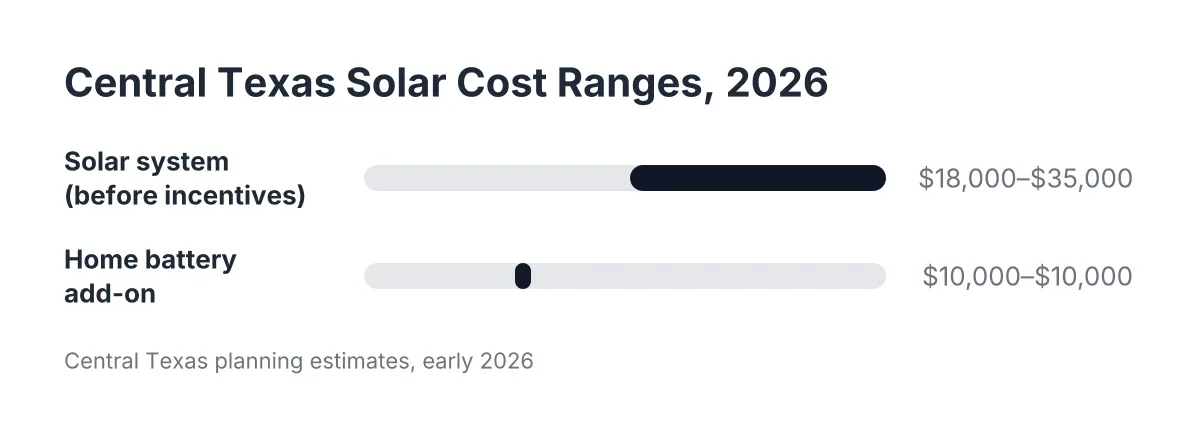
For a rough 2026 planning figure, cash costs for solar panels for home installation in Central Texas commonly land in the $18,000 to $35,000 range before incentives, depending on size and equipment. Treat that as a soft range as of early 2026. The cost of solar panels for home projects moves with equipment pricing and labor, and your quotes are the real data.
A home battery changes this math. Storing midday excess and using it at night converts low-value exports into full retail-value savings. Batteries add $10,000 or more to the project, so run the payback with and without one. Whether you look at a Tesla Powerwall paired with tesla solar panels or an Enphase or Generac setup, the battery decision is a rate-structure decision first and a backup-power decision second.
What the Solar Panel Cost Calculator Tells You About Your Bluebonnet Bill After Installation
After going solar in Bluebonnet territory, your bill drops but does not reach zero. You still pay the co-op's fixed monthly charges for grid access, you buy power at night and on cloudy days, and your exports earn a credit at whatever rate Bluebonnet currently sets. Expect a smaller bill, not a vanished one.
However, a well-sized system on a high-usage house can cut the energy portion of the bill by most of its value in summer. The fixed charges are the floor, and no calculator that promises a $0 bill is telling you the truth.
5. Get the 2026 Incentive Picture Right, Because the Federal Credit Changed
The federal side changed, and most calculator results have not caught up. Historically, a 30 percent federal tax credit applied to the total cost of a residential solar installation, according to the Internal Revenue Service. That purchase credit, the 25D path for homeowner-owned systems, has ended. The lease credit, the 48E path claimed by the system owner in a lease or power purchase arrangement, survives, which is why leasing pitches got louder in 2026.
Understand what a lease actually is before that pitch lands. A solar lease works like a car lease; you pay a fixed monthly amount for the panels regardless of production, and in neither a lease nor a PPA do you own the system, as the U.S. Environmental Protection Agency describes it. No upfront cost sounds good weeks after closing on a house. Compare the total 20-year lease payments against a loan or cash purchase before deciding, because the ownership math often still wins on payback even without the purchase credit.
Texas still helps in two durable ways. Solar equipment carries a sales tax exemption at purchase, and Texas offers a property tax exemption for the added home value, so the panels do not raise your property tax bill. Confirm both with your county appraisal district; the paperwork is on you.
6. Run the Payback Timeline by Hand Once, Even If a Calculator Did It First
Calculating the cost of solar panels for your home and the years to break even takes one honest page of math. First, take the installed cost after any incentives you can actually claim. Next, estimate annual production; PVWatts does this well for a Central Texas address. Then split that production into what you self-consume at Bluebonnet's retail rate and what you export at Bluebonnet's credit rate. Divide net cost by annual savings. That quotient is your payback in years.
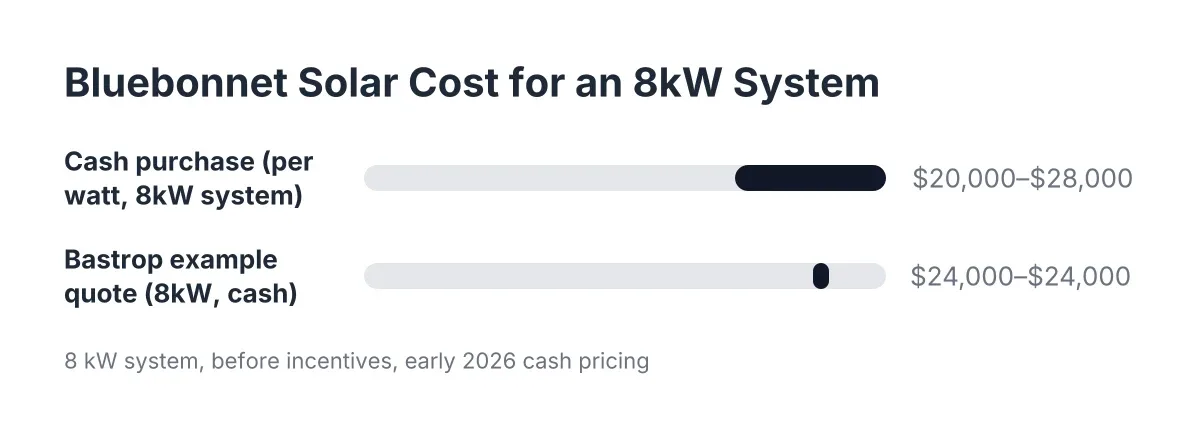
Here is an illustrative scenario, hypothetical and rounded. Say a new-construction buyer in Hutto's Bluebonnet-served area installs a system for $24,000 cash. Suppose it saves $2,000 a year at current rates with 75 percent self-consumption. That is a 12-year payback. If the export credit drops or the family adds an EV and self-consumes more, the timeline moves. Your numbers will differ, which is the entire point of doing the math yourself.
One structural note for spreadsheet builders: buyback rates and value-of-solar-style tariffs are not fixed for the life of your system. Utilities revise them periodically. Model a conservative case where the export credit falls, and see if the payback still fits your ownership horizon. If you plan to sell the house in five years, a 12-year payback is a hard conversation, and honestly, solar may be a poor fit.
7. If You Just Built, Decide Whether "Solar-Ready" Is Worth Waiting On
Solar-ready in a builder's brochure usually means conduit stubbed from the attic to the electrical panel, and sometimes a panel with spare breaker capacity. That saves an installer a few hundred dollars of labor and some drywall patching. It is worth something, but it is not a system, and it does not obligate you to any timeline.
Meanwhile, three things argue for waiting six to twelve months after move-in:
- You will have real usage data instead of guesses, which fixes the sizing problem from step two.
- Closing costs and move-in expenses are behind you, so a $24,000 decision is not stacked on top of them.
- Your HOA's actual enforcement behavior becomes visible. Texas law limits how far an HOA can restrict solar panels, but new-subdivision HOAs still control placement details, and it is easier to navigate that once you know the board.
The counterargument for moving sooner is a summer of $350 bills you could have offset. Neither answer is wrong. The mistake is deciding on a mailer's deadline instead of your own data.
How to Choose an Installer Once the Math Works
Bluebonnet requires interconnection paperwork before your system can operate, and utilities commonly require engineering documentation and drawings for review before approving installation, a standard practice Arizona Public Service describes for its own territory. Therefore this is not a DIY project for a grid-tied home; you need a licensed electrician, a permitted installation, and a signed interconnection agreement. Panel cleaning and monitoring-app checks you can handle yourself; wiring and interconnection you cannot.
When you compare quotes, ask each installer three questions:
- How many interconnections have you completed with Bluebonnet specifically, and what did the co-op's timeline look like?
- What export credit rate did you use in your savings projection, and what is its as-of date?
- What does the quote include: permitting, interconnection paperwork, monitoring, and workmanship warranty, or are any of those extra?
A fair quote itemizes equipment, labor, and soft costs, states its production estimate's source, and does not assume net metering that Bluebonnet may not offer. Installation itself typically takes one to three days on site once permits and utility approval clear; the paperwork phase before it often takes longer than the install. If a projection shows a payback under six years in co-op territory with no battery, ask hard questions about the export rate it assumed.
Texas has more installed solar than any state, 34,907 MW as of Q2 2024 according to Go Solar Texas citing SEIA data, and it led the nation again in early 2025 per the Solar Energy Industries Association. The market is mature here. That means good installers exist, and so do bad projections. Run your own solar panel cost calculator math with Bluebonnet's real terms first, and you will recognize which quote is which. For a payback question specific to your roof, your usage, and this year's rates, a conversation with a licensed local installer who knows Bluebonnet's process is the right next step.
For help with solar in Bluebonnet and San Marcos territory, Austin Solar FAQ is the place to start.
Prefer to talk it through? Call +15125571906 — a quick call is usually the fastest way to get a straight answer for your situation.