Georgetown Utility Systems Solar vs. Austin Energy: Which Buyback Pays Better in 2026?
If you are comparing quotes and trying to figure out whether Georgetown Utility Systems solar customers come out ahead of Austin Energy customers, the honest answer is: it depends on which lever matters more to you, the export credit or the upfront rebate. The two utilities take different approaches, and a solar buyback comparison shows how each one structures credits differently. Austin Energy pays a published Value of Solar rate on every kilowatt-hour your panels produce. Georgetown Utility Systems runs a smaller municipal program where the buyback terms are set locally and can change with a council vote. Neither one is retail-rate net metering, and neither one is what the national solar calculators assume when they spit out a payback number.
I have watched homeowners in both territories sign contracts based on the wrong utility's math. The installer quoted Austin Energy numbers to a Georgetown house, or the reverse. This article walks through how each utility actually credits your solar production in 2026, what that does to a payback calculation, and which questions to put to any installer whose quote is sitting in your inbox.
One caveat before the numbers start. Rates in this article carry their as-of dates because both utilities can and do change them. Your numbers will differ. Check the current rate sheet from the utility itself before you sign anything.
First, Confirm Which Utility Actually Bills You
This sounds basic. It is not. Georgetown Utility Systems serves the city of Georgetown and some surrounding areas, but Williamson County is a patchwork. Parts of Georgetown-adjacent neighborhoods sit in Pedernales Electric Cooperative territory. Some sit in Oncor's wires territory, where you pick a retail electric provider. The town name on your mailing address does not decide your solar economics. The logo on your electric bill does.
The same confusion runs the other direction. People search for solar costs in Buda, Kyle, Hutto, or Pflugerville "with Georgetown Utility Systems," and the short answer is that Georgetown Utility Systems does not serve those towns. Hutto and Pflugerville are mostly Oncor or co-op territory. Buda and Kyle are mostly PEC or San Marcos area utilities. If an installer's quote names the wrong utility for your address, that quote's savings projection is built on sand. Send it back.
So before you compare anything in this article against your quotes, pull out a recent bill and confirm the name at the top. Everything below assumes you are genuinely a Georgetown Utility Systems customer or an Austin Energy customer.
How the Georgetown Utility Systems Solar Buyback Works
Georgetown Utility Systems credits residential solar customers through a locally set buyback arrangement rather than one-to-one net metering. In practice that means the city credits exported energy at a rate it sets, which has historically tracked below the full retail rate you pay for imported power. The gap between those two numbers is the single most important figure in your payback math.
Here is the structure in plain terms. Your panels produce power during the day. Whatever your house uses in the moment, you avoid buying at the retail rate. That is the strongest dollar your system earns. Whatever your panels send to the grid gets credited at the buyback rate. When the buyback rate sits below the retail rate, every exported kilowatt-hour is worth less than every self-consumed one.
Georgetown drew national attention years ago for sourcing its power supply from renewable contracts, and that history still shapes how people talk about the city. However, the utility's power supply story and its rooftop solar buyback policy are two separate things. A city buying wind and solar at wholesale does not automatically pay rooftop owners generously. Judge the program by its current residential rate sheet, not by headlines from the renewable-contract era.
Two practical points follow from the structure:
- Because exports earn less than retail, sizing matters more here than in a true net metering territory. A system sized to your daytime consumption usually pays back faster than an oversized one that exports heavily at the lower credit.
- Because the rate is set by a municipal utility, it can change. A council or utility board decision can move the buyback up or down. Pre-dating owners in other territories have learned this the hard way when their utility cut export credits years after installation.
What Approval Looks Like Before You Install
The interconnection process with Georgetown Utility Systems follows the pattern most utilities use. You or your installer submits an application with system specifications before installation, the utility reviews it, and you need approval before the system can operate on the grid. Utilities commonly require engineering documentation and drawings for review before approving residential solar interconnection, according to Arizona Public Service, and Georgetown is no exception to that general practice. Expect permitting, inspection, and a meter change before you flip the switch.
Timelines in a smaller municipal utility can run either faster or slower than a big one, depending on staffing. Ask your installer for their last three interconnection timelines with this specific utility, with dates. An installer who works the territory regularly will have an answer. One who does not will guess.
How Austin Energy's Value of Solar Compares
Austin Energy does something structurally different. Instead of netting your exports against your imports, Austin Energy bills you for all the power you consume and separately credits all the power your panels produce under its Value of Solar tariff. Effective October 1, 2026, Austin Energy's Value of Solar rate credits 12.89 cents per kilowatt-hour on all the solar a system under 1 MW-AC produces, and the home is billed for all the electricity it uses, according to Austin Energy. That rate is reviewed periodically and can move, so treat 12.89 cents as a dated reference point, not a promise. Your numbers will differ.
The Value of Solar structure has a quirk that surprises quote-comparers. You get the credit on everything your panels produce, including power you use yourself, while paying retail on everything you consume. When the Value of Solar rate runs close to the retail rate, the system behaves almost like net metering. When retail rises faster than the tariff, the gap widens against you.
Austin Energy also layers a rebate on top for qualifying installations, typically conditioned on completing the utility's solar education course and using a participating contractor. Rebate amounts and conditions change, so verify the current figure with Austin Energy directly before counting it in your payback math. Georgetown Utility Systems has not matched that kind of standing rebate program, which matters when you compare upfront cost between the two territories.
Georgetown vs. Austin: Solar Buyback and Comparison of Payback Structures
For a Georgetown Utility Systems solar customer, payback hinges on self-consumption; for an Austin Energy customer, payback hinges on the Value of Solar rate and the rebate. Those are different games, and the same house with the same roof would be designed differently in each territory. A solar buyback comparison between these utilities reveals structural differences that significantly affect system design and expected returns.
Suppose a homeowner in Georgetown and a homeowner in South Austin both get quotes for a 7 kW system at $2.80 per watt, about $19,600 before incentives. That price is an illustrative estimate, not a quoted rate; fair pricing in 2026 depends on equipment, roof complexity, and the installer's overhead. In that scenario:
- The Austin Energy homeowner earns the Value of Solar credit on every kilowatt-hour produced, and may qualify for a utility rebate that cuts the upfront cost. Production is the whole game; shading and orientation drive the outcome.
- The Georgetown Utility Systems homeowner earns full retail value only on power used in the moment. Exports earn the lower buyback credit. Load shifting, pool pump timing, and possibly a home battery drive the outcome.
Run both as hypotheticals and the Austin Energy house usually models a cleaner payback on paper in 2026, because the credit applies to all production and the rebate trims the entry price. The Georgetown house can still pencil out, but only if the system is sized honestly against daytime usage. An installer who quotes a Georgetown house with an oversized array and a generic "net metering savings" line is either careless or counting on you not to check.
The Federal Credit Question Both Territories Share
How does the solar tax credit work in 2026? The federal residential purchase credit, the one that let homeowners claim 30% of a purchased system's cost on their taxes, has ended for new residential purchases. A federal tax credit of 30% historically applied to the total cost of a residential solar installation, according to the Internal Revenue Service, and that purchase credit is the figure most older guides still quote. If a sales rep is telling you in 2026 that you will get 30% back on a cash or loan purchase, ask them to put the claim in writing with the tax code section. Watch how fast the conversation changes.
What survives is the lease credit path. Commercial owners of leased systems can still claim a federal credit under the surviving 48E path, which is why leasing and third-party ownership pitches have multiplied. The leasing company captures the credit and, in theory, passes some value through in your monthly payment. Whether enough passes through is the question to pressure-test.
Keep the ownership distinction clear. Under both solar leases and power purchase agreements, the building owner gets a system installed with no upfront cost but does not own the system, according to the U.S. Environmental Protection Agency. A solar lease works like a car lease; you pay a fixed monthly amount for the panels regardless of how much energy they produce, also per the EPA. In a territory like Georgetown with a below-retail buyback, a lease payment that assumed net metering savings can leave you paying for panels and a bill at the same time. Tax situations vary, so confirm anything credit-related with a tax professional before you sign.
Where a Home Battery Changes the Georgetown Math
In a buyback territory, a home battery is not a luxury add-on; it is a tool for converting low-value exports into high-value self-consumption. Instead of selling midday surplus at the buyback rate, you store it and use it at night at full retail value. As buyback rates trend down and retail rates trend up across Texas utilities, the value of storing energy keeps rising relative to the value of exporting it.
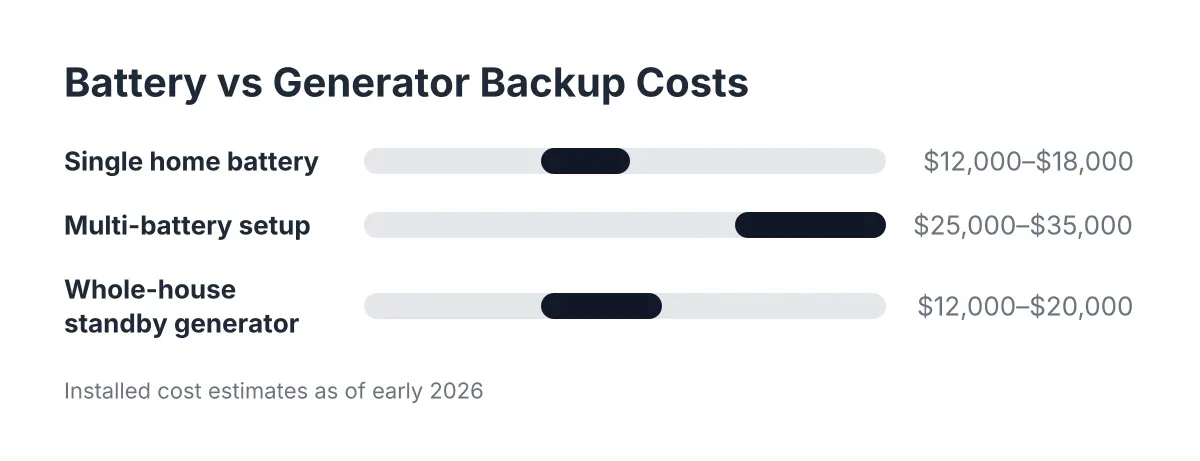
That logic matters most for two readers. First, the homeowner currently comparing quotes, who should ask each installer to model the system both with and without storage under Georgetown's actual rates. Second, the existing solar owner whose system predates current rules. If you bought panels eight or ten years ago and your export economics have eroded, a battery retrofit in the $8,000 to $25,000 range, depending on capacity and whether your inverter supports it, is the question worth running. Those figures are rough 2026 estimates; compatibility with your existing inverter brand decides half the cost, so get that answer in writing before anything else.
A battery also covers outages, which exported solar does not. A standard grid-tied system without storage shuts down during an outage for line-worker safety, in Georgetown and in Austin alike. If backup is your real goal, compare a battery honestly against a whole-house standby generator; for long multi-day outages, the generator sometimes wins on cost per hour of backup.
One honest limitation: if your Georgetown house uses most of its power during daylight hours already, a battery adds cost without adding much arbitrage value. Not every house in this territory needs one, and an installer who says otherwise without seeing your usage data is selling, not advising.
The Texas Backdrop, Briefly
Texas leads the country in solar deployment. The state installed 2.7 gigawatts of solar capacity in the first quarter of 2025, 92% more than second-ranked Florida, according to the Solar Energy Industries Association. None of that wholesale growth guarantees a good rooftop deal at your address, though. In regulated and municipal utility areas, homeowners typically have one buyback arrangement, take it or leave it, rather than the menu of plans available in deregulated markets, according to Solar United Neighbors. Georgetown Utility Systems customers and Austin Energy customers are both in that one-option position. Your neighbors in Oncor territory shop among competing buyback plans; you do not. That is neither good nor bad by itself, but it means your utility's single policy carries the whole weight of your decision.
Solar in Georgetown Utility Systems territory can still make financial sense in 2026; it just makes sense under tighter conditions than the national calculators assume. Right-sized system, honest buyback math, and a hard look at storage. That is the formula here.
Questions to Put to Every Installer Quoting Either Territory
You came here with quotes in your inbox, so here is the checklist I would run against each one. These apply whether the quote is from a national brand pushing Tesla solar hardware or a local crew.
- Which utility did you model, and at what import and export rates, with dates? If the quote says "net metering" for a Georgetown address, that is a red flag.
- What percentage of production did you assume I self-consume? For Georgetown Utility Systems solar quotes, this assumption drives the whole payback number. Ask to see it.
- What federal incentive did you apply, and under which mechanism? Purchase credit claims on a 2026 cash deal deserve skepticism; lease credit value should show up in the payment math.
- What is the price per watt before incentives? Strip every quote to this number so you compare apples to apples across different system sizes.
- What happens to my projection if the buyback rate drops by a third? A good installer will run the sensitivity. A script-reader will change the subject.
- For battery quotes, is the battery compatible with my inverter, and is that in writing?
The pattern to watch for is borrowed math. A savings projection built on Austin Energy's Value of Solar rate, pasted into a Georgetown quote, overstates your return. The reverse error, ignoring Austin Energy's rebate in an Austin quote, understates it. Either way, the installer who gets the utility right is the one who has actually worked your territory.
The Verdict, Stated Plainly
On paper in 2026, Austin Energy's structure usually rates better for the homeowner: a published Value of Solar credit on all production, reviewed on a known schedule, plus a standing rebate program. Georgetown Utility Systems offers a workable but thinner deal, where the burden shifts to you to size conservatively, self-consume aggressively, and consider storage.
That said, you do not get to choose your utility. The useful comparison is not "should I move," it is "does solar clear the bar at my address under my utility's actual 2026 rates." For many Georgetown roofs with good sun and daytime usage, it does. For shaded roofs, low daytime loads, or quotes built on the wrong utility's rules, it does not, and the honest answer is to pass or to fix the quote before you sign. Verify every rate with the utility directly, date-stamp every figure in your comparison, and make the installers compete on the same math. That is the whole trick.
For help with solar with Austin Energy, Austin Solar FAQ is the place to start.
Prefer to talk it through? Call +15125571906 — a quick call is usually the fastest way to get a straight answer for your situation.